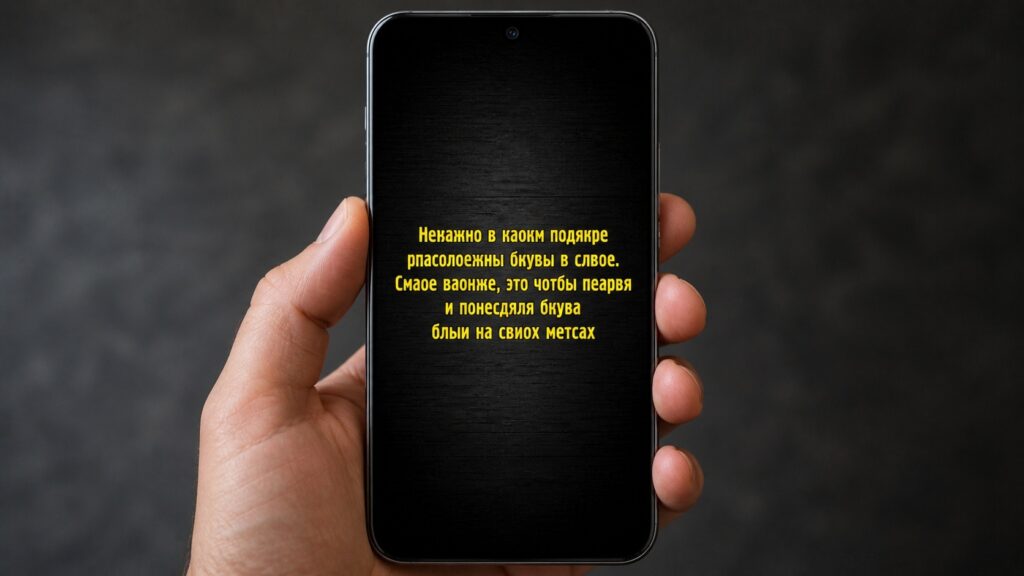
You’ve surely seen this viral text before
You’ve almost certainly seen the popular internet text where all the letters are scrambled except the first and last, yet it’s still easily readable. Online, this phenomenon is often called typoglycemia and explained by a magical rule of our brain, but science disproves the existence of strict reading rules based solely on the outermost characters. Let’s explore yet another fascinating fact about the human brain.
The Scrambled Letter Puzzle
The famous puzzle text, often attributed to researchers at Cambridge University, comes with a simple conclusion: it doesn’t matter what order the letters in the middle of a word are in. The important thing is that the first and last letters remain in their correct positions.
At first glance, this seems logical — after all, we can indeed read such a passage without difficulty. But the claim about the unimportance of the order of internal letters turned out to be a gross oversimplification. If this rule were universal, any text with the correct outermost characters would be easy to read.
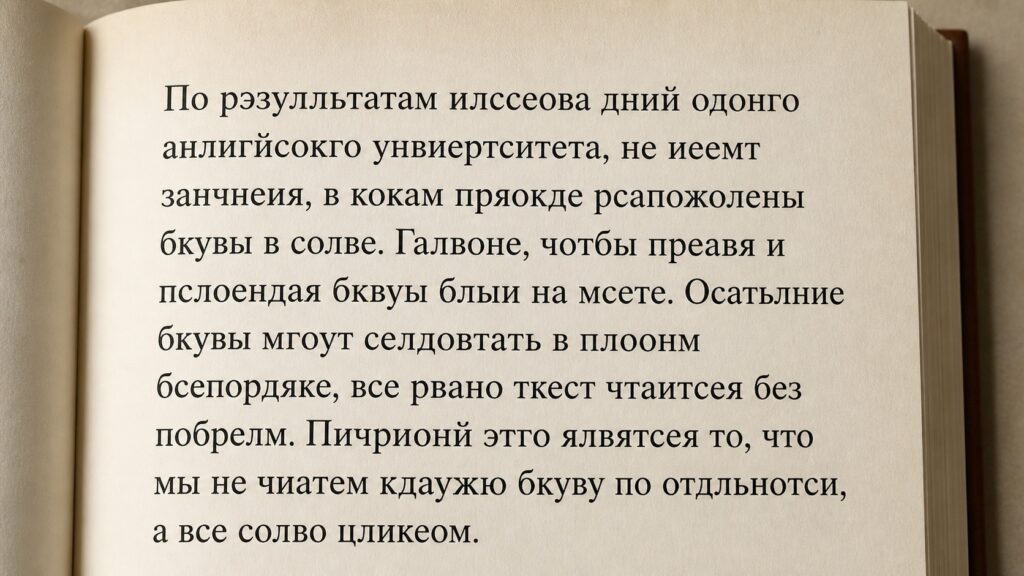
You can easily read this text, right?
To see the opposite in action, just take a complex phrase and scramble its letters following the same rules. For example, a line from a classic sonnet “Slahl I cmoprae thee to a smumer’s day” (Shall I compare thee to a summer’s day) is extremely difficult to decipher. Reading slows down, and the meaning is lost, because merely preserving the outermost letters is entirely insufficient for comprehension.
How the Brain Reads Letters
The secret lies in how exactly we process written language. When an experienced reader looks at a page, they don’t assemble words from individual sounds. Research shows that people perceive words as complete visual patterns, relying on multiple cues simultaneously.
The brain instantly evaluates familiar letter combinations, the overall shape of the word, and the context of the entire sentence. During reading, our brain continuously predicts the next word and then merely cross-checks the visual information against its expectations in fractions of a second.
This is precisely why we so often miss typos in our own writing. The eye sees not what is actually written on the screen, but what the mind expects to see there. The very same principle helps us assemble meaning from a scrambled set of characters by relying on the remaining structure of the word.
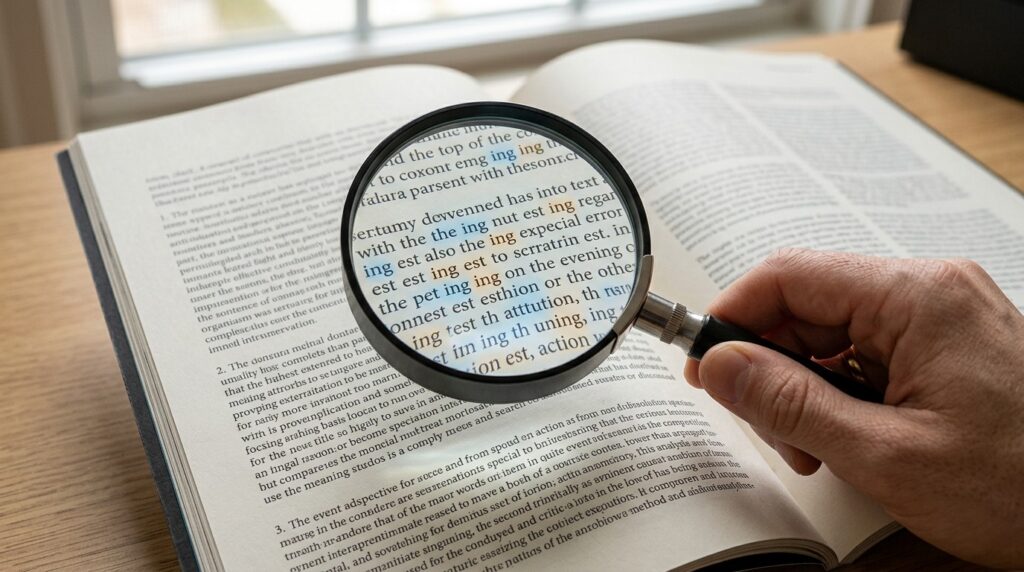
The visual structure of a word helps the brain instantly recognize familiar patterns
How Text Puzzles Work
So why does the famous viral paragraph read so effortlessly? The reason is that the text was unconsciously constructed in a way that maximally eases the workload on our perception.
There are several factors that make such puzzles solvable:
- Short words. Many words in viral texts consist of three to four letters, which severely limits the number of possible combinations;
- Untouched function words. Prepositions, conjunctions, and pronouns usually remain unchanged. Preserving short function words creates a grammatical framework that helps the brain predict further meaning;
- Minimal transpositions. In longer words, meme authors usually only swap adjacent letters, which is much easier to decipher than chaotically scattered characters;
- Predictability of the topic. Once you pick up the rhythm and the main idea, your brain immediately fills in the gaps, similar to how we reconstruct a speaker’s words in a noisy room.
Words are never processed in isolation. They always exist in connection with each other, allowing us to easily compensate for missing or distorted information.
The Influence of a Word’s Visual Shape on Perception Speed
We are very sensitive to how letters relate to each other within a word. Familiar combinations make text recognizable even with minor distortions. But if the structure is disrupted more severely, comprehension quickly vanishes.
For this reason, some visual alterations make reading unbearable. For example, alternating uppercase and lowercase letters destroys the familiar contour of a word, causing the pattern to stop being read automatically. The same thing happens when using fonts of different sizes and styles, because the brain loses its visual anchor.
Interestingly, modern algorithms have learned to decipher distorted texts using similar principles. Computers analyze probabilities across massive datasets to restore the original form of a word through pattern recognition, acting almost like the human mind. This proves that reading relies not on rigid rules about letter positions, but on a flexible system of probability assessment.
In the end, the popular internet meme turned out to be right about one thing: reading is not a mechanical process of assembling letters, but a dynamic interaction between our perception and expectations. Our brain is so skilled at finding meaning that it can turn chaos into a coherent narrative, as long as it’s given at least a few contextual clues.
All of this was explained by linguistics research fellow Karen Stollznow to the authors of Science Alert.