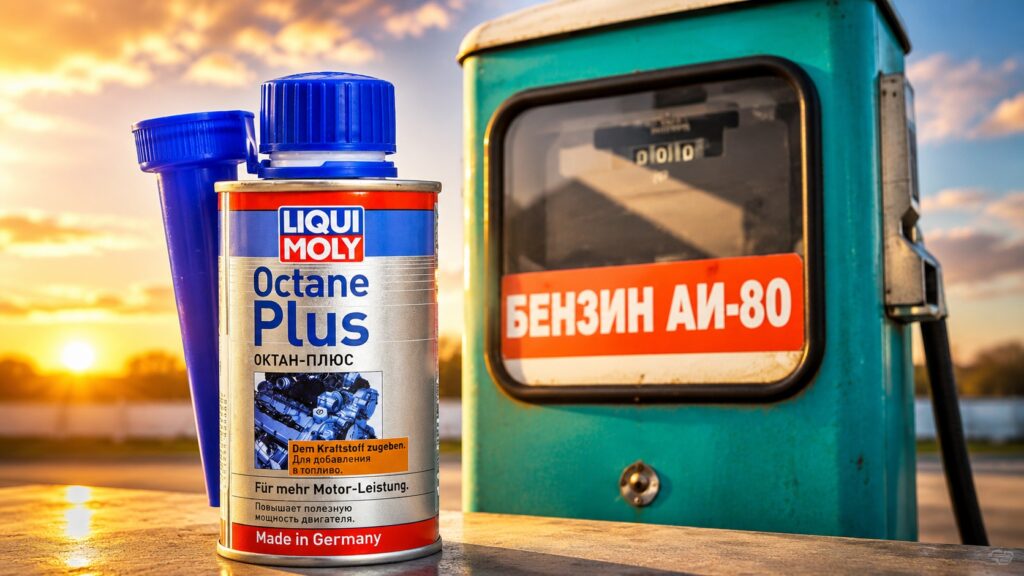
Fuel additives can cause more harm than good
The internet is full of videos promising to turn cheap gasoline AI-80 into full-fledged AI-92 or AI-95 with just a couple of bottles of additives. It sounds tempting because the savings are huge, and the quality is supposedly no worse than factory-grade. But is this really the case, and what will happen to the engine if you pour such a mixture into the tank? We’ve examined the chemistry behind the process and are ready to answer these questions.
What Do “AI” and the Numbers in Gasoline Mean
First, you need to understand what exactly we’re dealing with. The letter “A” in the name stands for automotive gasoline, and the letter “I” indicates that the characteristics were measured using the research method. The number itself represents the octane rating, meaning the fuel mixture’s ability to resist premature detonation.
The octane rating is not an indicator of power or hidden energy. Think of a spring: the higher the number, the more the fuel mixture can be compressed in the engine cylinder before it self-ignites. If the gasoline cannot withstand the pressure, detonation occurs.
Instead of smooth and efficient combustion from the spark, the mixture literally explodes with a shock wave. The impact loads on pistons and rings sharply reduce engine power and lead to overheating, which damages valves, spark plugs, and the catalytic converter.
How High-Octane Gasoline Is Made
At an oil refinery, nobody takes ready-made AI-80 to improve it with additives. Modern fuel at the pump is a complex cocktail assembled from many different components. Many car owners think about how to improve gasoline at home, but the industrial approach is radically different from garage experiments.
To obtain the right base, oil workers use heavy chemical artillery:
- Reforming. Low-octane fractions are subjected to high temperatures and pressure, causing molecules to rearrange into detonation-resistant compounds;
- Cracking. Heavy petroleum fractions are literally split into lighter ones, producing catalytic cracking gasoline with a high octane rating;
- Isomerization. Straight paraffin molecules change shape into branched ones, making the fuel more resistant to compression and reducing harmful benzene content;
- Alkylation. From light gases, alkylate is synthesized — an incredibly valuable and clean component for premium gasoline.
Only after obtaining all these fractions does the refinery proceed to carefully blend them, adding approved oxygen-containing additives.
Why Garage Additives Kill Modern Engines
If you walk into an auto parts store, you can find dozens of bottles of octane boosters promising a 5-10 point increase. Theoretically, they do work, but in practice the effect is often less than advertised, and the side effects are devastating for the car.
Octane correctors (octane boosters) are chemical additives that are added to gasoline to artificially raise its octane rating, meaning its resistance to detonation.
Most commonly, DIY enthusiasts try to use the following additives:
- Manganese and iron-based additives. They sharply raise the octane rating but increase the load on spark plugs and fuel injectors, leaving a dense red deposit on them, and quickly destroy oxygen sensors;
- Acetone and construction solvents. Yes, they burn better, but such chemicals are aggressive toward plastic tubing, rubber seals, and fuel pumps;
- Ethanol (alcohol). It has high detonation resistance, but actively attracts water, which leads to fuel separation in the tank.
Historically, the most effective method was leaded gasoline. However, this substance turned out to be so toxic to people and the environment that leaded automotive gasoline has been banned by law in Russia since 2003.
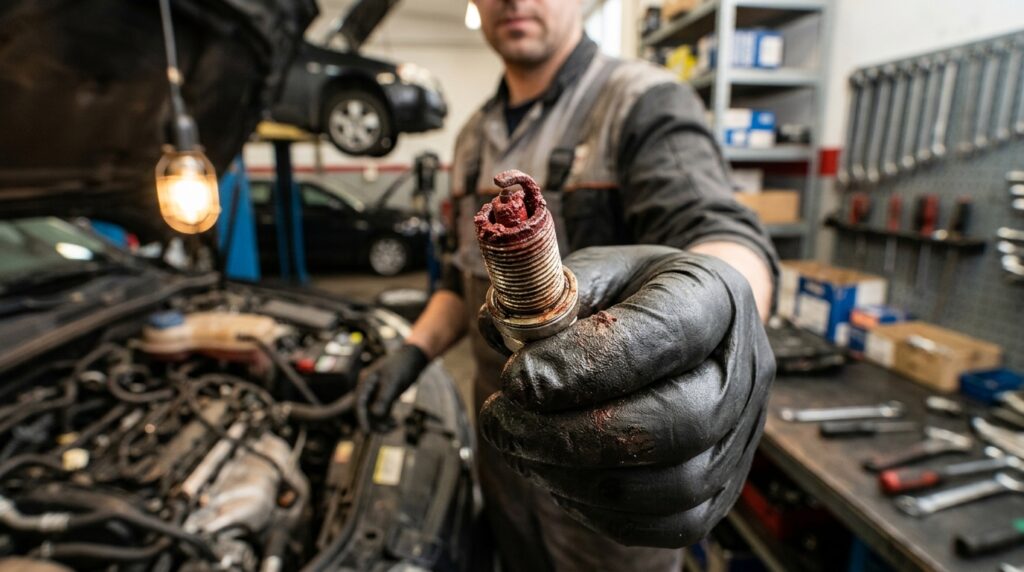
Using metal-containing additives quickly wears out spark plugs
What Happens If You Fill Up With AI-80 Instead of AI-95
AI-80 itself is a normal gasoline that is still specified in Russian state standards (GOSTs). It works perfectly for older, low-performance engines with a low compression ratio. But modern engines, especially those equipped with turbochargers, require completely different characteristics.
If you pour 80-octane gasoline into a modern car, the electronic control unit will detect detonation through special sensors. The computer will try to save the engine by adjusting the ignition timing. As a result, the car will become “sluggish,” acceleration will worsen, and fuel consumption will noticeably increase.
If at that point you try to drive uphill or suddenly press the gas pedal to overtake, the electronics won’t cope. Severe detonation will begin, which can end with burned-through pistons and a destroyed catalytic converter.
Mixing Different Grades of Gasoline in the Tank
Mixing is the only relatively safe everyday method. If AI-80 ended up in your tank by mistake, you can dilute it with a large volume of normal gasoline (AI-95 or even AI-98).
In this case, the average detonation resistance of the mixture will indeed increase, and you’ll be able to carefully drive to a service station. However, you need to understand that the octane rating when mixing is not always calculated using simple arithmetic.
Real factory-produced gasoline must comply with GOST standards not only in terms of detonation resistance. Its volatility, resin content, saturated vapor pressure, and environmental class are all strictly regulated. Without laboratory control, you don’t get quality AI-92 — you just get an unknown cocktail that will save you in an emergency situation but is not suitable for daily driving.