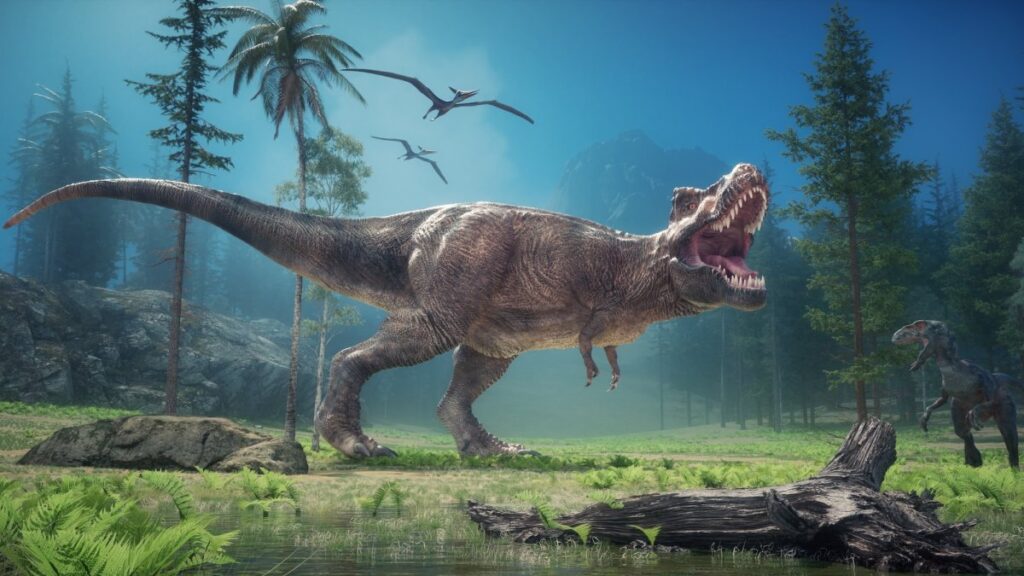
Scientists have finally revealed the secret of T. rex’s tiny arms, and the answer is convincing
The forelimbs of Tyrannosaurus rex are one of the most recognizable paradoxes in the world of paleontology. They look comical and have long been the basis for funny memes. How did a nine-ton predator with a monstrous bite force end up with such absurdly tiny arms?
Why Did T. Rex Have Small Arms
Paleontologist Charlie Sherrer from University College London and his colleagues studied data on 82 species of theropods — bipedal predatory dinosaurs, which include T. rex. The results of their work were published in the journal Proceedings of the Royal Society B.
The main conclusion reads almost like a proverb:
“Use it or lose it.”
As the jaws of theropods became increasingly powerful, the forelimbs played a decreasing role in hunting. Evolution had no reason to maintain them, and they gradually shrank generation after generation.
It’s roughly the same as with muscles of astronauts on the ISS. In zero gravity, the legs are barely used, and without special training, muscles weaken quickly. In dinosaurs, the process stretched over millions of years, but the logic is the same — the body doesn’t spend resources on what isn’t being used.
How Did Tyrannosaurs Hunt
Sherrer’s team developed a new system for assessing the “skull strength” of dinosaurs. They considered the overall head size, bone joint density, and bite force. Unsurprisingly, T. rex ranked first in bite force, while second place went to Tyrannotitan — an almost equally large predator that lived in what is now Argentina more than 30 million years before its famous relative.
The key finding of the study states that the link between tiny arms and a powerful skull was stronger than the link between arm size and body size. In other words, the arms didn’t shrink simply because the dinosaur was large. They shrank because the head and jaws took over all the work.
The head took on the role previously performed by the forelimbs and became the main weapon of attack, — explained Sherrer.
How Did T. Rex Hunt Without Long Forelimbs
Imagine hunting prey 30 meters long — for example, a giant sauropod. Grabbing such a creature with the claws of the forelimbs is simply pointless: it’s like trying to hold a bus by the bumper with two fingers. But clamping down with powerful jaws capable of exerting several tons of bite force — that’s far more effective.
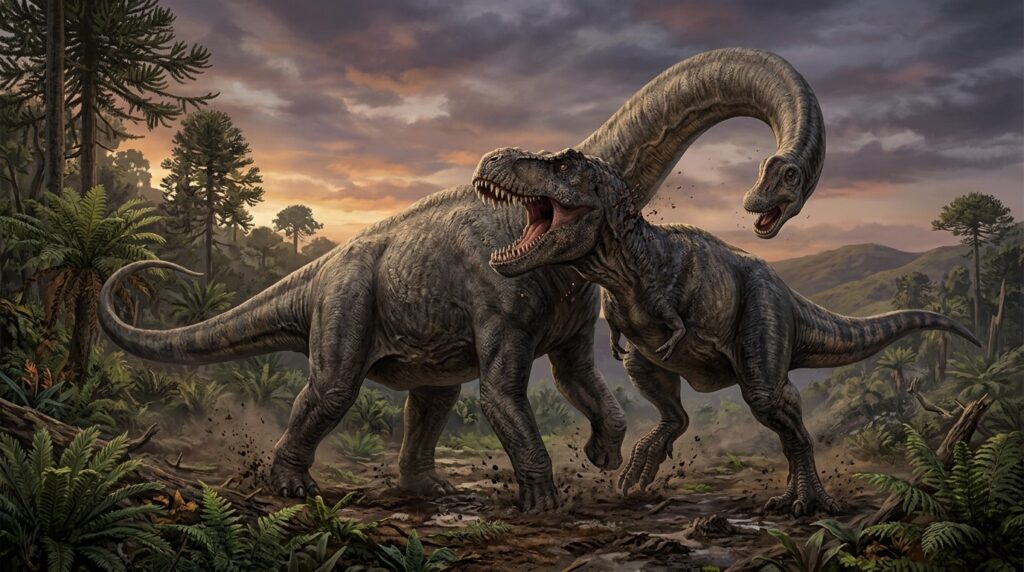
A Tyrannosaurus attacks large prey — powerful jaws were far more useful than tiny arms
This is exactly how the hunting strategy of T. rex shaped its body. The larger the prey became, the more dinosaurs relied on biting rather than grasping with their forelimbs. The front limbs gradually became a vestige — a body part that had lost its original function.
Other Dinosaurs With Short Forelimbs
T. rex is far from the only dinosaur with this feature. The study showed that at least five independent groups of theropods went through a similar process. Moreover, the reduction occurred in different ways.
In tyrannosaurids, the family to which T. rex belongs, the arms shortened proportionally — the upper arm, forearm, and hand all decreased in size evenly. In abelisaurids, however, another group of predators, the main reduction affected the part below the elbow and the hands.
A particularly telling example is the Madagascan Majungasaurus, which lived 70 million years ago. It weighed about 1.75 tons — roughly five times less than T. rex. But its head was also powerful, and its arms were small. This further confirms that it wasn’t about overall body size, but specifically about skull strength.
And the record holder for the most miniature forelimbs, according to Sherrer, was Carnotaurus. Its arms were even smaller than those of T. rex — so tiny that they looked almost decorative.
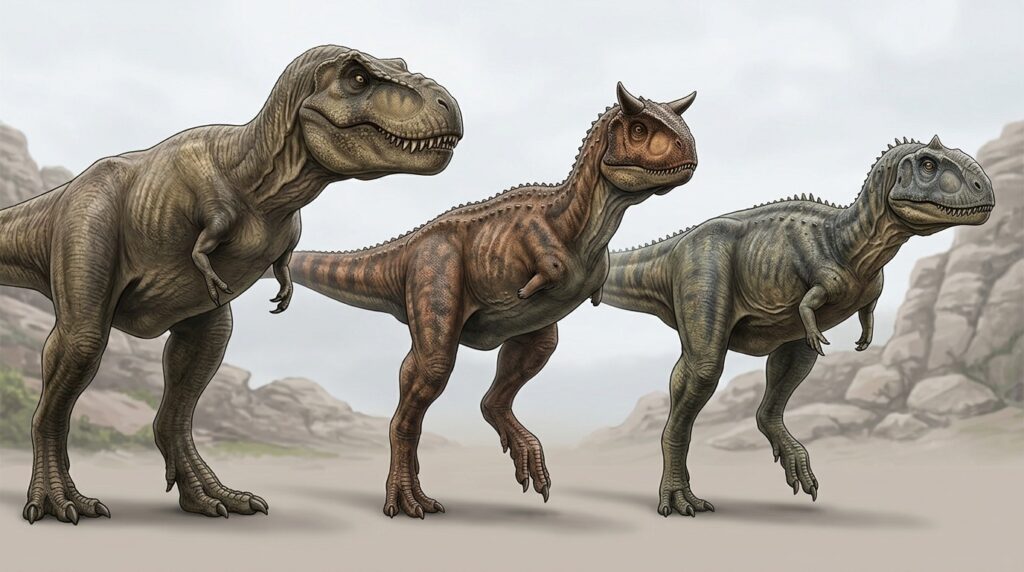
Comparison of theropods with reduced forelimbs: Carnotaurus had even smaller arms than T. rex
What the New Study Tells Us About Predator Evolution
This story is a vivid example of how evolution works not by plan, but by outcome. Originally, tyrannosaurs were never designed as predators with tiny arms. It’s just that those individuals that bit better and grasped worse survived and left offspring slightly more often. Over millions of years, this accumulated into a visible result.
Moreover, the same problem was solved by evolution independently in different groups of dinosaurs, on different continents, and in different eras. Biologists call this phenomenon convergent evolution — when similar conditions lead to similar solutions.
Sherrer’s research is important not only because it explains the long-standing mystery of T. rex’s arms. It shows that the body structure of extinct animals can be analyzed systematically by studying the connections between different body parts.
The jaws and arms of T. rex turned out to be parts of a single hunting system, in which the strengthening of one element inevitably led to the weakening of the other. And while T. rex’s tiny arms still look funny, we now know that behind them lie millions of years of ruthless but logical evolution.