
Science has everything needed to measure the mass of clouds
Clouds seem like weightless tufts of cotton floating in the sky. We say “light as a cloud,” implying something almost weightless. But in reality, a single cloud can weigh around 450 tons. That’s comparable to the mass of 100 elephants or a large airliner. So why is the question of how much a cloud weighs so complex, and why don’t clouds fall to the ground?
What Are Clouds Made Of?
Before calculating the weight of a cloud, it’s worth understanding what a cloud actually is. Essentially, it’s a collection of tiny water droplets or ice crystals suspended in the atmosphere. Each such droplet is incredibly small: its diameter is measured in micrometers, and its mass is negligible. But when there are trillions upon trillions of such droplets, the total weight becomes impressive.
A typical cumulus cloud contains approximately 0.3 grams of water per cubic meter. Sounds laughable, right? A third of a gram — that’s not even a drop from a pipette. But here’s the catch: the volume of such a cloud is enormous. An average cumulus cloud can occupy about one cubic kilometer. And a cubic kilometer is one billion cubic meters. Multiply 0.3 grams by a billion, and you get about 300,000 kilograms of water.
That's the weight of approximately 100 African elephants or one fully loaded Boeing 747!
And that’s still a modest little cloud. Thunderstorm clouds — cumulonimbus clouds that rise to heights of 10–15 kilometers — contain many times more moisture. The heaviest clouds on the planet weigh as much as 100 elephants or a large airplane, and that’s far from the limit for powerful storm systems.
Why Clouds Don’t Fall to the Ground
Here’s the main question that naturally arises: if a cloud weighs hundreds of tons, why doesn’t it come crashing down like a rock? The answer lies in how that mass is distributed in space. This was explained by the authors at IFL Science.
The thing is, all that water is dispersed across a colossal volume of air. The density of a cloud is only slightly higher than the density of the surrounding atmosphere. The droplets are so small that their falling speed is negligible: they descend at a rate of just a few centimeters per second. And rising currents of warm air easily compensate for this slow descent, keeping the droplets aloft.
Simply put, a cloud doesn’t hang in defiance of gravity. It is constantly and very slowly “falling,” but warm air rising from the sun-heated surface pushes the droplets back up faster than they can descend. It’s like trying to drop a feather in the stream of a hair dryer: technically it’s heavier than air, but the airflow won’t let it fall.
When droplets begin merging with each other and growing, the rising currents can no longer support them. That’s when rain begins. In essence, rain is the moment when a cloud finally “falls.”
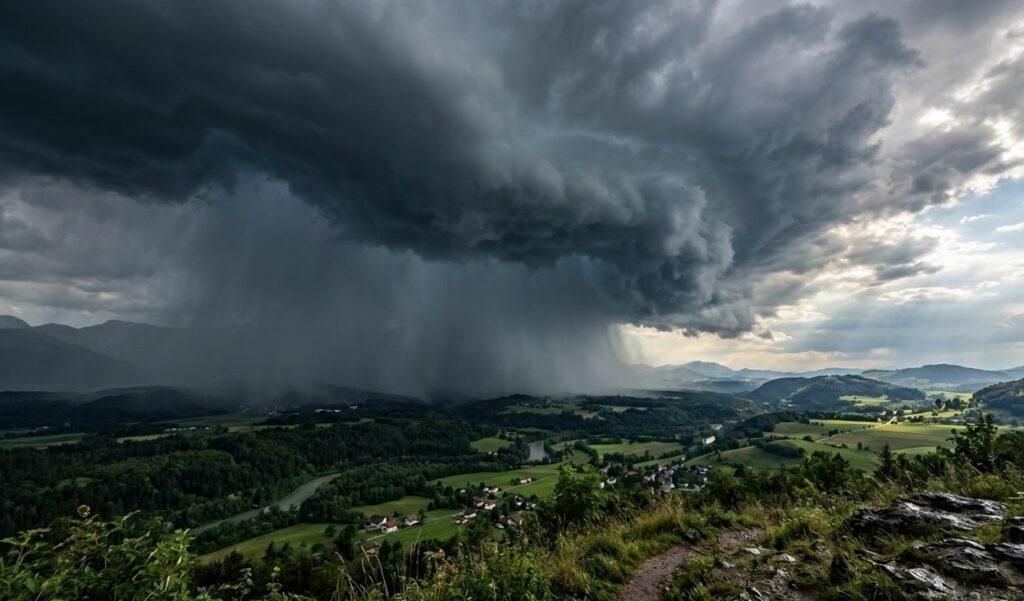
Rain is the process of a cloud falling to the ground
How Scientists Measured the Weight of Clouds
It might seem impossible to weigh a cloud. You can’t exactly put it on a scale! But the math here is surprisingly simple, and that’s the beauty of the problem.
The calculation requires just two parameters: the liquid water density in the cloud (that is, how many grams of water there are per cubic meter) and the volume of the cloud itself. Water density in clouds is measured using special instruments on aircraft and weather balloons. Volume is estimated from satellite images and radar observations.
After that, it’s pure arithmetic:
Take the average water density of 0.3 g/m³, multiply by the volume in cubic meters, and you get the mass. For a typical cumulus cloud with a volume of one cubic kilometer (that is, 10⁹ m³), this gives about 300 tons, or approximately 660,000 pounds. Rounded up, about a million pounds for a slightly larger specimen.
It turns out the hardest part here isn’t the formula, but accurately measuring the volume. Clouds constantly change shape, grow, evaporate, and merge. But even a rough estimate yields impressive figures. As for thunderstorm clouds, their mass can be tens or hundreds of times greater, since both their volume and moisture density are significantly higher.
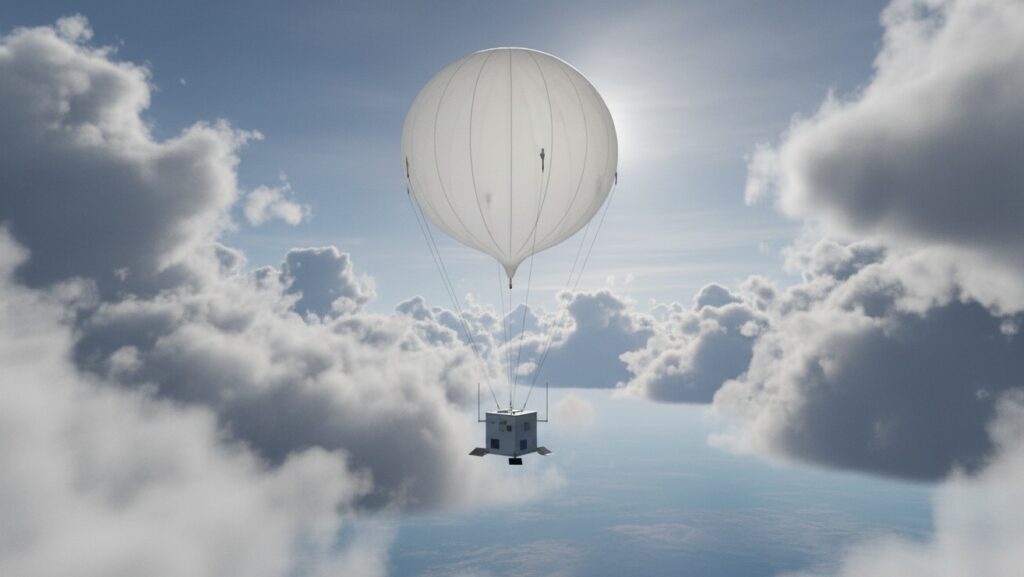
Weather balloons help scientists measure water content in clouds. Simple arithmetic does the rest
The Heaviest Clouds on the Planet
Not all clouds are created equal. Light cirrus clouds high in the atmosphere consist of ice crystals and weigh relatively little. But cumulonimbus clouds — those stormy monsters — are the true heavyweights of the atmosphere.
Such clouds can extend from an altitude of about 2 kilometers all the way to the tropopause at 12–15 kilometers. Their volume exceeds that of an ordinary cumulus cloud by hundreds of times, and their water content per cubic meter is also higher. As a result, the mass of a single thunderstorm cloud can reach hundreds of thousands of tons.
For comparison: the mass of a large passenger aircraft at takeoff is about 400 tons. So even a “modest” cumulus cloud weighs roughly as much as one such airliner. And a thunderstorm — that’s an entire squadron.
But there’s a nuance: despite its enormous mass, a cloud remains less dense than the surrounding air when considered as a whole together with the air inside it. That’s precisely why it floats rather than crashing down. The trick is that the mass is distributed across a colossal volume, and the average density of the “air + droplets” system remains lower than the density of the dry air around it.