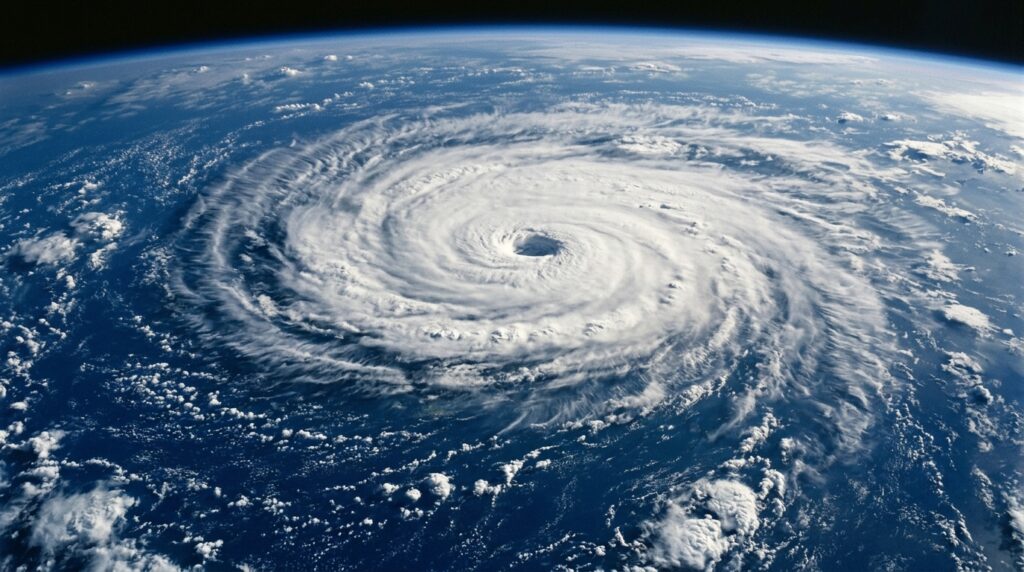
The equator acts on hurricanes like an invisible barrier
Tropical storms slam into coastlines every year, destroying homes and flooding cities. But this natural force has a strange rule: hurricanes almost never form near the equator and cannot cross it, no matter how powerful they are. This is not a coincidence — it’s the physics of our planet’s rotation.
What Are Hurricanes, Typhoons, and Cyclones
Hurricanes, typhoons, and tropical cyclones are all the same natural phenomenon. They are powerful rotating storms that are born over warm tropical and subtropical waters.
The only difference is the name. In the North Atlantic, central, and eastern North Pacific, they are called hurricanes. In the northwestern Pacific, they are typhoons, and in the Indian Ocean and southern Pacific, the term tropical cyclones is more commonly used. For simplicity, I’ll refer to all of them as hurricanes from here on.
It’s worth noting that such storms don’t typically originate in Russia. Typhoons that formed farther south over the warm waters of the Pacific Ocean can reach the Russian Far East. On their way north, they often weaken or transform into extratropical cyclones, but they can still bring strong winds, heavy rain, and stormy weather.
How Warm Water Turns Into a Storm
The mechanism is simpler than it seems. Warm ocean water heats the air above the surface, which rises and cools, forming clouds and thunderstorms. When air rises, an area of low pressure forms beneath it, and new air rushes in from all directions.
Then wind enters the picture. Along with the inflowing air, it sets the entire system in motion, causing it to spiral. The rising clouds release rain and return heat back down, which further fuels the storm. This creates a self-sustaining cycle. The longer a hurricane stays over warm water, the stronger it becomes.
What Is the Coriolis Force in Simple Terms
The main character of this story is the Coriolis force. This is an effect that arises from Earth’s rotation. Moving air on the planet is deflected from a straight path. In the Northern Hemisphere, flows are deflected to the right, and in the Southern Hemisphere — to the left.
Imagine trying to draw a straight line with chalk on a spinning carousel: your hand moves straight, but the mark on the surface comes out curved. In a similar way, air currents on Earth don’t travel in a straight line but gradually curve to the side.
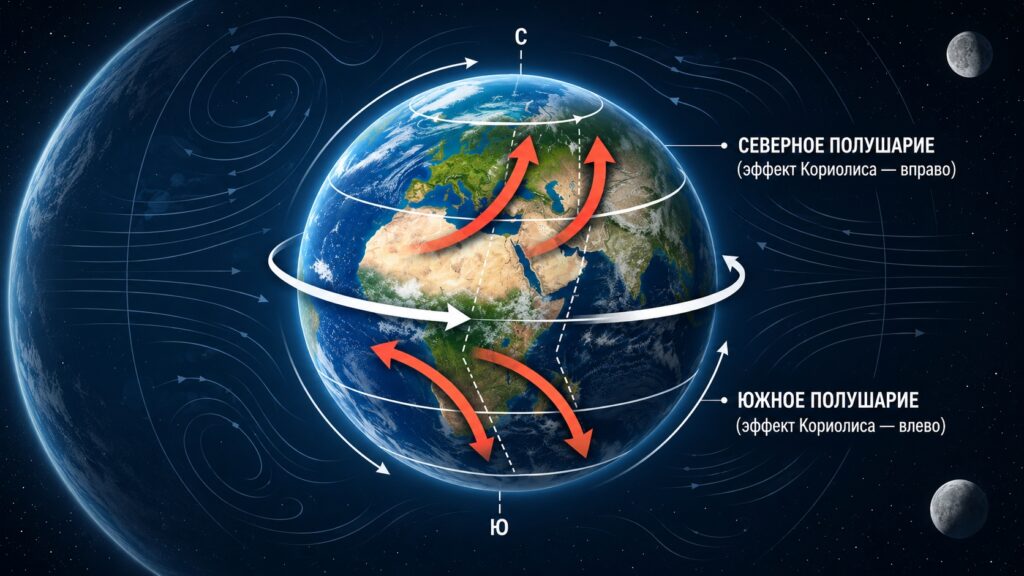
Earth’s rotation deflects air currents — this is the Coriolis effect
It is precisely this force that determines the direction of a storm’s rotation. In the Northern Hemisphere, hurricanes spin counterclockwise because Earth’s rotation pulls the air in that direction. In the Southern Hemisphere, it’s the opposite — storms rotate clockwise. The hemispheres are like mirror reflections of each other.
Why Hurricanes Almost Never Form Near the Equator
Although hurricanes love warm tropical water, they almost never form closer than 300 kilometers from the equator. The reason is that right at the equator, the Coriolis force is virtually nonexistent. Without it, patches of stormy weather simply cannot spin up into a full-fledged hurricane — there is simply no deflecting force to initiate the rotation.
Exceptions are so rare they can be counted on one hand. In 2001, Typhoon Vamei formed just 150 kilometers north of the equator, and this was such an unusual event that something like it happens less than once a century. So near the equator itself, the elements are effectively powerless to give birth to a storm.
What Happens to a Hurricane Near the Equator
But let’s assume a very powerful hurricane did approach the equator closely. It still wouldn’t be able to cross it. To move into the other hemisphere, the storm would have to stop its rotation, reverse direction, and start spinning the opposite way — and its structure is simply incapable of doing that on the move.
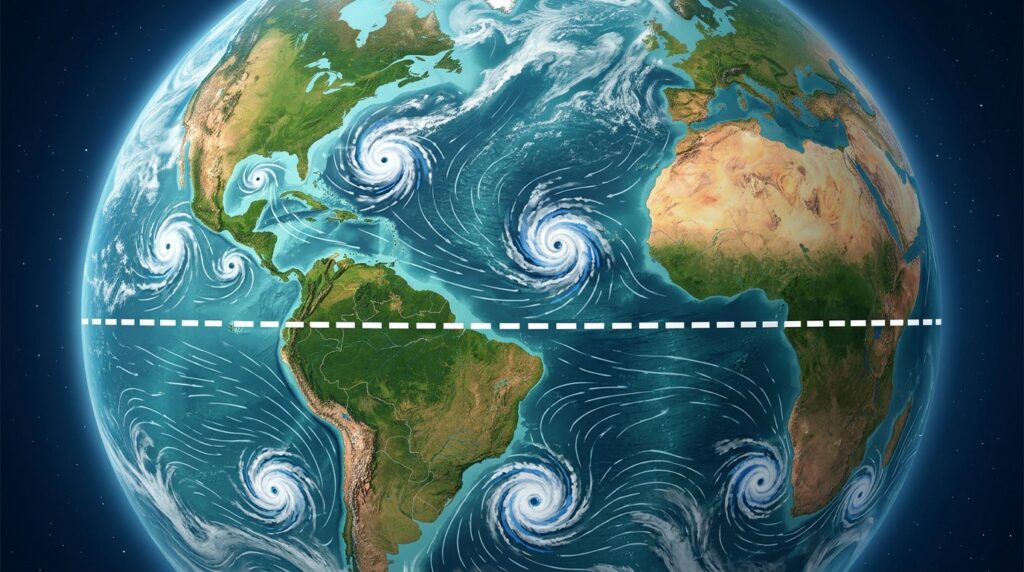
Storms from both hemispheres stay on their own sides of the equator
So it turns out that the equator is an invisible wall for hurricanes. Without the rotation provided by the Coriolis force, a storm cannot survive an attempt to cross this narrow strip in the middle of the planet. Therefore, no matter how fiercely hurricanes rage in the tropics, the thin zone around the equator remains a place where they can neither truly form nor cross to the other side.
It turns out that enormous natural phenomena obey the simple physics of Earth’s rotation. The Coriolis force both spins hurricanes into existence and determines where they can exist and where their path is blocked. This means that by understanding it, we can better predict where the next storm will head.