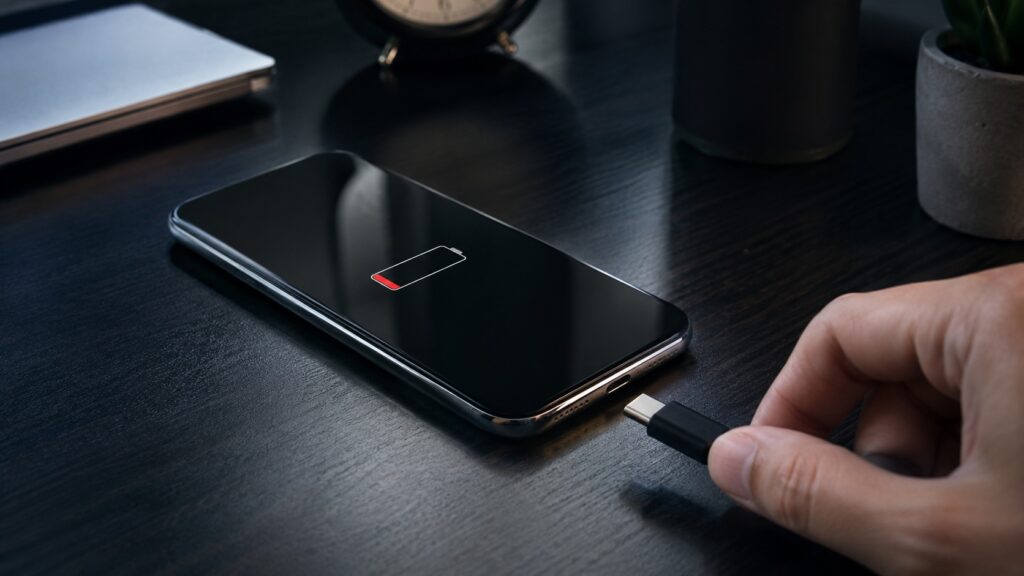
Scientists found a way to protect smartphone batteries from capacity loss, and it’s very simple
Every day we charge our smartphones, and each time the battery drains a little faster. We’re used to thinking that the main enemy of a battery is time or the number of charge cycles. It’s also been proven that phone batteries wear out significantly in hot weather. But scientists have discovered that smartphone battery degradation is accelerated by a factor that most people don’t even suspect. And the solution to this problem turned out to be so simple that you can apply it right now.
What causes smartphone batteries to age in the first place
For many years, lithium-ion battery degradation was attributed exclusively to the energy storage process. Scientists believed that the surface of the cathode — the material that stores and releases lithium ions — breaks down under high voltages during charging. At this point, the cathode loses lithium, becomes unstable, its structure collapses, and the material turns into a disordered mass. This interferes with the normal movement of ions and gradually reduces battery performance.
A new study conducted by specialists from South Korea proved that battery wear also occurs in the opposite direction — during discharge. Details about this were published in the scientific journal Advanced Energy Materials.
What happens when a smartphone discharges
The researchers attempted to find out how a battery ages during discharge at a microscopic level. To do this, they studied popular NMC (nickel-manganese-cobalt) cathodes, which are widely used in modern electric vehicles. When voltage drops below 3.0 volts, lithium returns to the cathode, but oxygen atoms near the surface begin to detach.
The scientific work required the researchers to use advanced microscopes, spectroscopy, and complex computer modeling. They discovered that the loss of oxygen creates microscopic voids. The cathode surface changes its phase to a structure resembling rock salt. If you imagine the cathode as a smooth brick wall, then during deep discharge its outer layer crumbles and turns into a pile of rubble.
Modeling showed that oxygen atoms on the surface are bonded more weakly than those deep within the material, so they easily detach even under seemingly safe conditions.
How a smartphone battery loses capacity
The physical consequences of these changes proved devastating. As a result, constant discharge to zero causes battery swelling — a sure sign of internal damage. When a device discharges almost completely, oxygen begins to rapidly leave the cathode surface.
Gas analysis showed that deeply discharged cells released 29 times more gas. The electrolyte inside the battery turned into a toxic cocktail of methanol and ethylene carbonate fragments.
Experiments confirmed frightening numbers. Batteries with high nickel content that were regularly subjected to deep discharge lost almost all their ability to store energy after 250 cycles — they retained only 3.8% of their original capacity. By comparison, batteries that were not allowed to discharge too deeply retained more than 73% of their capacity even after 300 cycles.
Which batteries degrade during discharge
It’s important to understand that this research is not a universal diagnosis for absolutely all devices. The vulnerability primarily concerns batteries with high nickel content. These are most commonly found in powerful smartphones, laptops, and electric vehicles.
At the same time, lithium iron phosphate (LFP) batteries, which today account for more than half of the electric vehicle market, are designed completely differently and are at lower risk of wear.
How to extend your smartphone battery’s lifespan
The solution proposed by scientists is disarmingly simple: the cutoff voltage threshold needs to be raised. In other words, the device should think it’s discharged before the voltage drops to a critical 3.0 volts. Manufacturers can implement this at the software level.
Until corporations change their factory algorithms, you can protect your devices yourself. By following these rules, you will significantly extend your battery’s lifespan without a trip to the service center:
- Try to plug in the charger when the battery level drops to 20–30%, without waiting for a complete shutdown;
- If your electric vehicle or smartphone has an option to limit depth of discharge, be sure to enable it;
- Avoid situations where a device sits completely discharged in a drawer for weeks.
This research proves that noticeable improvements in technology don’t always require new exotic materials or billions of dollars in investment. Sometimes you just need to better understand how batteries break down in the real world.