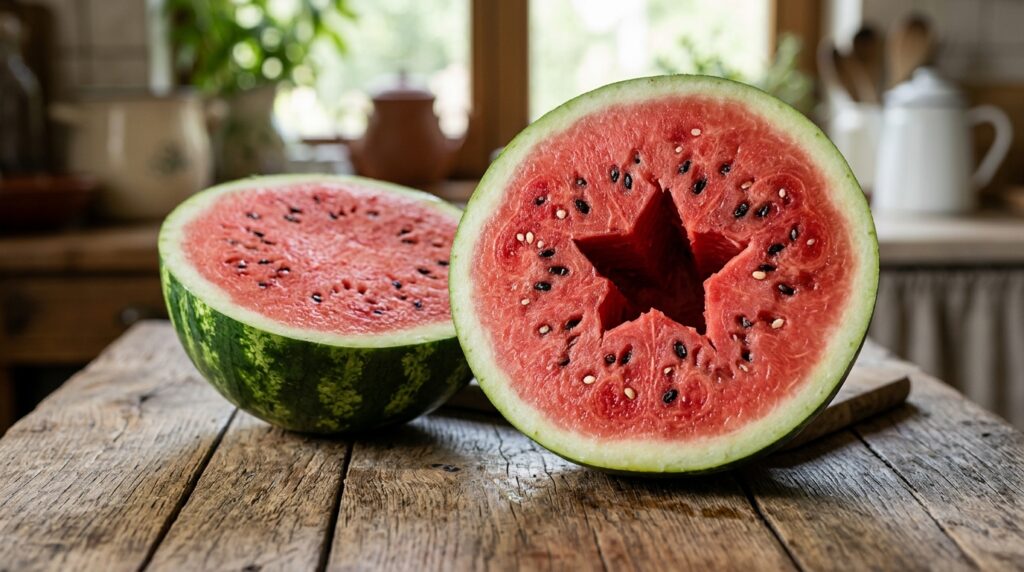
Voids inside a watermelon don’t indicate nitrates — there’s another reason
You cut open a watermelon, and instead of the usual red flesh, you find a deep crack or strange voids inside. Sound familiar? Many people immediately think the watermelon was overfed with nitrates or that it’s spoiled. But things aren’t that straightforward, and what you see could turn out to be either a completely harmless defect or a reason for concern. Where do these cracks inside a watermelon come from, do they always indicate poor quality, and in which cases is it better not to eat the watermelon?
Why Are There Cracks Inside a Watermelon
Internal cavities in the berry are not a disease and not traces of syringe injections. The main reason why a watermelon has cracks lies in poor pollination during the early stages of ripening.
If the weather was too cold during flowering or bees were reluctant to fly, the flesh and rind begin to grow out of sync. As a result, fractures, star-shaped voids, or symmetrical patterns form inside.
This cosmetic defect doesn’t interfere with enjoying the taste at all. Experts note that you can safely eat a watermelon with such fractures, and it often turns out to be even sweeter than usual, as sugars concentrate specifically along the edges of the split.
The Nitrate Myth in Watermelons
Perhaps the most popular fear among buyers is the belief that the fruit was pumped full of chemicals. However, internal voids have nothing to do with artificial growth acceleration. Old theories that fractures occur due to excess nitrogen or sudden changes in watering have not found scientific confirmation.
Therefore, nitrates in a watermelon cannot be determined by eye based solely on the shape of the flesh. Only laboratory analysis can provide an accurate verdict on the presence of harmful substances. Visual details like overly yellow fibers or an unnaturally glossy cut surface should raise concerns, but the cracks themselves don’t indicate anything harmful.
Signs of a Spoiled Watermelon
A dry fracture from uneven growth is one thing, and the beginning of a rotting process is quite another. There are several clear criteria for how to tell if a watermelon is spoiled and could cause severe food poisoning.
The main danger marker is the smell and texture of the flesh. Immediately throw away your purchase if you notice the following signs:
- a sharp sour, wine-like, or outright rotten smell;
- a slimy, sticky, or overly watery cut surface;
- the appearance of gray coating, strange foam, or areas with mold;
- a taste with a hint of fermentation that seems slightly carbonated.
It’s also worth knowing how to choose a watermelon correctly before cutting it open. If it’s not the flesh inside that’s cracked but the green rind on the outside — such a fruit should absolutely not be purchased. Through any external cracks and punctures, bacteria from soil and dust penetrate inside instantly.
How to Safely Store Watermelon at Home
Sweet juice with neutral acidity is an ideal environment for the rapid multiplication of microorganisms. This is precisely why sanitary doctors strictly prohibit buying half-cut fruits or asking vendors to cut out a sample piece right at the market.
After bringing a whole berry home, be sure to wash it with warm water and soap. This is necessary so that bacteria from the dirty rind don’t get onto the edible part when the knife passes through.

Thorough rind washing will protect the flesh from microbe contamination during cutting
Cut pieces should not be left at room temperature for more than a couple of hours. The remaining portion must be immediately placed in the refrigerator, first wrapped in plastic wrap or placed in an airtight container. When cooled to four degrees Celsius, the risk of dangerous bacteria multiplying is minimized.
In summary, internal voids in a watermelon are merely a harmless quirk of nature that doesn’t make the berry toxic. It’s much more important to pay attention to the integrity of the rind before purchasing, the fresh smell on the cut surface, and to follow basic hygiene rules during storage.