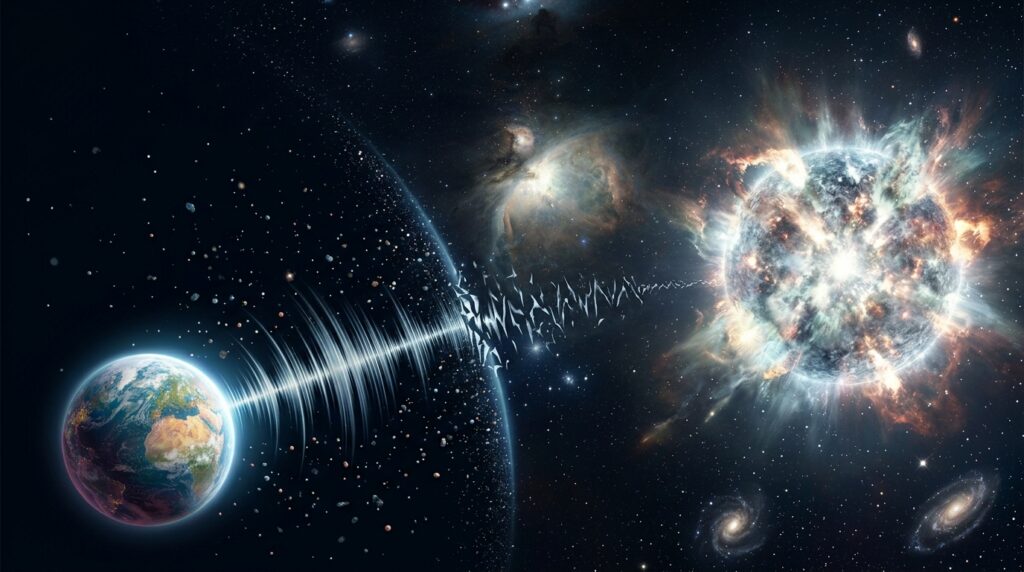
The sounds of space can be heard if you know how to do it
In space, no one can hear you scream! Everyone who has watched sci-fi movies or read books about space travel has surely come across this phrase. And there’s a lot of truth in it, because sound needs a medium, and there is none in a vacuum. But that doesn’t mean the Universe is completely silent. Sounds in space do exist — they just can’t be heard the way we’re used to. Where exactly do they occur, and how do scientists detect them? You might be surprised, but even the Sun produces sounds.
Why Sound Doesn’t Travel in Space
To understand this topic, we need to recall how we perceive speech or music on Earth. By its nature, sound is a mechanical wave that is transmitted from particle to particle. When a guitar string vibrates, it pushes air molecules, which collide with neighboring ones, and this relay continues all the way to the listener’s eardrum.
The process resembles a wave started by fans in stadium stands: the people themselves don’t run anywhere, but the motion propagates around the circle. The main condition for transmitting sound is the presence of a dense chain of particles. Waves travel excellently through gases, liquids, metal, and even the human body.
However, in interstellar vacuum, there are so few molecules that there is physically nothing to transmit the vibrations. A source can vibrate with enormous force, but without a surrounding medium, that vibration will quickly die out on the spot.
How Do Astronauts Communicate in Space
Knowing the principles of wave propagation, it’s easy to understand the implausibility of science fiction movies. If a huge spacecraft explodes in vacuum, a distant observer won’t hear the explosion — they will only see a blinding flash. Within the cloud of hot gas itself, pressure fluctuations will bounce around for a short time, but they will never reach another vessel through the void.
So how do crews work in orbit if shouting to each other is pointless? Astronauts on spacewalks communicate using radio waves, which don’t need air at all.
A microphone picks up speech, converts it into an electrical signal, and sends it to a partner. At the same time, an oxygen atmosphere is maintained inside the sealed spacesuit, so a person can perfectly hear their own breathing and the hum of cooling systems.
What Sounds Does the ISS Make
The answer to this popular question is definitive — yes, and the conditions inside spacecraft are as close to Earth-like as possible. Normal atmospheric pressure is maintained in habitable modules. Thanks to this, sounds inside the ISS propagate in the usual way, allowing the crew to talk without radios.
Moreover, it can be quite noisy in orbit. Astronauts have to get used to the hum of equipment.
The following systems produce constant noise on the station:
- fans for air circulation;
- cooling system pumps;
- carbon dioxide scrubbing mechanisms;
- signals from scientific instruments.
In addition to air, solid structures serve as excellent conductors. If a small meteorite strikes the hull from outside, the vibration will travel right through the metal body. The wall of the compartment will transmit this impulse to the internal air, and the crew will clearly hear a sharp knock.
The same principle works during repairs outside the station. An astronaut can feel and hear the operation of a power tool in their hand because the vibration travels through the solid materials of the glove directly into the body.

Numerous life support mechanisms are constantly running inside the orbital station
How Scientists Listen to the Sounds of Space
Interstellar space is not an absolutely empty mathematical abstraction. There is solar wind and rarefied plasma. In these concentrations of matter, powerful acoustic oscillations periodically arise.
The human ear won’t detect them due to the minuscule density and unsuitable frequencies, but instruments on probes can handle this task. By collecting radiation data, scientists run it through computers. Many people wonder what our Universe actually sounds like in reality. The secret lies in the process of sonification.
Researchers convert graphs of plasma bursts into the audible range, assigning high volume to strong signals. Physicists can indeed turn recorded gravitational waves into an audio track. This is not a direct recording from a microphone, but a convenient way to present the most complex data in an understandable form.
Which Planets Have Sound
If a celestial body has its own gaseous envelope, then vibrations can propagate there. Conditions vary everywhere, but the laws of physics work without fail.
The situation with sound conductivity on other planets looks like this:
- Mars. Due to its thin carbon dioxide atmosphere, sounds are quiet and muffled, but the Perseverance rover recorded real sounds of Martian wind and the crunch of rocks;
- Venus and Titan. The extremely dense gaseous layer on these bodies creates an excellent medium for acoustics. Soviet spacecraft successfully recorded rumbling during landing;
- The Moon. Our satellite has no air, so a thrown rock will fall in complete silence. The impact will only be detected by seismometers through the ground.
So, physics proves that our Universe is far from soundless. It is full of vibrations, impacts, and rustling — it’s just that to perceive them we need the right conditions: either a spacesuit with oxygen or sensitive detectors on a research probe.