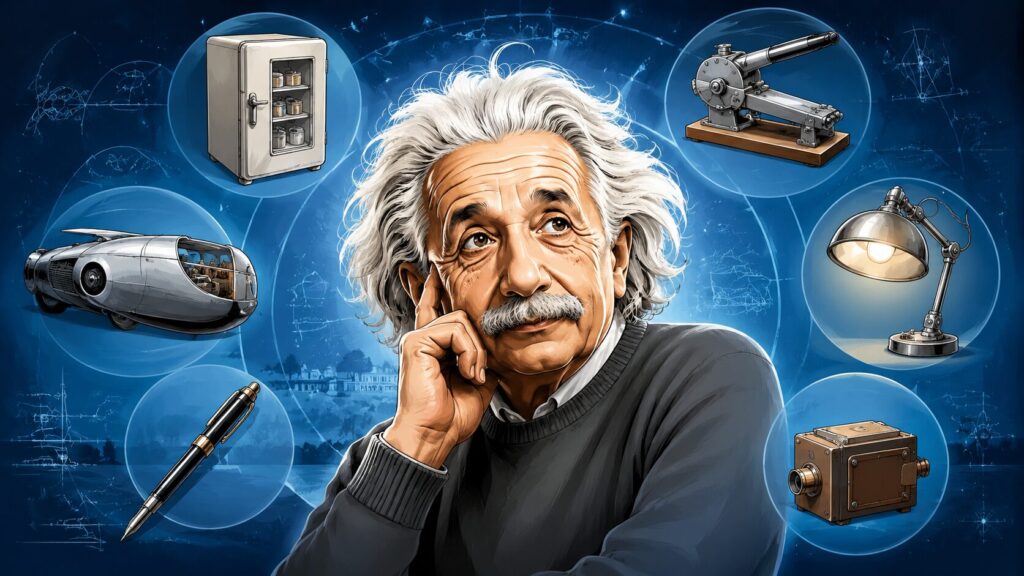
The genius Einstein patented not just theories: refrigerators, blouses, and other forgotten inventions
In our imagination, Albert Einstein is a person who writes equations about space and time, not someone tinkering in a workshop with a soldering iron. But Einstein held more than 50 patents in various countries. None of these inventions ever made it to store shelves, but they reveal an unexpected side of the great physicist — a man who wanted to fix very earthly problems. And some of these problems were literally killing people in his time.
What Is Known About Albert Einstein: Childhood and What Influenced Him
The passion for inventing didn’t appear out of nowhere for Einstein. He grew up surrounded by dynamos, lamps, and electric meters — his father and uncle owned an electrical engineering factory. Uncle Jakob was an inventor in Munich who patented arc lamps, electric meters, and dynamos back in the late 19th century. Young Albert literally grew up surrounded by wires and instruments.
This experience came in handy when from 1902 to 1909, Einstein worked as a patent examiner in Bern. His job was to review applications and evaluate their novelty. It was during these years that he published his “miracle year” papers of 1905: he explained the photoelectric effect, proved the reality of atoms through Brownian motion, introduced the special theory of relativity, and derived the famous equation E=mc². According to historian Matthew Trainer, this double life gave Einstein a deep understanding of how the patent system works and what benefits it can bring.
Einstein’s Refrigerator That Tried to Save Lives
In 1926, a Berlin newspaper told a horrifying story: a family of four suffocated in their sleep because their refrigerator leaked toxic gas. Early refrigerators often ran on ammonia, sulfur dioxide, or methyl chloride — if a seal broke, these gases became deadly.
Einstein was shocked by this news and called his friend — Hungarian physicist Leo Szilard, who was well-versed in engineering. Together they invented a safe refrigerator with no moving parts and no seals that could break or leak. Instead of a noisy mechanical compressor, they designed what’s known as an absorption refrigerator.
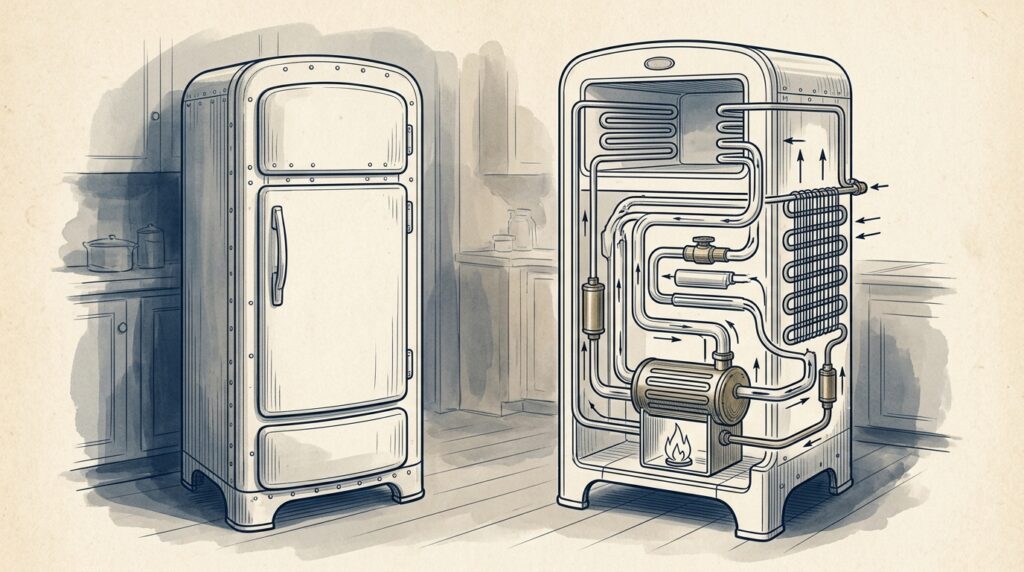
Einstein and Szilard’s refrigerator worked without a compressor and moving parts
The principle was simple: liquids boil at lower temperatures when pressure drops. The system used butane as a refrigerant and ammonia as a carrier gas, while a carefully designed network of chambers and tubes allowed the butane to evaporate and recondense, cooling food. The heart of the device was an electromagnetic pump without a piston: alternating current created an alternating magnetic field that made a liquid alloy of potassium and sodium move back and forth, functioning like a piston.
For its time, it was a brilliant design. But it had a serious drawback — noise: one engineer said the pump “howled like a jackal.” And while the patents were being processed, chemist Thomas Midgley introduced Freon — a non-toxic refrigerant that proved to be a far more successful solution. Einstein and Szilard’s refrigerator faded into obscurity, although decades later engineers noticed that its pump found use in nuclear reactors.
A Hearing Aid for a Singer Friend
Einstein’s inventive streak didn’t stop there. In 1928, his friend, singer Olga Eisner, began losing her hearing. Einstein turned to engineer Rudolf Goldschmidt, and together they sketched out a new type of hearing aid.
It was based on magnetostriction — a phenomenon in which a magnetic field slightly changes the length of a metal rod. If the rod is held under tension, these tiny changes in length can be used to track electrical signals from sound. Their 1934 patent described the device as an “electromagnetic sound reproduction apparatus.” The invention never reached the market — it was quickly overtaken by electronic amplifiers.
A Camera That Automatically Adjusts to Light
A decade later, Einstein teamed up with Gustav Bucky — a German-American radiologist. They envisioned a camera that automatically adjusts to lighting conditions. Their 1936 patent described a “camera with self-regulating light intensity.”
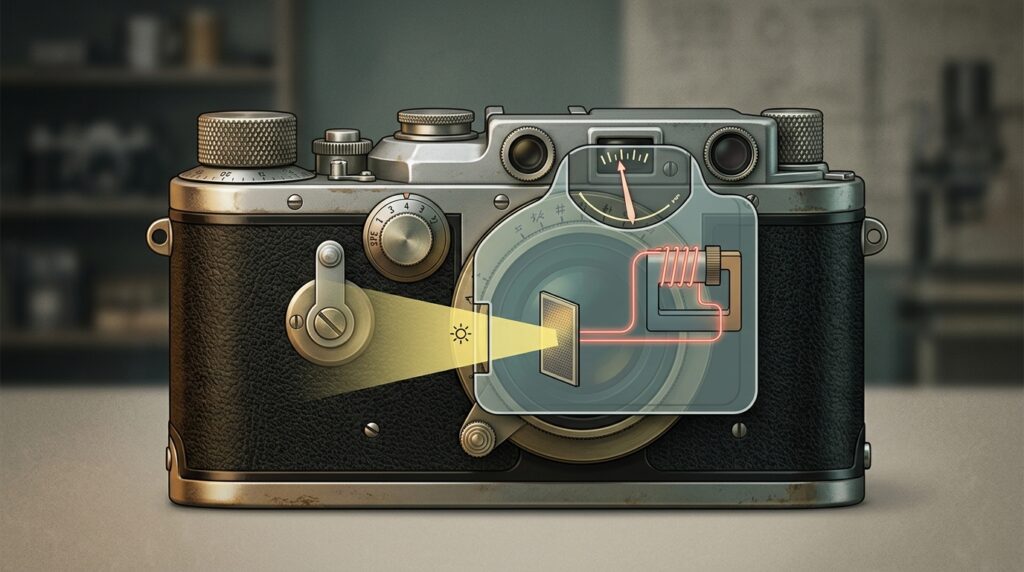
Einstein and Bucky’s camera was supposed to regulate exposure automatically using a photocell
The device relied on the photoelectric effect — the very phenomenon for which Einstein received the Nobel Prize. The idea was simple: a photocell measured incoming light and adjusted a screen so the frame wouldn’t be overexposed or too dark. Whether a prototype was ever built remains unknown. But the concept anticipated the automatic cameras that later flooded the market. Kodak would later release the Super Six-20, which is called the first automatic camera, but Einstein and Bucky’s idea came first.
Einstein’s Most Unexpected Patent — A Women’s Blouse
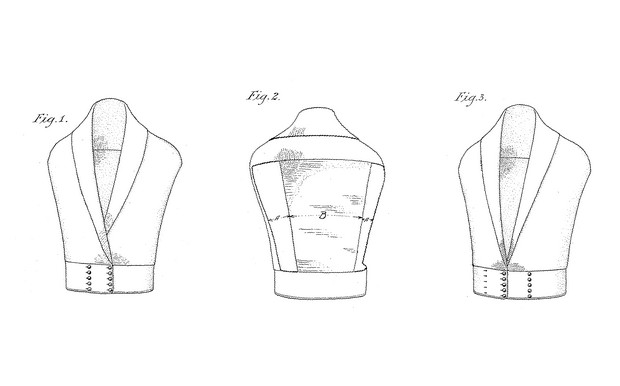
Einstein was not only an inventor but also a fashion designer
Perhaps the strangest entry in Einstein’s patent list is a women’s blouse design, filed in 1936. Why — nobody really knows. Maybe it was a favor for a friend, maybe just amusement. Either way, it reminds us that even the author of general relativity could dabble in fashion when the mood struck.
As science historian Asis Kumar Chaudhuri described, the design featured side cutouts that doubled as armholes, with a central back panel running from the yoke to the waist. It sounds more like a blueprint than a garment — but that’s quintessential Einstein, who engineered even clothing like an engineer.
Why Einstein’s Inventions Never Became Products
By the late 1920s, when his scientific reputation was already rock-solid and the political situation in Germany was heating up, Einstein returned to inventing once again. He teamed up with co-inventors who were themselves avid experimenters. But none of his patents became a mass-market product.
The Great Depression, the rise of the Nazis, and the ensuing World War got in the way, along with rapid technological progress that outpaced his projects. His co-inventors — Szilard, Goldschmidt, and Bucky — often achieved other breakthroughs, but their joint inventions remained in the archives.
And yet these patents are valuable in their own way. As Trainer notes, they help reconstruct historical portraits of Einstein’s colleagues and reveal his true drive — solving real problems for real people. The genius celebrated for abstract equations about the Universe spent his whole life trying to make the most mundane things safer and more convenient: a kitchen refrigerator, a loved one’s hearing, an ordinary photograph. And although he never achieved commercial success in these endeavors, his attempts remind us that a true researcher’s curiosity doesn’t divide into “high science” and “everyday trivialities.”