The largest tree weighs 5,900 tons
Imagine you’re driving along a road past a lake in Utah and you see an ordinary aspen grove — thousands of pale trunks stretching to the horizon. In reality, what lies before you is not a forest but a massive tree called Pando, connected underground by a shared root system. It is most likely the heaviest living organism on the planet, and right now it is slowly dying.
What Is Pando and Why Is It the Heaviest Organism
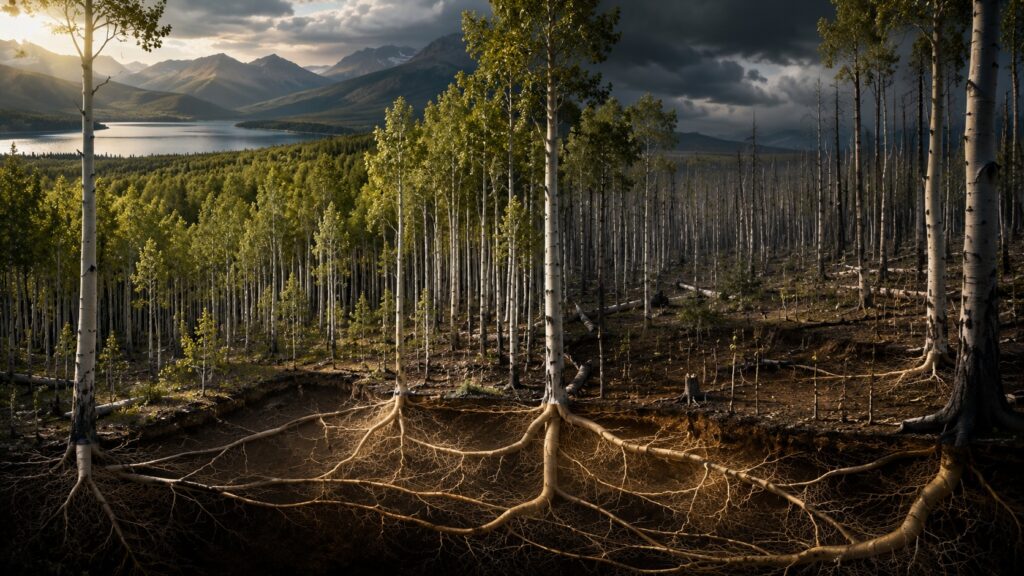
Pando is a massive grove of trembling aspen that looks like an ordinary forest but is actually a single organism. All of its trunks are genetically identical and connected by one living root system underground. In other words, what appears to be separate trees are actually shoots of a single plant.
Aspen can reproduce in two ways. It produces seeds, like all flowering plants, but it also clones itself by sending up new shoots from expanding roots. This is why Pando is called a clonal organism — a group of genetically identical “individuals” that actually constitute a single whole.
Each individual trunk in such a grove is sometimes called a ramet by scientists. Outwardly it looks like an independent tree, but genetically it is part of one large shared being. It sounds strange, and even the researchers themselves didn’t figure it out right away.
Why Pando Is Considered One Organism Rather Than a Forest
The fact that the entire grove is a single organism was first understood in the 1970s. According to ZME Science, scientists Jerry Kemperman and Burton Barnes studied traits such as leaf shape, color, and timing of seasonal changes and noticed that all the trees behaved absolutely identically.
Later this was confirmed by genetic analysis, and the entire grove turned out to be a single clone. If these were different trees, they would differ in DNA and respond to seasonal changes at different times. But Pando turns yellow in autumn all at once, like a single organism — because that’s exactly what it is.
Where Is the Largest Tree on Earth Located
Pando grows in the USA, in the state of Utah, near Fish Lake, right alongside State Route 25. The organism covers an area of about 43 hectares, and this is not a remote nature reserve but a well-traveled area with recreation zones and a constant flow of people.
It is precisely the proximity to the road and recreation areas that would later play an important role in the tree’s problems. Pando does not live in ideal isolation but in an ordinary working landscape where wild animals, livestock, tourists, and land managers all coexist.
How Old Is Pando and How Big Is It
Pando’s age is not straightforward. The popular figure is 80,000 years, and it’s plausible, but not strictly confirmed. The age of an individual trunk can easily be determined by growth rings, but rings won’t reveal when the entire underground organism first emerged.
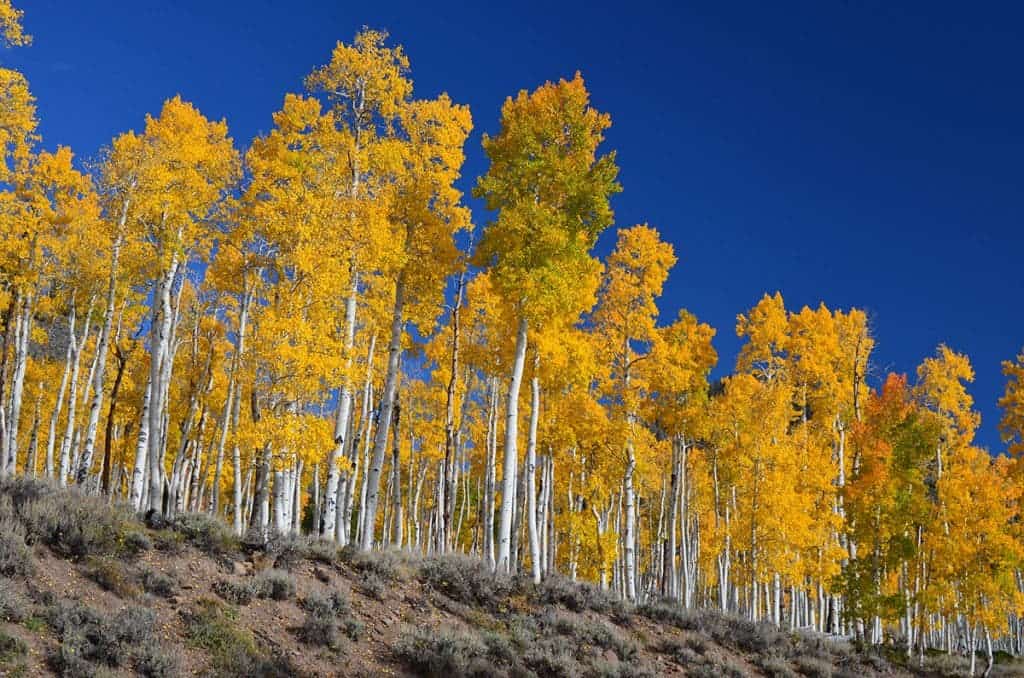
All of Pando’s trunks are connected by a single underground root system
The living trunks of Pando are usually just over a hundred years old, but researchers at Utah State University openly state that there is no reliable way to precisely date the entire clone. Modern genetic studies suggest that Pando may be many thousands of years old — it may have started growing after the end of the last ice age. Even the most conservative estimates make it old enough to have survived significant climate changes, fires, and shifts in the fauna around the lake.
Its dimensions, however, are impressive beyond any qualifications. Measurements have shown that Pando, also known as the Trembling Giant, weighs nearly 5,900 tons and consists of more than 40,000 trunks. Individual trees appear and die off, but the colony as a whole continues to live.
Why the Largest Organism on Earth Is Dying
Even an age of tens of thousands of years does not guarantee Pando a future. The main threat is the browsing of young shoots by animals. For the grove to renew itself, old trunks must be replaced by new ones, and for that to happen, young sprouts must have time to grow above the level at which animals can reach them.
The problem is that this isn’t happening. Pando is not dying all at once — it is thinning gradually, through a process of attrition. The organism still has thousands of old trunks but is critically short of young ones to replace them. To put it simply, this forest is full of elders and has almost no children.
How Deer and Humans Are Harming Pando
The main culprits are deer. Mule deer, and in some areas livestock, eat young aspen shoots before they have a chance to grow. A 2018 study showed that deer significantly hinder Pando’s recovery.
The role of humans here is indirect but important. Recreation areas and the nearby road alter predator behavior and animal distribution, which affects how many deer graze in the grove and how actively they browse young growth. As a result, an organism that survived the ice age has turned out to be vulnerable to a thoroughly modern combination of factors.
Can Pando Be Saved
The good news is that people are trying to save Pando, and in some places it’s working. The main method is to fence off sections of the clone so that hungry animals cannot reach the young shoots.
Where sprouts are successfully protected, they grow into saplings and begin restoring the grove. Pando’s future depends on several simple things:
- keeping enough young trunks alive;
- protecting them from deer and livestock;
- constantly monitoring the results;
- changing the approach where protection has not worked.
In essence, the survival of the most ancient organism now depends on routine management and care — on how attentively people monitor the situation and respond in time.
What Other Large Organisms Exist on Earth
Pando is almost certainly the heaviest organism on the planet, but its title as the largest is contested by another contender. This is a huge honey fungus in Oregon, in the Malheur National Forest, which may exceed Pando in area.
The trick lies in how you measure. The fungal mycelium is hidden underground and stretches over enormous distances, and the result depends on how scientists estimate its hidden mass. By weight, Pando apparently leads, but by area there are possible alternatives.
Pando’s story clearly demonstrates that “enormous” and “immortal” are far from the same thing. An organism that survived tens of thousands of years of climate upheavals can quietly fade away simply because its young shoots are not allowed to grow. And that is precisely why it is worth continuing to watch over it — this is a rare case where the fate of an ancient giant truly depends on our everyday decisions.