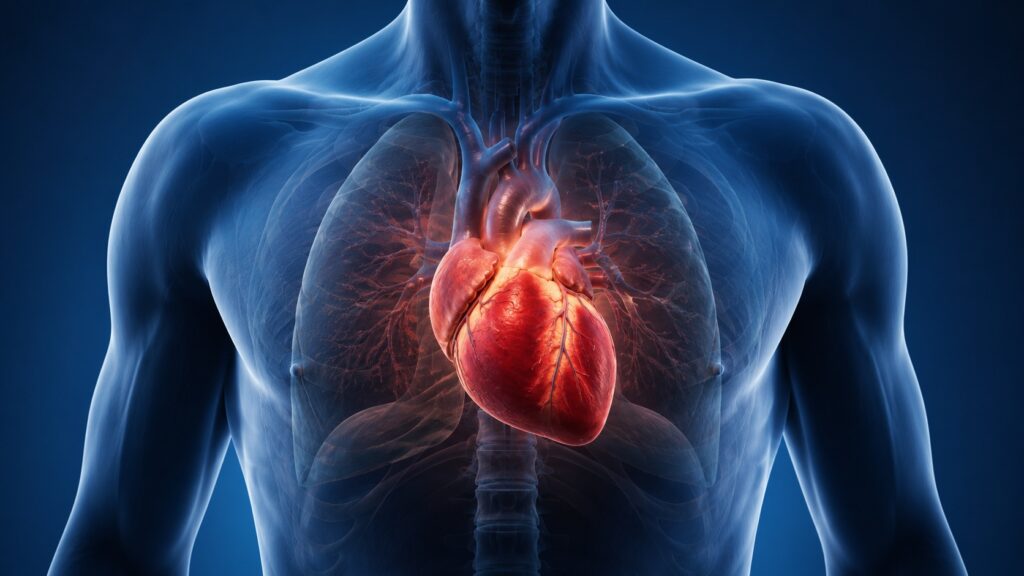
All this time we’ve been wrong about where our heart is located
If you ask an ordinary person where the heart is, they will confidently place their hand on the left side of their chest. The heart is indeed shifted to the left, but its true anatomical position is very different from what we’re used to. In reality, the main engine of our body is located right in the center, and the sensation of beating on the left is a clever biological illusion.
Why It Seems Like the Heart Is on the Left
If you open a book on human anatomy, you’ll see that the heart is located in the mediastinum, the central section of the chest cavity, right behind the sternum. Many of us have been confident in simple truths since childhood, but it turns out that the heart is not pressed against the left side.
However, the heart has one anatomical feature — its lower part is tilted to the left. This tilt has a clear practical purpose. The left ventricle of the heart is significantly more massive and stronger than the right one. Its job is to push oxygen-rich blood throughout the entire body, all the way to the tips of the toes. The right ventricle only needs to deliver blood to the neighboring lungs, so its muscular wall is much thinner.
It is precisely because the left part of the organ is larger and works with maximum effort that we feel the strongest beats on the left. For the same reason, doctors always place a stethoscope on the left side of the chest, since that’s where the sound of heart contractions is heard best.
Asymmetry of Internal Organs in Humans
The human body appears symmetrical only on the outside: two eyes, two arms, two legs. Inside us, there is strict asymmetry, meaning our organs are distributed unevenly. The heart goes through an amazing journey even before our birth to take its place in the center with a leftward tilt.
In the first weeks of embryonic development, our body doesn’t yet know where right and left will be. We often live with false ideas about our own bodies. In a special microscopic cavity, tiny hairs form and begin to rotate synchronously, creating a directed flow of fluid strictly to the left.
This flow gives a chemical signal to genes that begin forming the heart with a leftward tilt, and the liver on the right. If this perfect process is disrupted by even a fraction of a millimeter, human anatomy begins to develop according to a different scenario.
What Is Dextrocardia of the Heart in Simple Terms
Although the central-left position is the absolute norm, there are conditions in which the heart and its apex shift. One of the most striking anatomical phenomena is called dextrocardia. This is a congenital feature in which the heart’s apex points to the right.
Dextrocardia occurs in approximately one out of 12,000 people. Sometimes it is limited to just a mirror rotation of the heart, but there is also a more global form — transposition of internal organs. In this case, the entire human anatomy is rearranged:
- the heart shifts to the right;
- the liver ends up on the left side;
- the stomach and spleen move to the right;
- the appendix also mirrors its position.
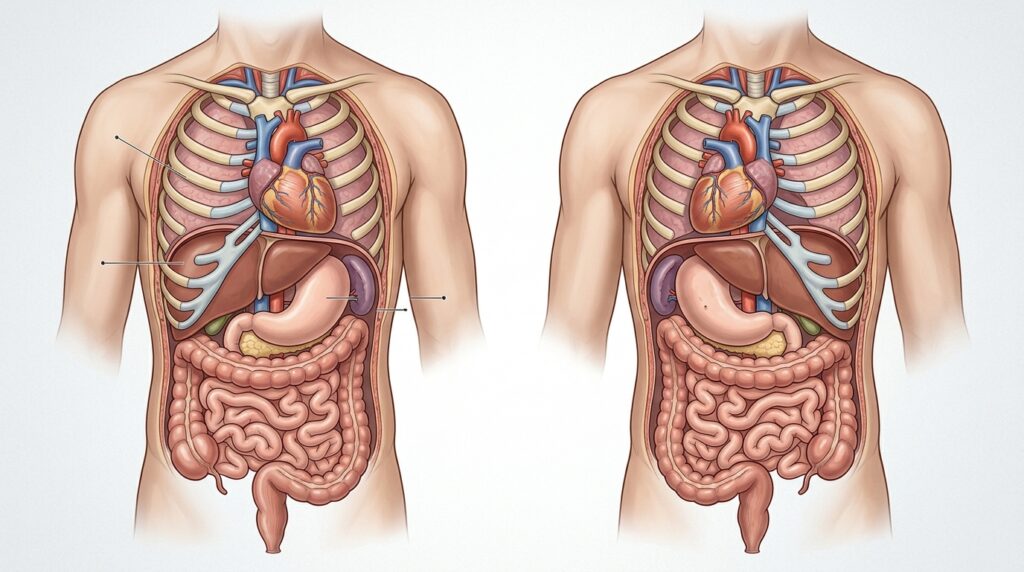
With complete mirror arrangement of organs, a person may not realize their uniqueness for years
The most amazing thing is that people with such mirror anatomy often live completely healthy lives. They may discover their uniqueness entirely by accident — for example, during a routine X-ray or ECG, when a doctor is surprised to find that electrical impulses are traveling in a non-standard direction.
What Can Cause the Heart to Shift
In addition to congenital features, the organ’s position can temporarily or permanently change due to external factors throughout life. The heart is not rigidly fixed in the chest; it is suspended on large blood vessels and surrounded by elastic tissues, which gives it freedom of movement.
Here are the main reasons why the heart may deviate from the center:
- Pregnancy. In the later stages, the growing uterus pushes the diaphragm upward, causing the heart to shift slightly higher and more to the left. After delivery, the organs gradually return to their usual positions;
- Lung diseases. If one lung loses volume, the heart may shift toward the freed-up space.
- Spinal curvature. Severe forms of scoliosis deform the rib cage, which physically presses on internal organs and forces them to adapt to a new position.
So, understanding where our heart is located is important not only for medical students. This knowledge helps us better understand our own physiology and not panic over an occasional tingling in the left side. Nature has securely hidden our main engine in the most protected center of the body, behind the sturdy shield of the sternum, leaving only the powerful muscular apex on the left, whose rhythmic beats remind us of how harmoniously our body works.