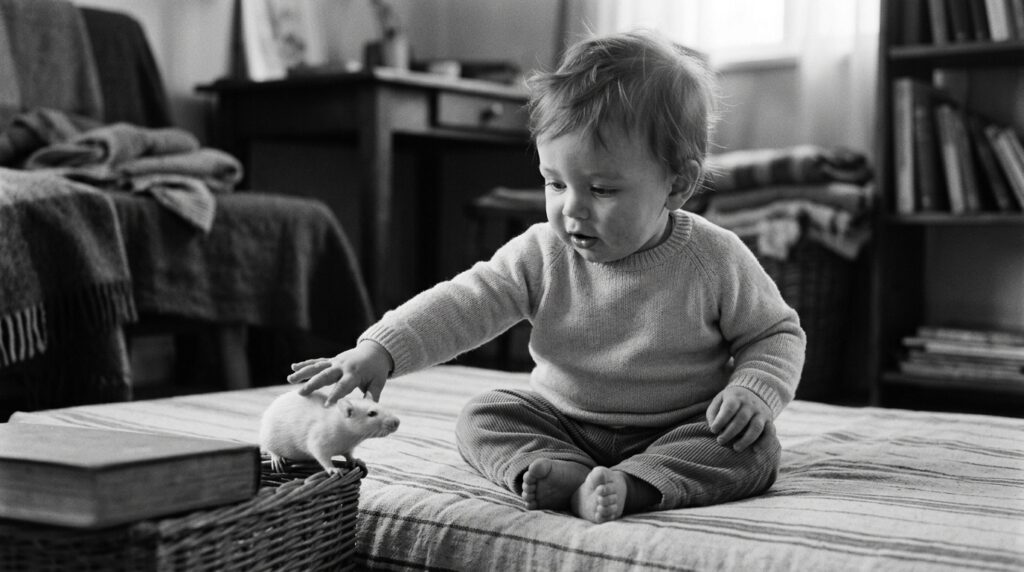
The Little Albert experiment is considered one of the most psychologically cruel
In 1920, science posed the question: are we born with our fears or do we acquire them throughout life? To find out, researchers conducted one of the most famous and scandalous experiments of the last century. This cruel scientific experiment proved that human phobias are not always innate and can be created artificially by simply linking a neutral object with a strong fright. Every person has fears, of course, unless they have a rare syndrome.
The Essence of the Little Albert Experiment
American researchers John Watson and Rosalie Rayner worked at Johns Hopkins University. They knew that Russian physiologist Ivan Pavlov had successfully conditioned reflexes in dogs. The scientists decided to test whether this mechanism would work on human emotions.
For the study, they chose a nine-month-old boy named Albert. His mother worked as a wet nurse at the hospital, so the child had grown up in a medical environment since birth. The boy was remarkably calm — he was healthy, hardly ever cried, and showed no aggression. This officially went down in history as the Little Albert experiment, the goal of which was to trace the formation of a phobia under laboratory conditions.
First, the scientists conducted a baseline check. They showed the child a white rat, a rabbit, a dog, masks with and without hair, and burning newspapers. The boy was not afraid of anything — he merely reached curiously toward the objects. The only thing that frightened him was a sharp hammer strike on a steel bar behind his back. This sound made him flinch and start crying.
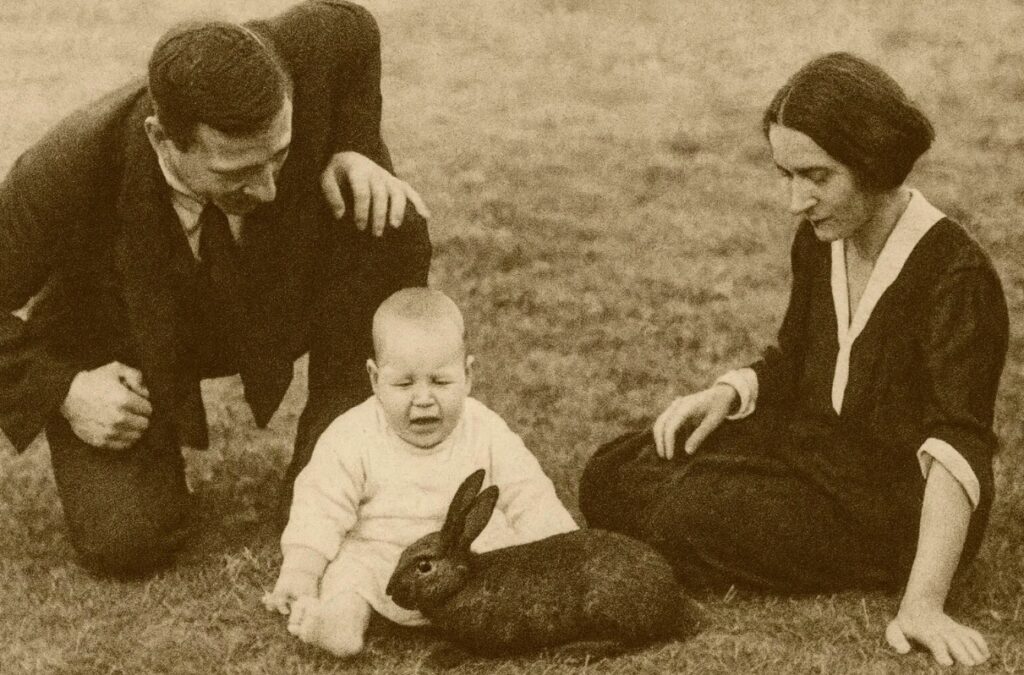
John Watson, Rosalie Rayner and Little Albert
How the Infant Was Taught to Fear a White Rat
Two months later, when Albert turned 11 months old, the actual experiment with the white rat began. The scientists wanted to test whether they could make the child fear an animal that had previously only aroused his curiosity.
The fear was formed as follows:
- A white rat was placed in front of the boy;
- As soon as the child reached out to touch the animal, the researcher forcefully struck a steel bar with a hammer;
- The terrifying crash made the infant flinch and bury his face in the mattress.
A week later, the experiment was repeated. After five such pairings of sound and the appearance of the rat, the child’s psyche gave in. Now Albert didn’t even need the loud sound — the mere sight of the white rat was enough to make him start crying and try to crawl away quickly.
To make sure the boy hadn’t become afraid of everything around him, he was given wooden blocks between tests. He played with them happily and calmly. This proved that the fear was tied to a specific object rather than caused by general anxiety.
Classical Conditioning as Illustrated by the Albert Experiment
The mechanism the researchers used explains the nature of many of our irrational fears. In psychology, this is called classical conditioning — a learning process in which two different events become linked in the brain as one.
Imagine that you got food poisoning from a certain food. Previously, this product was neutral to you, but now even its smell causes nausea. The same thing happened to Albert, only on an emotional level.
The white rat was originally a neutral stimulus. The loud strike on metal served as a natural trigger that automatically causes fright in any person. When the scientists combined these two factors several times, the child’s brain created a strong neural connection. The harmless rat turned into a signal of mortal danger.
How Albert’s Fear Spread to Other Objects
Having confirmed that the boy feared the rat, the researchers decided to complicate the task. They wanted to find out whether this artificial phobia would spread to other objects resembling the original stimulus.
The results exceeded expectations. When Albert was shown a rabbit, he turned away and burst into tears. A dog caused a similar reaction. The boy began to crawl away in panic from an ordinary fur coat, refused to touch cotton, and cried at the sight of a Santa Claus mask with a white beard. The transfer of fear to new objects proved that phobias tend to generalize: a person begins to fear not only the source of stress but also everything that visually resembles it.
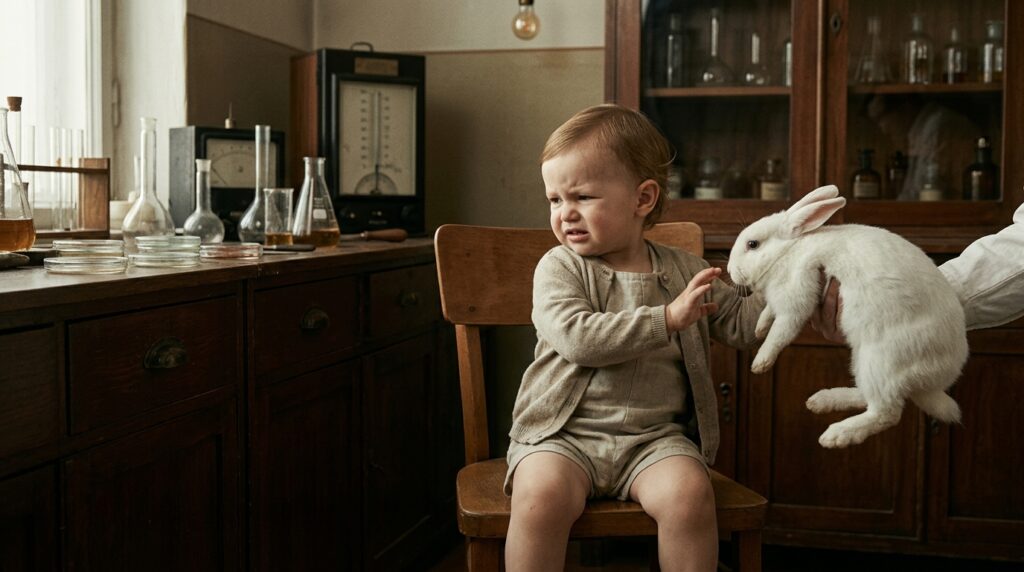
Over time, the child began to react with panic to any furry objects
Did Albert’s Fear Remain After a Month?
After 31 days, the scientists conducted a follow-up check. They wanted to find out how long-lasting the induced phobias were without reinforcement from the frightening noise.
The boy’s reaction had weakened. He no longer wailed loudly at the sight of a rabbit or rat, but he still avoided them, turned away, recoiled with his whole body, and covered his face with his hands. He developed new coping mechanisms — at the sight of furry animals, he began to tremble, nod his head, or suck his thumb.
Thumb-sucking worked as a powerful sedative that blocked panic. The scientists had to forcibly pull his hand out of his mouth to observe his frightened reaction again. The child’s psyche had found a way to cope with stress, although the fear never completely disappeared.
Why the Scientists Did Not Remove Albert’s Conditioned Fear
The most common question asked when studying this story is: why wasn’t the child helped to get rid of the phobia? The answer is mundane — the researchers simply didn’t have time.
On the day the final tests were conducted, Albert’s mother took him from the hospital and they moved away. The study’s authors had planned to carry out a reverse procedure to eliminate the fear. They wanted to use a method now known as exposure therapy: gradually showing the rat in a safe environment, feeding the child his favorite food in the presence of the animal, or encouraging play.
Unfortunately, this never happened. The boy’s subsequent fate remains a subject of debate, and scientists do not know whether he carried this phobia into adult life.
Criticism of the Little Albert Experiment Results
Today, this classic experiment is subjected to harsh criticism from the scientific community. Modern psychologists point to numerous methodological errors.
First, there is no certainty that a specific phobia of rats actually developed. It is possible that due to the repeated strikes on metal, the infant simply became more nervous and fearful in general. Second, the child was one year old by the end of the tests. At this age, children begin to fear new things as part of normal development, and the researchers did not account for this factor in any way.
Moreover, notes and surviving video footage show that Albert reacted quite inconsistently. Sometimes he calmly looked at the animals and only cried when the rat was suddenly thrust directly into his hands. Many modern scientists believe that the video recordings served more as promotional material to attract funding than as rigorous evidence.

Modern researchers find numerous methodological errors in Watson’s records
Ethical Problems of the Little Albert Experiment
By modern standards, what psychologist John Watson did is absolutely unacceptable. In 1920, strict ethical committees protecting the rights of people in research did not yet exist.
Albert’s mother did not know that her child would be deliberately frightened, so she did not give informed consent for the traumatization of his psyche. The scientists intentionally caused emotional pain to the infant, violating the fundamental medical principle of “do no harm.”