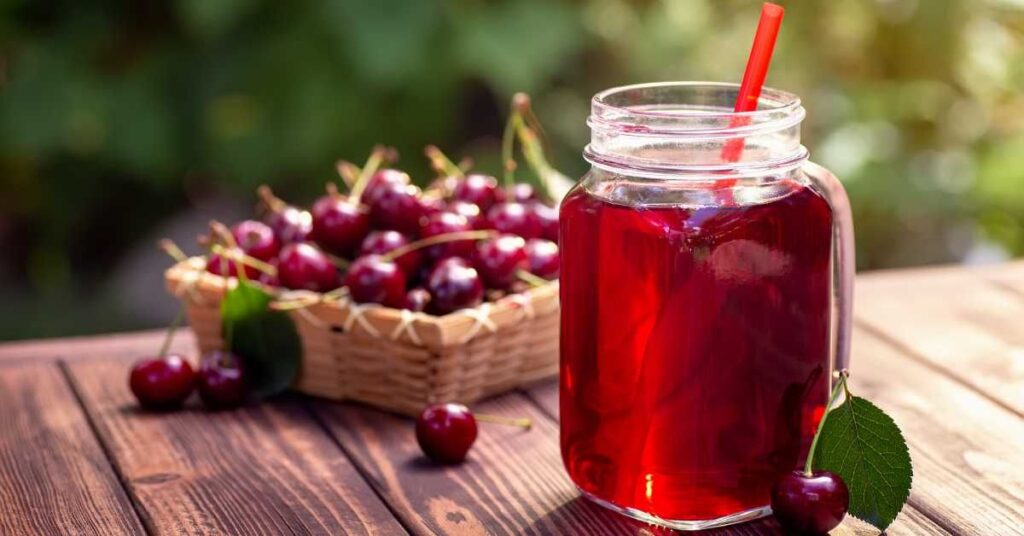
Tart cherries contain melatonin and compounds that may support its production
Tart cherry juice has been declared a natural sleep aid on social media: videos tagged #TartCherryJuice have drawn more than 30 million views on TikTok. The trend has some basis. In a small experiment, people who drank the juice for two weeks slept an average of 84 minutes longer. The key word is tart (sour) cherry, not sweet cherry. The evidence so far is modest, and doctors describe the juice as a gentle sleep support rather than a treatment for chronic insomnia. Its proposed mechanism is fairly clear, and the main downside comes down to one thing: sugar.
What you need to know
- In a small placebo-controlled trial using polysomnography, people with insomnia slept about 84 minutes longer on tart cherry juice, with higher sleep efficiency.
- Two proposed mechanisms: tart cherries contain melatonin directly, and their anti-inflammatory polyphenols may raise tryptophan, the raw material for melatonin.
- Trials so far involved dozens of participants for one to two weeks, so the findings are preliminary, not a verdict.
- A 240 ml glass of 100% tart cherry juice carries about 25 g of natural sugar and 100 kcal; people with diabetes should consult a doctor first.
A sleep aid without the morning fog
The main driver of the trend is the promise of falling asleep easily and waking up refreshed. People sharing their experiences online compare the juice with familiar options such as sedating antihistamine tablets and melatonin capsules, which often leave them sluggish or foggy the next morning. Cherry juice does not produce that effect: it is an ordinary drink, not a drug.
Social media testimonials are not evidence, but in this case they line up with what dietitians say. Many specialists recommend the juice to clients as a natural sleep helper for occasional use, not as a substitute for treatment. Several clinical checks support this: falling asleep becomes easier and sleep lasts longer.
Tryptophan, melatonin and inflammation: three links in one chain
Cherries are rich in polyphenols, plant compounds with anti-inflammatory effects, and in vitamin C. These are thought to set off a chain that ends in sounder sleep. Why would inflammation matter for sleep? The connection turns out to be direct.
The body has an enzyme called IDO that breaks down the amino acid tryptophan, and inflammation ramps up that enzyme. Tryptophan is the raw material from which the body makes melatonin, the hormone of the sleep-wake cycle, and serotonin, which governs mood. The logic runs: less inflammation means less of the enzyme, more tryptophan, and therefore more melatonin. Blood tests in people who drank the juice did show increased tryptophan levels.
There is a second, simpler route. Cherries themselves contain melatonin, and after a week of evening servings of concentrate, it appeared in measurable amounts in participants’ urine samples. In other words, the juice both supplies ready-made sleep hormone and helps the body produce its own.
An extra hour and a half of sleep, tested on dozens of people
The most telling test worked like this. People with insomnia drank a tart cherry beverage in the morning and two hours before bed for two weeks, took a break, then drank a cherry-flavored placebo for another two weeks without knowing which was which. Sleep was recorded by polysomnography, in which sensors track brain waves, eye movements, heart rate, breathing and blood oxygen. On the juice, participants slept 84 minutes longer and spent less time tossing awake: their so-called sleep efficiency, the share of time in bed actually spent asleep, went up.
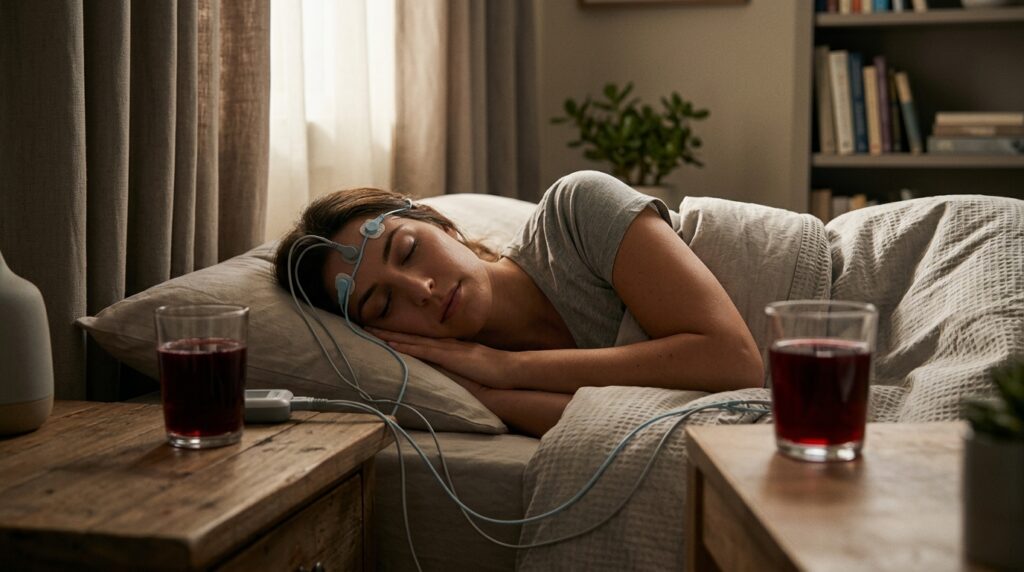
In a small study, tart cherry juice increased sleep duration by an average of 84 minutes
Other checks produced a similar picture. In one, 20 people received about 30 milliliters of concentrate in the evening for a week, and their total sleep time and sleep efficiency increased. In another, older adults with insomnia drank a tart cherry juice blend at bedtime for two weeks, and their insomnia severity fell more noticeably than in those given a placebo.
An important caveat: all of these experiments involved dozens of participants, not thousands, and lasted one to two weeks. These are early signals, not a final verdict. The juice appears to work as a gentle helper; it does not cure chronic insomnia.
Possible bonuses for muscles, joints and heart
Sleep is not the only reason clinicians like tart cherries. They are credited with supporting immunity, benefiting brain and heart function, and helping with weight control. The phrase “may help” is deliberate here: these effects are plausible but less well established than the effect on sleep.
The sports angle is the best studied. A serving of juice before or after a hard workout speeds muscle recovery and reduces next-day soreness. The explanation is straightforward: cherry antioxidants neutralize free radicals, the aggressive molecules that damage cells after exertion. The same mechanism is used to explain a long-standing folk practice of using cherries for gout and joint pain.
How much sugar is in a glass, and who should be careful
Cherry juice has a downside that enthusiastic videos leave out. Even 100% juice with no added sugar contains about 25 grams of sugar and 100 kilocalories in a 240-milliliter glass. These are the fruit’s natural sugars, but the body makes little distinction: drinking a glass before bed is roughly the equivalent of eating five sugar cubes.
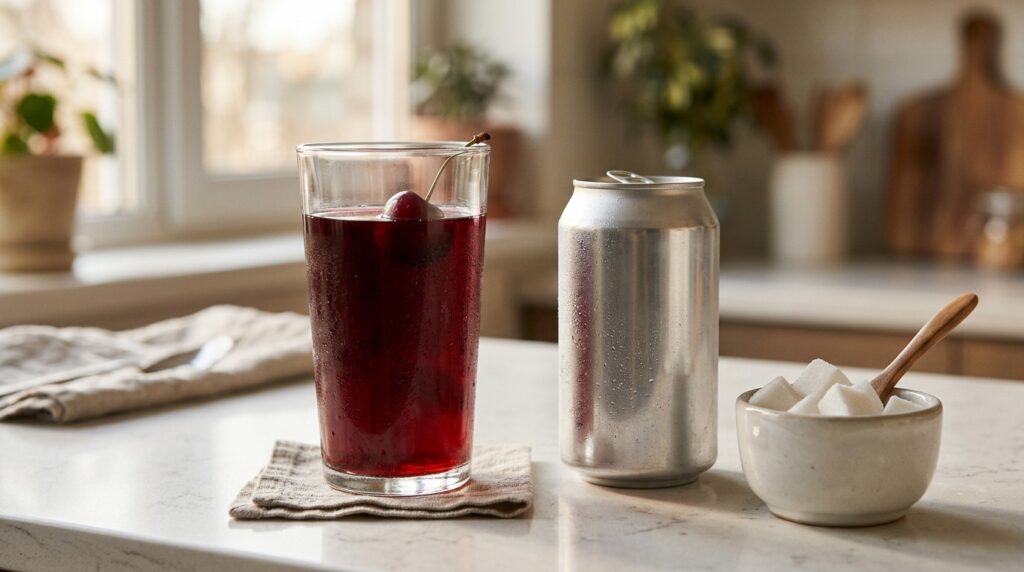
Even juice with no added sugar contains a lot of natural sugar, so portion size matters
Store-bought juices can be worse. Some manufacturers add sugar, pushing a serving to 35 grams or more, roughly the amount in a can of soda. Read the label: you want juice pressed directly from tart cherries, with no “sugar” in the ingredients list.
People with diabetes should talk to a doctor first. An evening spike in blood glucose could outweigh any sleep benefit. One alternative is tart cherry extract in capsule form, which delivers the same polyphenols and melatonin without the sugar load.
The regimen used in the experiments
Juice is not a pill, and there is no dosing label. But the routine among those who benefited in the studies was roughly the same.
- Choose juice made specifically from tart cherries with no added sugar (the Montmorency variety is the best studied).
- Drink one glass twice a day: in the morning and two hours before bed. An alternative is about 30 milliliters of concentrate in the evening.
- Do not expect a miracle on the first night: the effect built up over one to two weeks of regular intake.
- Use the juice as temporary support, not as a permanent replacement for treatment. If insomnia persists for weeks, the cause is more likely stress, routine or an underlying health issue, and a doctor should look into it.
For people who want to avoid pills and do not have diabetes, tart cherry juice is a reasonable thing to try: there is little to lose beyond an extra hundred calories. But the science is worth watching. For the juice to move from folk remedy to accepted intervention, it would need to be tested on hundreds of people over months, not two weeks.