Solar Eclipse of August 12, 2026: Where It Will Be Visible in Russia
On August 12, 2026, a rare coincidence of a solar eclipse and sunset will occur over Europe and northern Africa. This event promises to rank among the best astronomical phenomena of the last decade. For millions of people, the Sun will be setting below the horizon while already partially covered by the Moon, transforming into a thin blazing crescent. Usually during a total solar eclipse, all attention is focused on the narrow path where the Moon completely covers the solar disk. In 2026, this trajectory will pass through Russia as well. But this time, the main intrigue unfolds far beyond the path of totality.
What Will Happen During the Eclipse on August 12, 2026
On this day, the Moon will pass directly between Earth and the Sun and briefly completely cover the solar disk. The narrow path of totality will cross eastern Greenland, western Iceland, and northern Spain — thousands of eclipse chasers are already planning trips to these locations.
But this time, the most interesting part unfolds beyond this path. Across a vast territory of Europe, people will see a deep partial eclipse right at the moment of sunset. In many regions, the Moon will remain in front of the solar disk until the last seconds before the Sun disappears below the horizon.
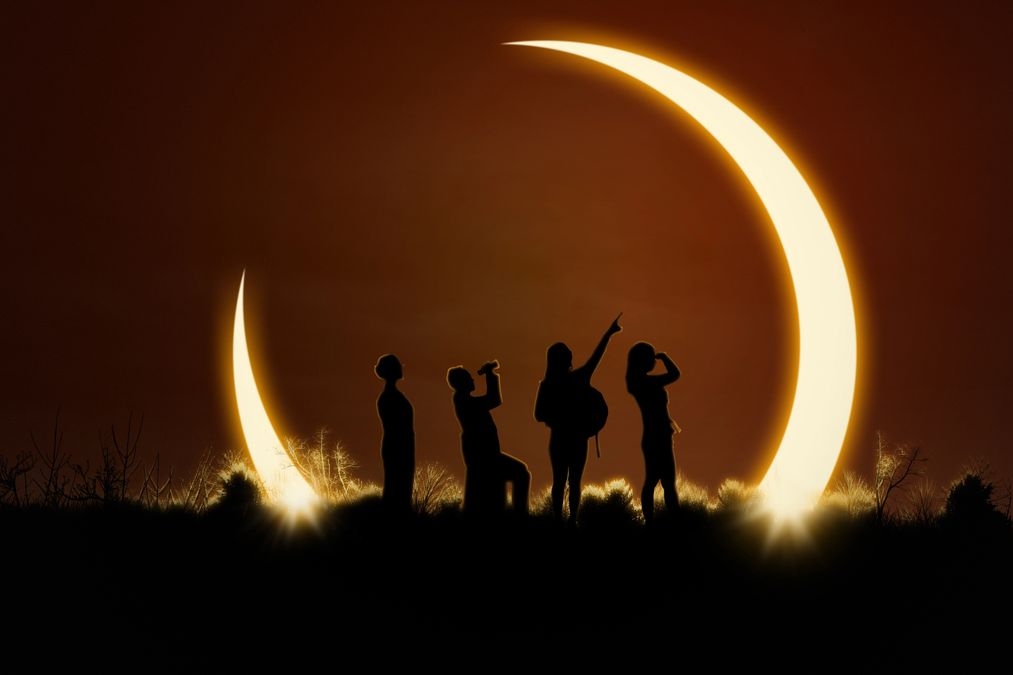
As a result, the familiar solar disk will turn into a thin crescent against the sunset sky. Experienced observers sometimes call this view, with the crescent’s tips pointing downward, a “sad face,” while in parts of North Africa, the Sun will take on a “C” shape.
Why the Sunset Eclipse of August 12, 2026 Is Considered Rare
The main highlight of the event is the geometry. For many European cities, the maximum phase of the eclipse will occur just minutes before sunset. Such “sunset eclipses” over densely populated areas happen very rarely.
Usually, the total phase of an eclipse and sunset occur in different places or at different times. But here, both phenomena may coincide within a single evening — especially in Spain, where some observers will first see the total phase and then continue watching the partially covered Sun as it moves toward the horizon.
An additional effect comes from the atmosphere itself. At sunset, sunlight passes through a denser layer of air, so the sky fills with rich orange, red, and golden hues. The combination of these colors with the darkened disk promises one of the most spectacular astronomical shots of the year.
Where the Eclipse Will Be Visible in Russia
It’s important to be honest here: the path of totality does not enter Russia — it is limited to Greenland, Iceland, and northern Spain. The zone of deep partial eclipse mainly covers Western and Central Europe.
In the European part of Russia, one can expect only a shallow partial eclipse — and only with a clear western horizon and clear weather, because the event occurs in the evening, close to sunset. The farther east the region, the less chance of catching a noticeable phase before the Sun goes below the horizon.
If you want to see a truly spectacular sight, the logic is the same as for European observers: you need a maximally open western or northwestern horizon. Sea coasts, elevated points, and open fields where the view is not blocked by buildings, hills, and trees work best.
Best Viewing Locations in Europe and Africa
Astronomers recommend choosing spots with a clear view to the west. Among the most promising locations are:
- French Corsica and the Ligurian Sea coast in Italy, including Venice
- select areas of the Austrian Alps, Munich, Prague, Wrocław, and Warsaw
- Cape Matifou in Algeria and Essaouira in Morocco, North Africa
- the areas of Soria, Sigüenza, Zaragoza, and Teruel in Spain, where totality is accessible
Spain will be the main destination for astronomers and photographers: the country will experience its first total solar eclipse on the mainland since 1905. There, some lucky observers will see the total phase and then an eclipsed sunset — a combination that occurs extremely rarely.
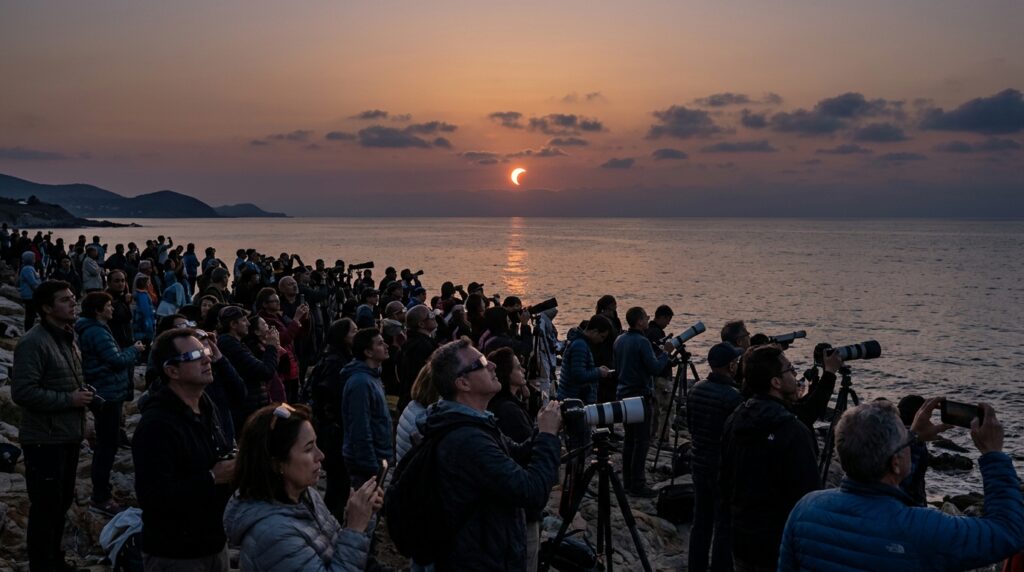
An influx of photographers and astronomy enthusiasts is expected at coastlines with open horizons
This is exactly why these regions are expecting a significant influx of tourists and science enthusiasts from around the world.
How to Safely Watch the 2026 Solar Eclipse
The main rule: looking at the Sun without special protection is not allowed, even when it is partially covered by the Moon. Regular sunglasses, smoked glass, X-ray film, and shooting “by eye” through a smartphone do not protect against ultraviolet and infrared radiation and can lead to retinal burns.
What actually works:
- special eclipse viewing glasses with ISO 12312-2 certification
- solar filters placed on camera lenses, telescopes, or binoculars
- the projection method — where the Sun’s image is projected through a small hole onto a sheet of paper
Looking at the solar disk without a filter is only safe during the brief seconds of totality and only where totality is observed. In the partial eclipse zone, which includes Russia, the total phase does not occur at all, so protection is needed the entire time.
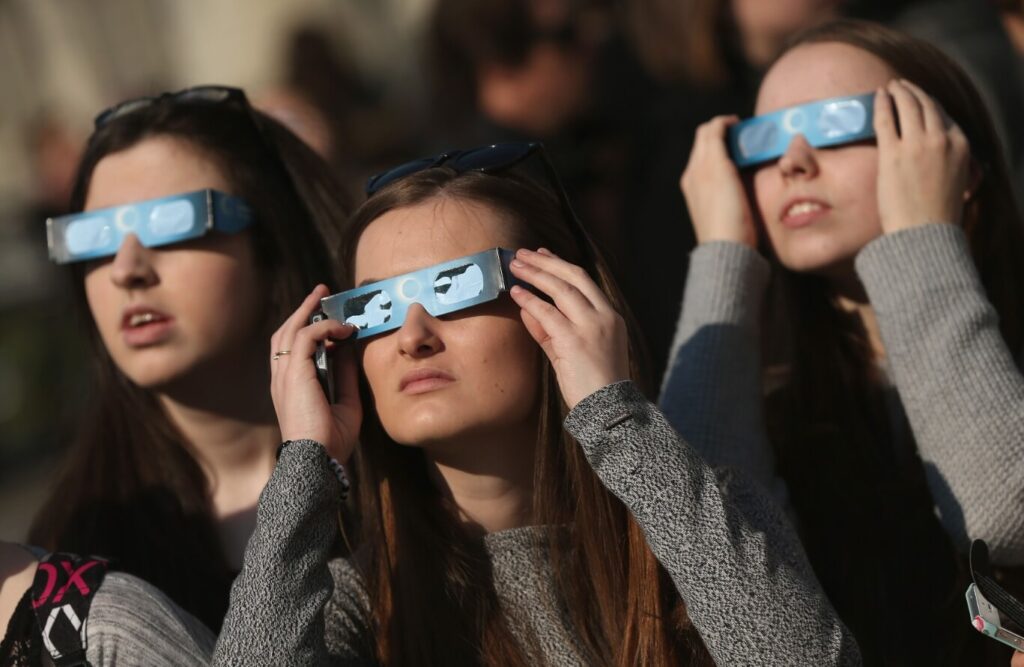
Eclipse viewing glasses. Image source: ntd.com
How Weather and Atmosphere Can Interfere with Eclipse Observation
Even perfect geometry doesn’t guarantee a beautiful shot. For a sunset eclipse, you need an absolutely clear horizon to the west or northwest, and even distant clouds can block the Sun in the final minutes. That’s why experts advise scouting several backup observation points in advance.
Accurate weather forecasts only become available a few days before the event, so travelers should remain flexible in their plans.
There is also a pleasant bonus — atmospheric refraction. Due to the bending of light in the air, the Sun near the horizon appears slightly higher than it actually is. Thanks to this, some observers at the very edge of the phenomenon’s visibility may get even better conditions than astronomical maps promise.
What Solar and Lunar Eclipses Await Russia in the Coming Years
The eclipse of August 12, 2026 is not the only celestial event in the foreseeable future, but the combination of a total or deep phase with sunset makes it special. Such “evening” eclipses over populated Europe are rare, and the next equally convenient opportunity will require a long wait.
For residents of Russia, total solar eclipses are a separate story: the path of totality crosses the country infrequently, and in the coming years, most regions will only have access to partial phases. Therefore, those who truly want to see the total phase of 2026 should consider traveling to Spain or Iceland.
August 12, 2026 could become one of the most spectacular astronomical evenings of the decade — but only for those who choose an observation point with an open horizon in advance, prepare eye protection, and are ready to adapt to the weather. This is a case where the impression depends not only on the cosmos but also on your preparation.