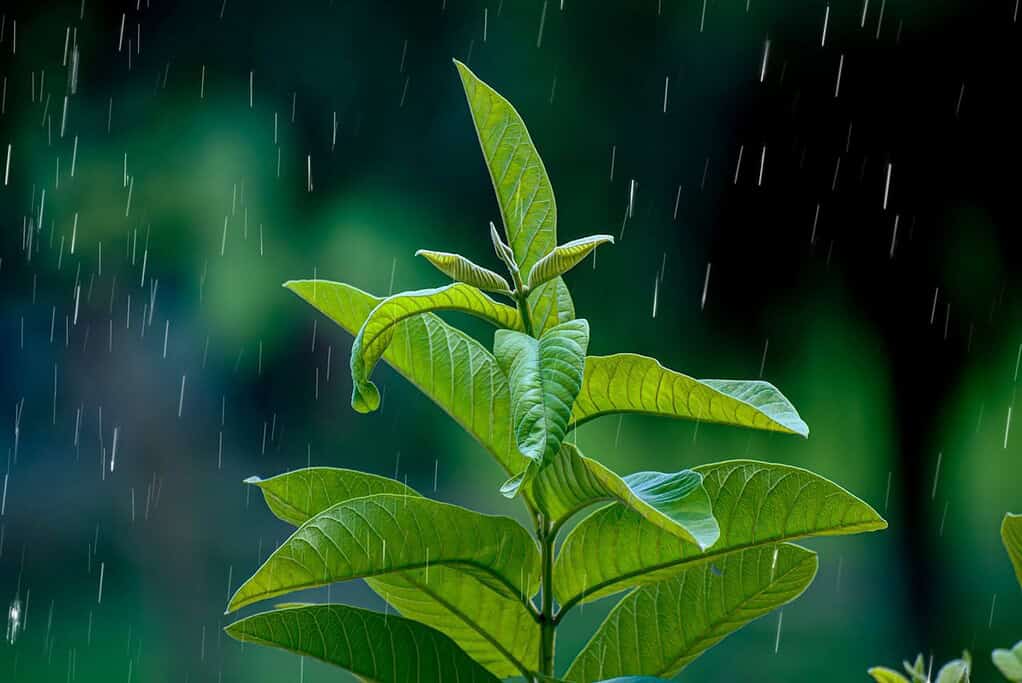
Seeds can hear the sounds of rain and germinate 40% faster
We’re used to thinking of seeds as passive objects that simply wait for water and warmth. But engineers at the Massachusetts Institute of Technology (MIT) have discovered that seeds appear to be able to “listen” and respond to what they hear. Scientists have long studied how plants can see and hear without conventional sensory organs. It turns out that the sharp sound of a raindrop hitting a puddle acts as a mechanical switch that awakens a dormant seed to life.
How Sound Affects Seed Germination
To understand the discovery, it’s worth looking at one remarkable detail from plant biology. Inside plant cells, there are tiny structures called statoliths. These are dense starch granules that settle at the bottom of the cell under the force of gravity and tell the plant where up and down are — which way to push the root and which way to send the sprout.
To understand the discovery, it’s worth looking at one remarkable detail from plant biology. Inside plant cells, there are tiny structures called statoliths. These are dense starch granules that settle at the bottom of the cell under the force of gravity and tell the plant where up and down are — which way to push the root and which way to send the sprout. Plants don’t have ears, mouths, or eyes, but they still know how to read environmental signals and communicate with each other.
Imagine grains of sand in a bottle of water: shake the bottle and the grains scatter, then settle back to the bottom. That’s roughly how statoliths work. When a statolith settles, its position on the cell membrane serves as a signal about the direction of growth. And if the statolith is displaced, that too can trigger seed germination.
Scientists have long known that artificial vibration can shift statoliths and accelerate germination. But MIT mechanics professor Nicholas Makris and his colleague Kadin Navarro hypothesized that in nature, this role might be played by the sound of rain — and they were right. In experiments with rice seeds, they found that the sound of falling drops literally shakes the seeds, bringing them out of dormancy.
How the Sound of Rain Travels Through Water and Soil
There’s an important physical nuance here. We’re accustomed to the quiet patter of rain outside the window, but that’s the sound in air. Underwater, everything is completely different: sound in water travels much faster and transfers impact energy more efficiently. When a raindrop hits a puddle, the pressure of underwater sound waves reaches hundreds of pascals — a colossal magnitude for a tiny seed lying just a few centimeters below the surface.
Makris compared these conditions to standing a few meters from a jet engine — that’s the level of sound pressure a seed experiences in soil or shallow water when a drop hits. He drew on research into underwater rain acoustics conducted in the 1980s and published in the Journal of the Acoustical Society of America.
In shallow puddles, the most powerful sound components fall in the low-frequency range — from 10 to 100 hertz. These low-frequency vibrations turned out to be the most significant for displacing statoliths.
Scientists Tested the Effect of Rain Sound on Seeds
To test the hypothesis, the researchers conducted a series of experiments with approximately 8,000 rice seeds. Rice was chosen deliberately: it can germinate both in soil and in shallow water, making it an ideal subject for measuring underwater acoustic effects.
The seeds were placed in shallow containers of water at a depth typical of natural puddles — far enough from the surface that the physical splash from the drop wouldn’t touch them, and only the sound would reach them. Using hydrophones, the scientists confirmed that the acoustic profile of the laboratory drops matched recordings of real rain in wetlands. They simulated everything from light drizzle to heavy downpour by varying the size and drop height of the drops.
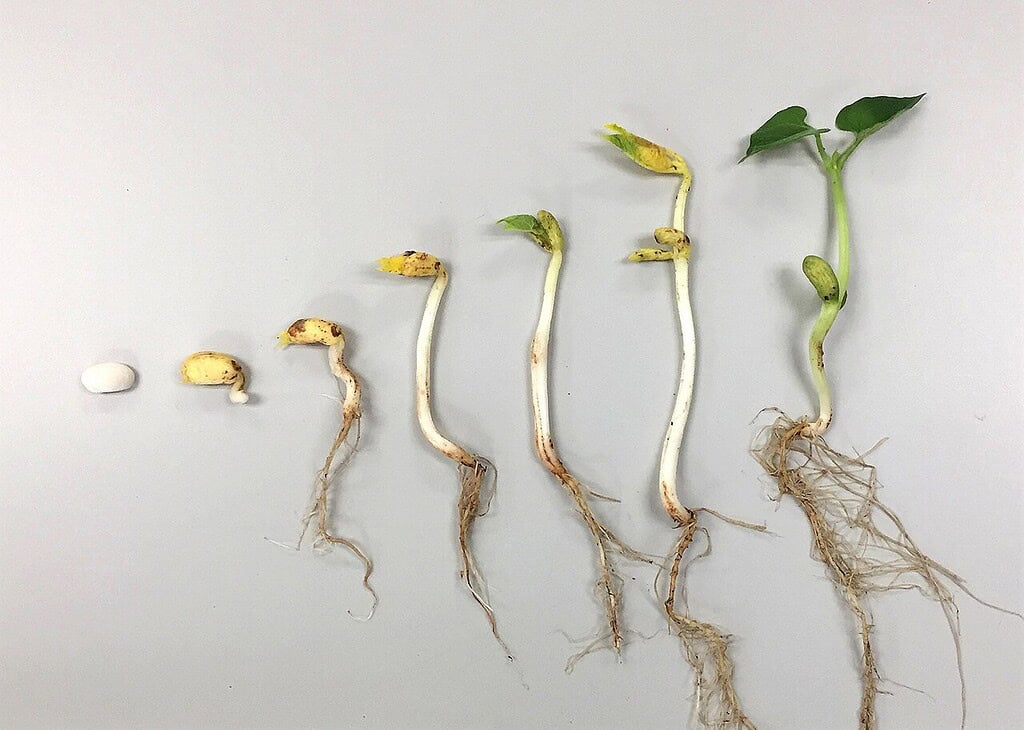
Rice seeds in a laboratory water container during an experiment on the effects of drop sounds
The result was compelling: seeds subjected to acoustic “bombardment” germinated 30–40% faster than control groups kept in identical conditions but in silence. Additionally, seeds positioned closer to the surface responded more strongly to the sound and grew faster than those lying deeper.
Rain Sound as a Depth Sensor for Seeds
The researchers performed calculations accounting for drop size, terminal velocity, and sound wave amplitude. Mathematical models confirmed that vibrations from a drop hitting water or soil are indeed strong enough to shift statoliths inside a seed. The calculations matched the experimental data.
But the most interesting part is the biological significance of the discovery. The researchers suggest that perceiving rain sound gives seeds an evolutionary advantage: if a seed is close enough to the surface to “hear” the rain, it means it’s at an optimal depth for absorbing moisture and successfully germinating.
This effect is limited by depth. According to the scientists’ estimates, significant germination acceleration from rain sound works only at depths of up to 5 centimeters in water and soil. A seed buried too deep simply doesn’t “hear” the rain — and doesn’t waste energy on growth that might be hopeless. In essence, rain sound acts as a natural depth sensor, helping the seed decide whether it’s worth germinating right now.
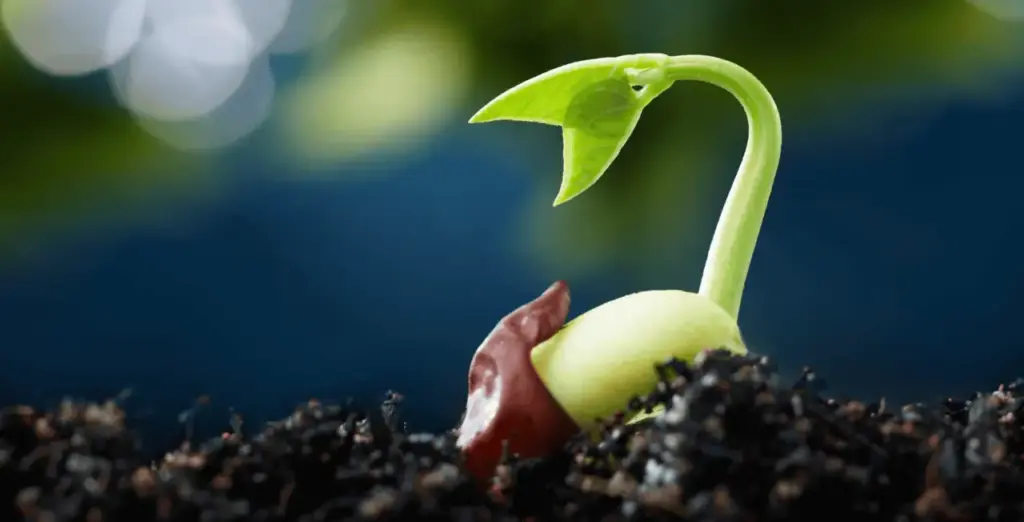
Sound waves from a drop impact reach only shallowly buried seeds
Scientists Prove for the First Time That Seeds Can Hear Sound
This study is the first direct evidence that seeds and plant seedlings are capable of perceiving sounds in their natural environment. For now, this is fundamental science rather than a ready-made agricultural technology, but it significantly expands our understanding of how seeds assess their surroundings.
The researchers suspect that many other seed species with similar gravity-sensing systems may respond to rain sound in a similar way. The team also hypothesizes that plants may respond to other natural vibrations — for example, those created by wind.
It’s important to understand: what we’re talking about is a hypothesis regarding the mechanism, not a proven chain of “sound → statolith displacement → growth signal.” The calculations and experiments aligned, but the precise biochemical signaling pathway inside the cell remains the subject of further research.
Nevertheless, the idea itself is impressive. It turns out the plant world is far more “sensitive” than we’re used to thinking. Seeds don’t just passively wait for water — they pick up acoustic cues from the environment and “decide” based on them when to start growing. In this context, Makris recalls the fourth Japanese microseason — “Falling Rain Awakens the Soil.” The poetic metaphor turned out to be closer to biological reality than anyone could have imagined.