
Seawater holds 50,000 years’ worth of lithium and magnesium
Mining is usually associated with quarries, shafts, and mountains of rock. But valuable metals are also found underwater, and American researchers propose going even further — extracting them directly from seawater. It contains dissolved lithium, magnesium, nickel, and other substances vital to modern technology. According to their estimates, just 0.1% of seawater contains enough lithium and magnesium that, if fully extracted, humanity would have enough of these reserves for at least 50,000 years. At first glance, this seems like a ready-made solution to the resource problem. In reality, however, finding minerals in the ocean is much easier than extracting them cheaply.
How Much Lithium and Magnesium Does Seawater Contain
Seawater seems like ordinary salty liquid, but it is actually a very dilute mineral solution. Its composition is roughly similar across different parts of the world, so a single successful technology could theoretically work in many coastal regions at once.
Lithium is already extracted from mineral-rich underground brines, but its concentration in the ocean is much lower.
A vivid example is an Olympic swimming pool filled with approximately 2.3 million liters of seawater. It would contain about 2,980 kilograms of magnesium, but only 0.42 kilograms of lithium and less than a gram of nickel.
This is precisely why magnesium is relatively convenient to extract, while lithium has to be literally hunted down. To obtain a noticeable amount of the rare element, a colossal volume of water must be pumped and processed. This requires energy, equipment, and money.
Reserves for 50,000 years are not a ready-made deposit that can be developed starting tomorrow. This is an estimate of the total amount of substances, assuming they can be fully and affordably extracted.
How Magnesium Is Obtained from Seawater
Researchers have created a flow reactor in which two streams move side by side: seawater and sodium hydroxide. Where the liquids meet, solid magnesium hydroxide forms, which can be collected.
Essentially, it is a conveyor: the desired substance precipitates out of the solution on its own. Moreover, magnesium hydroxide is already in demand by industry, so it does not necessarily need to be converted into pure metallic magnesium through additional reactions.
Magnesium itself is one of the popular lightweight metals and is used in device casings, engines, and various alloys.
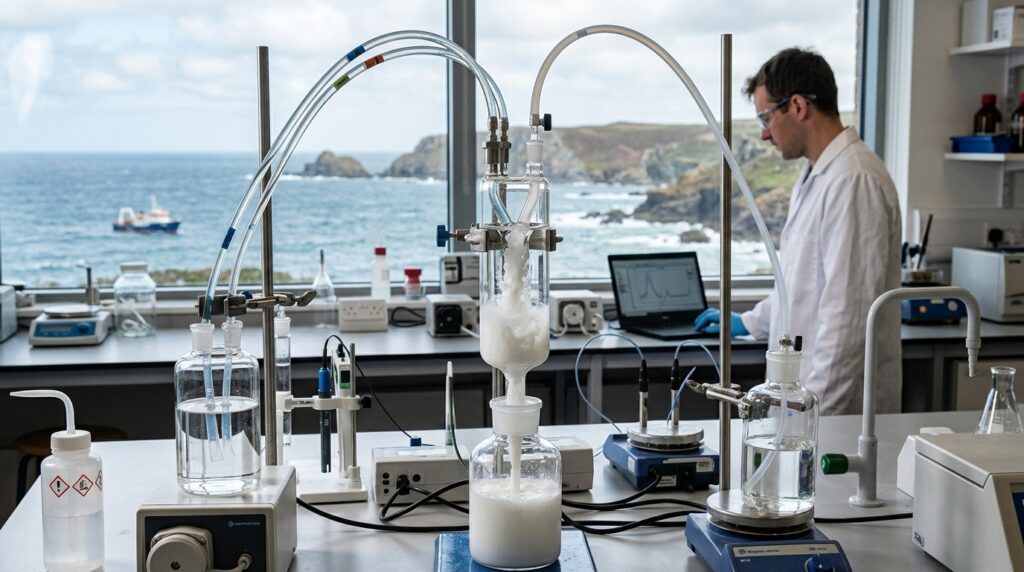
White magnesium hydroxide precipitate forms from seawater in the reactor
The idea of extracting magnesium from the sea is not new. In the United States, this method was widely used after World War II, and then the country switched to imports. The new variant reduces several processing stages and is designed as a modular unit that can be placed next to existing infrastructure.
Desalination Plants Could Become Ocean Mines
The most logical location for such a system is a water desalination plant. It already takes in enormous volumes of liquid from the sea every day, and after desalination, a salt brine remains. Therefore, there is no need to build separate pumping infrastructure, and the raw material for further processing is already available.
Calculations for the desalination facility in Carlsbad, California, yield an impressive figure. At 100% extraction, the installation could produce 524,000 kilograms of magnesium hydroxide per day. This is more than triple the current daily consumption of this substance in the United States.
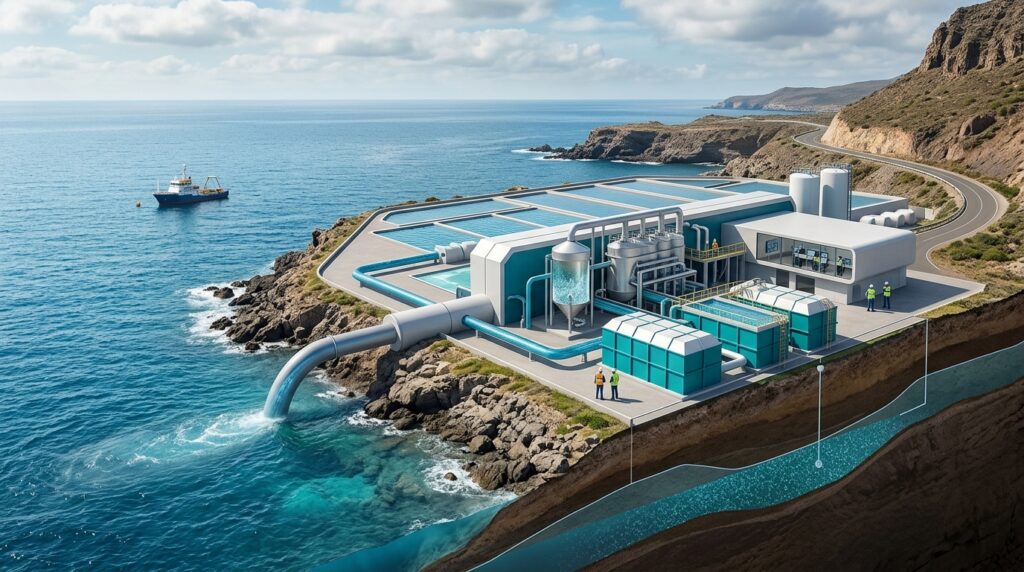
Seawater holds 50,000 years’ worth of lithium and magnesium
100% extraction is an ideal scenario, not a promised production rate. But even as a benchmark, this figure demonstrates the scale: the water first gives up its useful mineral and then goes on to regular desalination.
The remaining concentrated brine is also proposed to be put to use rather than discarded. Using electricity, it can be split into acidic and alkaline solutions needed for further mineral processing. The acid obtained in this way, in laboratory tests, extracted nickel 37% more efficiently than regular hydrochloric acid.
Seaweed Can Help Collect Rare Elements
Marine seaweed can also be enlisted in the extraction process. They are capable of accumulating heavy metals, and the concentration of some critically important substances in their tissues can be up to a million times higher than in the surrounding water.
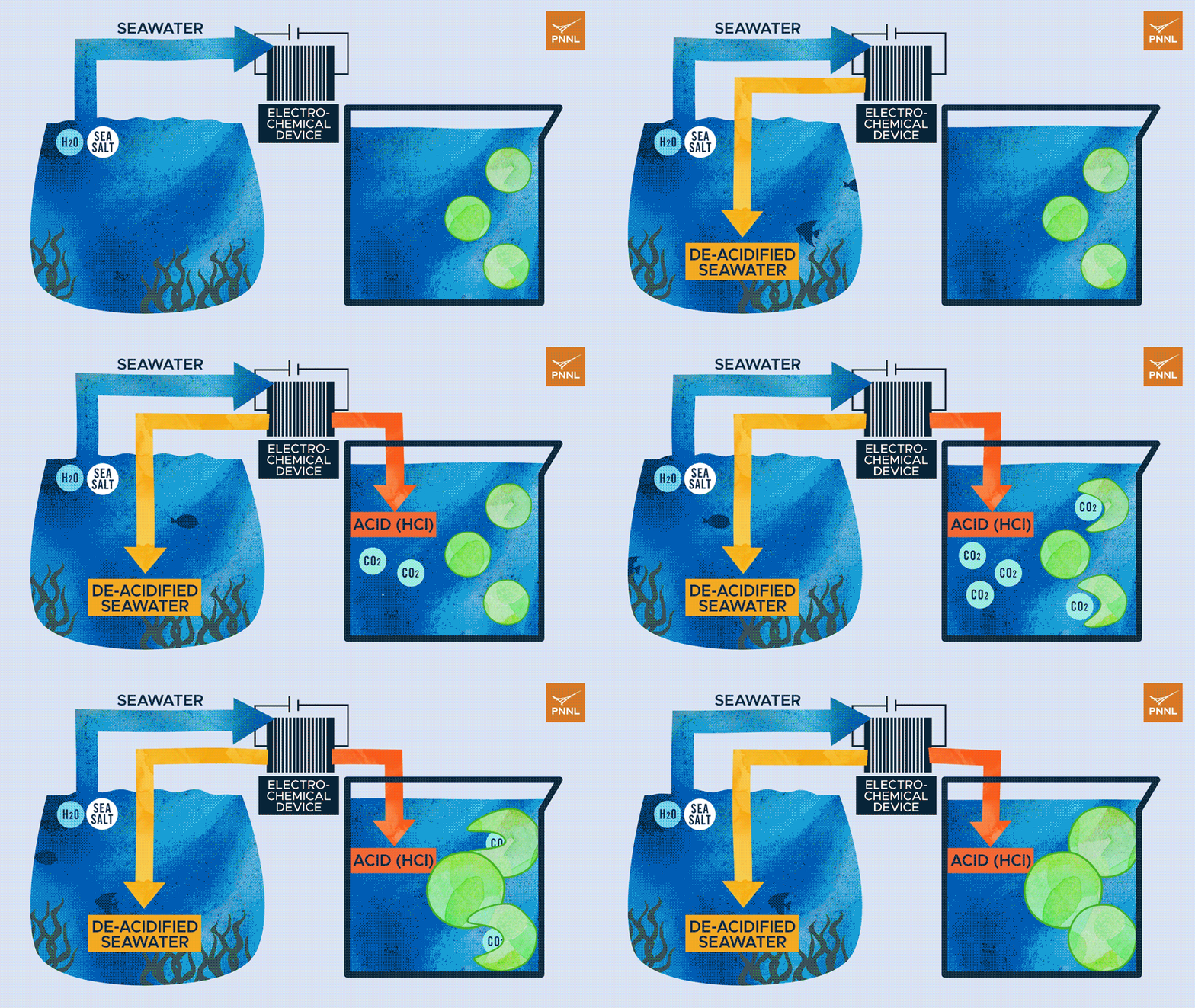
In bipolar membrane electrodialysis, seawater is pumped through a device that uses electricity to split water and remove acid. The acid byproduct can be used to grow seaweed for accumulating and extracting critical minerals.
This does not mean that plantations of “lithium cabbage” will appear anytime soon. Researchers still need to determine which seaweed species are best at collecting different elements, how to cultivate them, and how profitable it is to extract the accumulated substances.
This approach allows the use of nearly all parts of the process. Minerals and fresh water can be obtained from seawater, useful chemical solutions from brine, and fertilizers, fuel, and other products from the grown biomass.
The main problem so far is not the reserves, but the cost and scale of extraction. Technologies must process enormous volumes of water without consuming too much energy and without harming marine ecosystems.