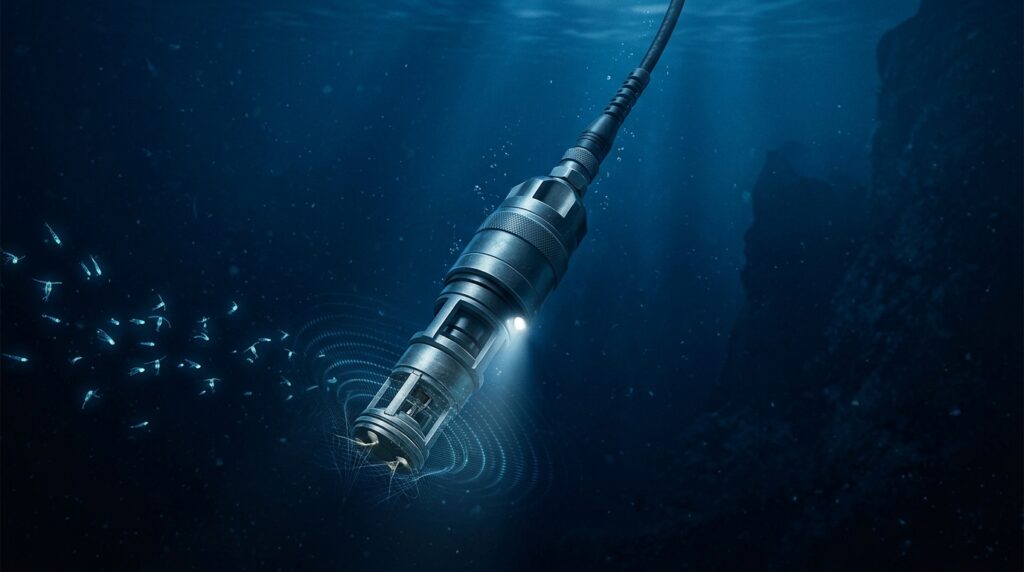
In 2014, scientists heard a mysterious sound called Biotwang in the Mariana Trench
In 2014, marine biologists recorded a strange humming sound near the shores of the Mariana Islands that puzzled them for years. Unraveling the mystery of the ocean’s moan was only recently possible thanks to artificial intelligence technologies, which pointed to an elusive marine giant. What was it? A huge whale, or a giant squid up to 14 meters long?
Mysterious Sounds in the Mariana Trench
It all began almost ten years ago, when hydrophones were lowered into the water near the deepest place on the planet. The instruments picked up a low-frequency noise that didn’t fit any catalog of known natural sounds.
Researchers dubbed this acoustic phenomenon Biotwang. It resembled a low hum or a mechanical moan emanating from the darkness. At first, specialists even doubted they were dealing with a living creature. This mysterious phenomenon was described in the journal Frontiers in Marine Science.
Sound Anomaly in the Mariana Trench
The ocean is filled with all kinds of noises, from cracking ice to the rumble of underwater earthquakes. But this humming signal stood out due to its unusual tonality.
The sound most closely resembled the noise of a ship’s engines, rather than an animal’s call. Although biologists suspected that some kind of baleen whale might be producing the sound, proving it was nearly impossible. Without visual confirmation — when the animal is visible at the surface at the moment of singing — identifying a species by sound alone is extremely difficult.
What Marine Creature Was Making the Mysterious Sound
An unusual alliance of marine biologists and Google developers helped solve the puzzle. The programmers created a special artificial intelligence — a kind of “Shazam for whales” — capable of recognizing the voices of marine mammals.
The program analyzed a massive array of acoustic and visual data collected in the area of the Mariana Archipelago. Ultimately, the algorithm confidently linked the mysterious moan to Bryde’s whale (Balaenoptera brydei). It turned out that this whale produces the metallic hum while communicating with its kin.
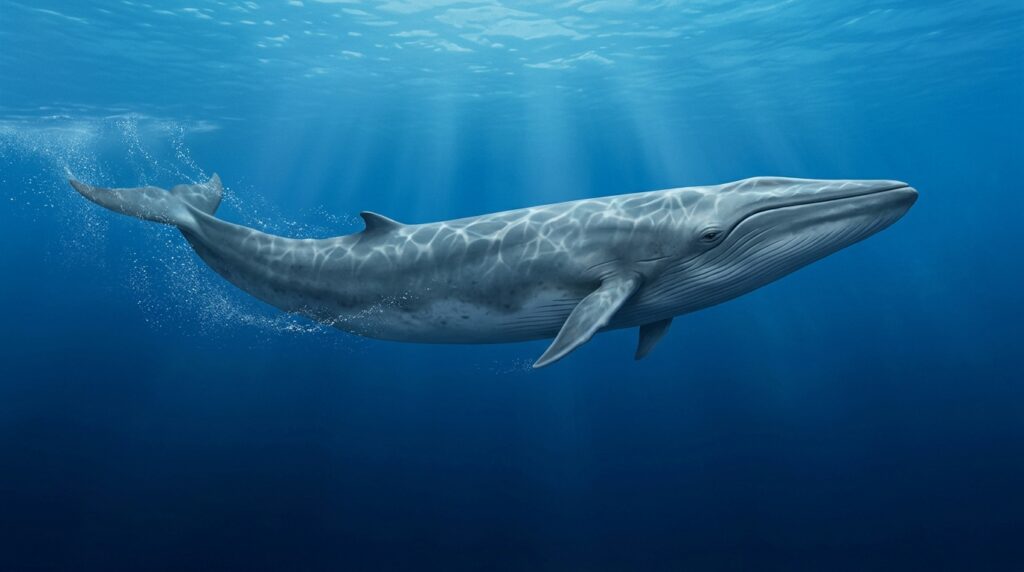
Bryde’s whale turned out to be the source of the mysterious humming
Why Bryde’s Whale Remained Elusive for So Long
Bryde’s whales are true ocean wanderers. They are not tied to a single location and constantly move across vast territories, making observation incredibly challenging.
The global movements of these whales are closely linked to changes in oceanic conditions. Their range covers the central and western parts of the North Pacific Ocean, meaning the animals literally dissolve into the boundless expanses of water.
What Makes Whale Sounds Unique
The voices of marine giants are a crucial tool for navigation and maintaining social bonds. Sound waves can travel enormous distances through water.
In the case of “Biotwang,” biologists identified a clear pattern. Whales sing depending on the season, which allows researchers to track their migration invisible to the naked eye:
- the first small surge of activity occurs from February to April;
- the main peak of sounds is recorded from August to November;
- during this time, whales actively move between low and mid-latitudes.
Studying the Ocean Through Sound Analysis
To understand the scale of Bryde’s whale journeys, researchers had to combine the manual work of biologists with the computational power of neural networks.
Scientists retrieved historical hydrophone recordings collected from various corners of the Pacific Ocean over many years. The algorithm combed through thousands of hours of audio and discovered the familiar “Biotwang” not only near the Mariana Islands but also far to the east near Wake Atoll, as well as near the Hawaiian Archipelago and close to the equator near Howland Island.
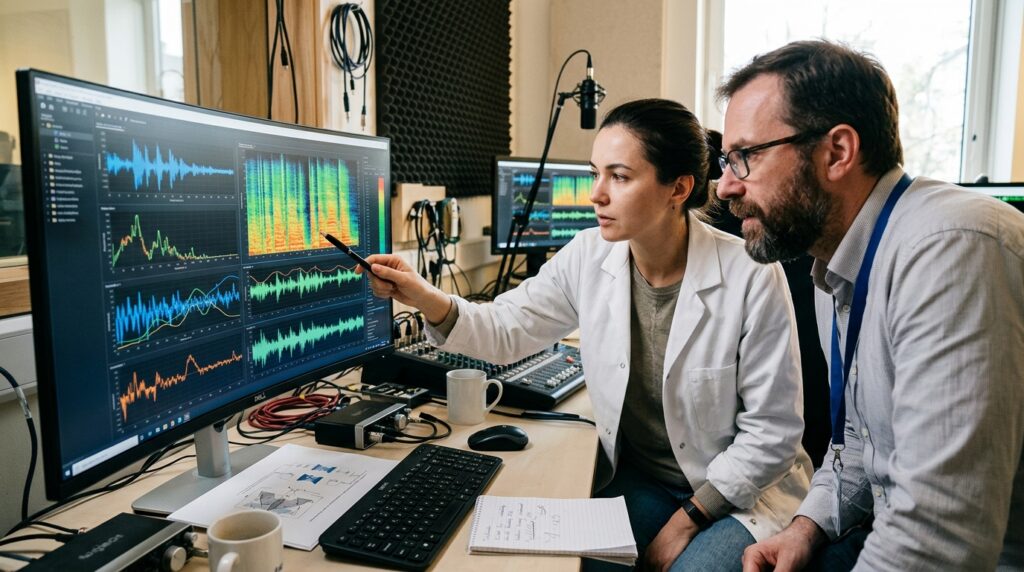
Specialists study sound wave graphs on monitors
Mysteries the Deep Ocean Still Hides
This discovery proved that a large, previously unknown population of Bryde’s whales living in the water column inhabits the western North Pacific Ocean.
The abyss around the Mariana Islands continues to surprise the scientific community. We still know very little about how ocean currents, water temperature, and food abundance affect the hidden routes of marine giants. Each new ocean study shows that even in the 21st century, there are areas on Earth that live by their own mysterious rules.
Unraveling the mystery of “Biotwang” is a wonderful example of how modern technologies help us hear nature. Biologists now have a reliable method for tracking rare whales by their songs, which in the future will help better study and protect these amazing ocean wanderers.