Cats don’t always have a positive effect on the psyche: scientists found a link to schizophrenia
For many people, cats have long been more than just pets — they’re family members: they have their own favorite spots at home, they sleep on our beds and laps, they purr, make the home cozier, and even noticeably affect our brains. But in 2023, a group of Australian scientists reviewed dozens of studies spanning the last 44 years and reached an unexpected conclusion: people who have a cat at home have roughly twice the odds of developing schizophrenia. That sounds alarming — but before you hand your cat over to the neighbors, let’s figure out what this actually means.
What scientists discovered about the link between cats and schizophrenia risk
Researchers from the Queensland Centre for Mental Health Research collected 17 studies from 11 countries, including the US and the UK, and analyzed them together. This approach is called a meta-analysis — instead of looking at a single experiment, you examine many at once to see the overall picture.
The result: a significant association between cat ownership and an increased risk of schizophrenia-spectrum disorders does indeed exist. After adjusting for various factors, it turned out that cat owners had roughly double the odds.
But here’s what’s important: this is an association, not a cause. The scientists themselves emphasize this in every paragraph. An association means that two phenomena occur together more often than usual. A cause means one directly produces the other. And those are not the same thing at all.
Why the link between cats and schizophrenia is not proof of their guilt
Consider a simple example: in summer, ice cream sales and the number of sunburns both increase at the same time. But ice cream doesn’t cause sunburns — both are simply related to hot weather. A similar story could be at play with cats: behind the association, dozens of hidden factors that the study simply didn’t account for could be lurking.
Moreover, 15 of the 17 studies were so-called case-control studies. This is a format that is inherently incapable of proving cause and effect — it merely compares groups of people in retrospect. And the researchers themselves explicitly described some of the studies as low quality.
There’s another inconsistency: the results contradict each other. One study found no link between having a cat at home before age 13 and schizophrenia. But that same study did show a link when narrowing the age range to 9–12 years. In other words, even the “dangerous age” of contact with a cat hasn’t been established — and that’s a sign the picture is far from clear.
How the Toxoplasma parasite is connected to schizophrenia risk in cat owners
The main suspect in this story is a tiny parasite called Toxoplasma gondii. The idea of linking cats and mental health first appeared back in 1995, and toxoplasma was named as a possible explanation.
This parasite reproduces in cats’ bodies and can be transmitted to humans — most often through contact with the animal’s infected feces. But, importantly, you can get infected without any cat at all: through undercooked meat or contaminated water.
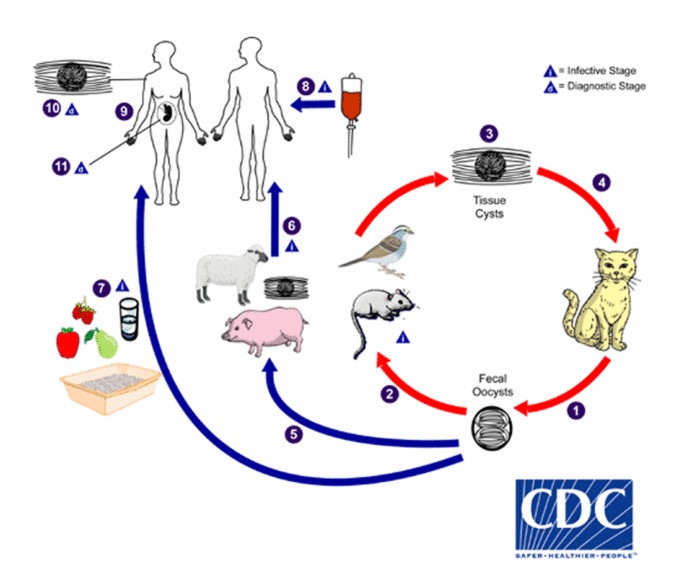
T. gondii reproduces in cats’ bodies (1), but can also be transmitted to humans through intermediate hosts (2, 5, 7).
The scale here is serious: according to estimates from the American CDC, more than 40 million people are infected with toxoplasma in the United States alone — and usually without any symptoms. Once inside the body, the parasite can persist in the nervous system and affect brain function. That’s why scientists are studying its effects: behavioral changes, personality shifts, and psychotic symptoms.
But here, too, it’s important not to confuse coincidence with causation: the association doesn’t prove that toxoplasma is actually causing all of this, and even less so that the person got it specifically from a cat.
An unexpected twist: it might be about cat bites
There’s a detail in the review that breaks the simple logic of “cat in the house = risk.” In one study involving 354 psychology students, the mere fact of owning a cat had no effect at all. But those who had been bitten by a cat showed higher scores.
Another study confirmed: the association was found specifically with bites, not with the mere presence of the animal. And the scientists hypothesized that a completely different microbe might be to blame — the bacterium Pasteurella multocida, which enters the wound during a bite. So cat bites are more dangerous than they seem, even when it’s a house pet.
This shifts the focus. Perhaps it’s not about the cat as such, but about specific situations of contact. Although this too is still just a hypothesis that needs testing.
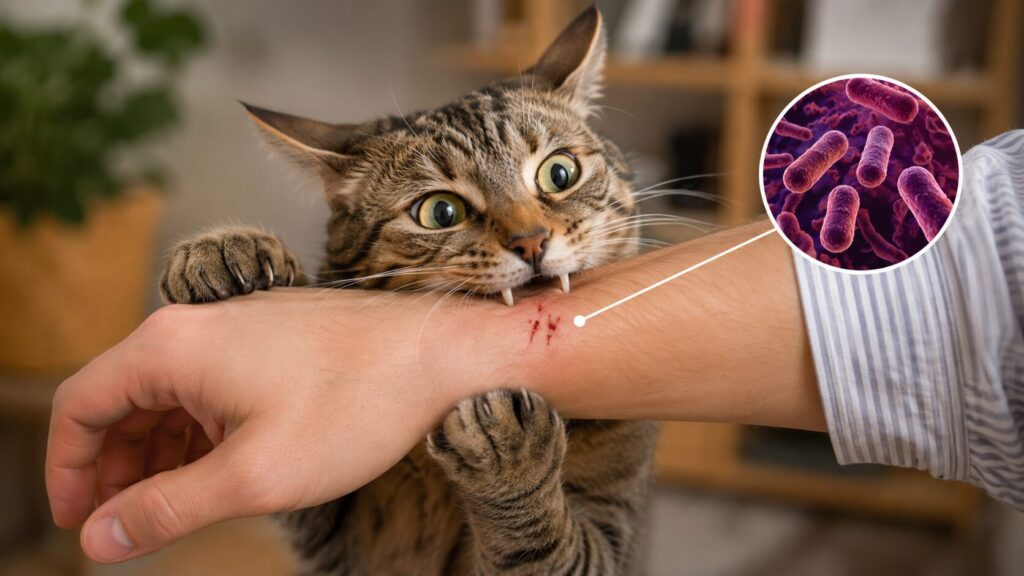
Cat bites may not be as harmless as they seem.
Should you get rid of your cat because of schizophrenia risk?
Of course not. None of the studies say that a cat makes a person sick. The review authors honestly write: higher-quality studies with larger samples are needed to even understand whether there’s a real cause here.
In practice, the important thing is not to panic but to follow basic hygiene: it reduces the risk of toxoplasmosis regardless of all the debates.
- Wash your hands after cleaning the litter box
- Clean the litter box daily — the parasite doesn’t become infectious immediately
- Don’t eat undercooked meat and don’t drink raw water from questionable sources
- Pregnant women should, if possible, delegate litter box cleaning to someone else
These measures are beneficial on their own and don’t require giving up your pet.
What we ultimately know about cats, toxoplasma, and mental disorders
The main takeaway of this story isn’t about cats — it’s about how to read science news. The headline “cats are linked to increased schizophrenia risk” is technically accurate, but misleading: behind the word “link” here lie contradictory data, weak studies, and a host of unaccounted-for factors.
A cat on your lap is almost certainly not a threat to you, especially since cats genuinely help with health and often serve as a living stress reliever. But the habit of distinguishing “correlation” from “causation” is a skill that will definitely come in handy for everyone.