
Children’s IQ tests don’t predict success: debunking the myth
Mozart began composing at five, wrote his first symphony at eight, and an opera at eleven. That’s why he has long been considered a symbol of early genius and “brain training.” But new research tells a different story: childhood IQ fluctuates significantly and poorly predicts future success. Although IQ tests themselves measure real cognitive abilities, a single test taken in elementary school may mean far less than commonly believed.
Where the “Mozart Effect” came from and why it collapsed
In 1993, a study was published that launched an entire industry. Scientists found that listening to a Mozart sonata temporarily improved results on spatial reasoning tests compared to silence or a relaxation recording. The difference reached up to nine points in spatial IQ — which sounds impressive.
The problem is that the effect was short-lived and lasted less than 15 minutes, and the experiment itself was conducted on adults, not children. Despite this, the idea exploded in popular culture: parenting books, self-improvement guides, and CDs appeared, all promising to develop a child’s brain through music. Later, the evidence for the “Mozart Effect” itself was debunked, but the myth had already taken on a life of its own.
This story shows how highly society values intelligence measured by tests. The global cognitive assessment and training market was valued at approximately $6.87 billion in 2024 and is projected to grow to $35.3 billion by 2032. Real money — and real decisions about children’s futures — rest on the belief in the predictive power of tests.
Why schools switched to cognitive ability tests instead of IQ
The desire to identify talent as early as possible is understandable: it is gifted individuals who drive science and culture forward. For over a century, scientists have been trying to understand and measure intelligence, and this interest has intensified as countries have shifted from mass production to knowledge economies.
One of the most well-known arguments in favor of early diagnosis is the Study of Mathematically Precocious Youth, which has been running for over half a century. More than 1,600 talented 13-year-olds who scored in the top 1% on the standardized SAT test were tracked for decades. Forty years later, many had achieved outstanding results: 4.1% earned professorships at major universities, 2.3% became top executives at Fortune 500 companies, and together they published 85 books and obtained 681 patents.
But there’s an important caveat: these were already teenagers and at the very top of abilities. Today, however, cognitive tests are taken by a much broader range of children. Since the 1980s, aptitude tests have gradually replaced traditional subject exams as filters for school admissions — it was believed they assessed potential more objectively than knowledge of the school curriculum.
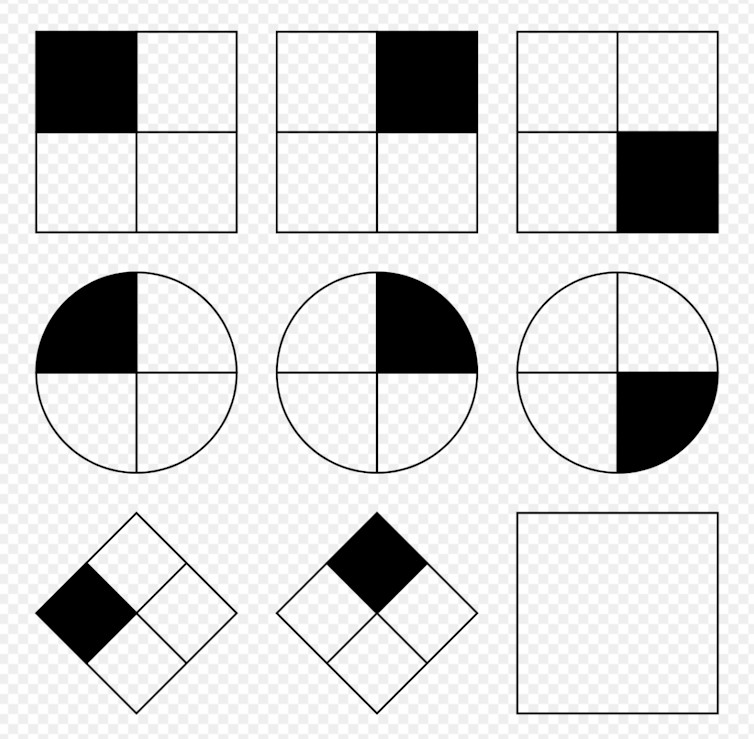
One version of an IQ test modeled after Raven’s Progressive Matrices.
Schools around the world — from the US and Britain to Singapore and Vietnam — use such tests for admissions. In the UK, for example, entry to many prestigious schools partly depends on a test like the notoriously difficult CAT4, which ten-year-old children take in the autumn of their final year of primary school. CAT4 takes about 2.5 hours and assesses verbal, non-verbal, quantitative reasoning, and spatial abilities. An average score is considered to be between 89 and 111, where exactly 100 is the norm for the child’s age.
How much children’s IQ fluctuates with age
The brain is the only organ that is not fully developed at birth. A newborn’s brain is roughly four times smaller than an adult’s and doubles in the first year of life, reaching 90% of adult size by age seven. But it’s not just about size: during this time, the brain is actively reorganizing neural connections and “pruning” some of them.

In childhood, the brain grows rapidly and reorganizes connections between neurons
This is also visible in the data. A 2015 analysis combining more than 100,000 students from 240 studies confirmed the link between intelligence and school grades. But the strength of this link depended on age: intelligence predicted academic performance in secondary school much better than in primary school. In other words, cognitive abilities in the first years of life are not stable.
Even more striking is a major 2024 analysis that compiled data from 205 studies and more than 85,000 people from 29 countries. The stability of cognitive abilities grows exponentially with age and is very low in the first decade of life. Simply put, a child’s position relative to peers changes significantly in childhood, so their IQ can shift noticeably. Stability increases through childhood and adolescence, plateaus around age 20, and remains high into old age.
Even in adolescence, when scores are already becoming more stable, IQ can fluctuate by up to 20 points. For example, a score of 100 is roughly the 50th percentile, while 120 is already the 91st — a huge jump. In one study, such shifts coincided with physical changes in the brain.
The conclusion follows: making long-term predictions based on a single test is risky. Admissions decisions based on a single unstable metric lead to systematic errors. Worse still, the metric can be “gamed”: research shows that a simple retest can raise a result by about eight IQ points, and parents with resources are better positioned to prepare their children for this.
The myth of the child prodigy destined for greatness
The most direct refutation of the “genius from childhood” idea is a 2025 study that combined data on more than 34,000 elite performers: from Nobel laureates and chess players to composers and athletes. It turned out that exceptional results in childhood weakly predict elite-level performance in adulthood.
The numbers are striking: About 90% of those who excelled in youth did not achieve comparable status as adults. Similarly, 90% of top high school students stopped being top performers in university. Moreover, several Nobel laureates and elite athletes had childhood results that were even lower than those of their peers.
The paths to the top also diverged. Early outstanding talent was associated with intensive, narrowly specialized training from an early age. On the other hand, among those who reached world-class level as adults, there were more often people with more diverse practice and gradual growth. For early selection systems, this is bad news: they may miss many future innovators.
What actually influences a child’s intelligence
If IQ is so plastic, it’s logical to ask: what drives it? The answer is environment. A classic example is a study by pediatrician Herbert Needleman in 1979, which provided the first reliable evidence that lead harms children’s cognitive abilities even at levels considered safe. By comparing lead content in baby teeth, scientists showed that children with higher levels scored approximately four points lower on IQ tests. These findings influenced the ban on lead in gasoline and paint in the US.

Reading and communicating with a child significantly affect early development
Nature walks, physical activity, and nutrition have also been linked to development — though with mixed results. But the most widespread and successful intervention, received by more than 85% of children worldwide, is education. Combining data from more than 600,000 people, researchers