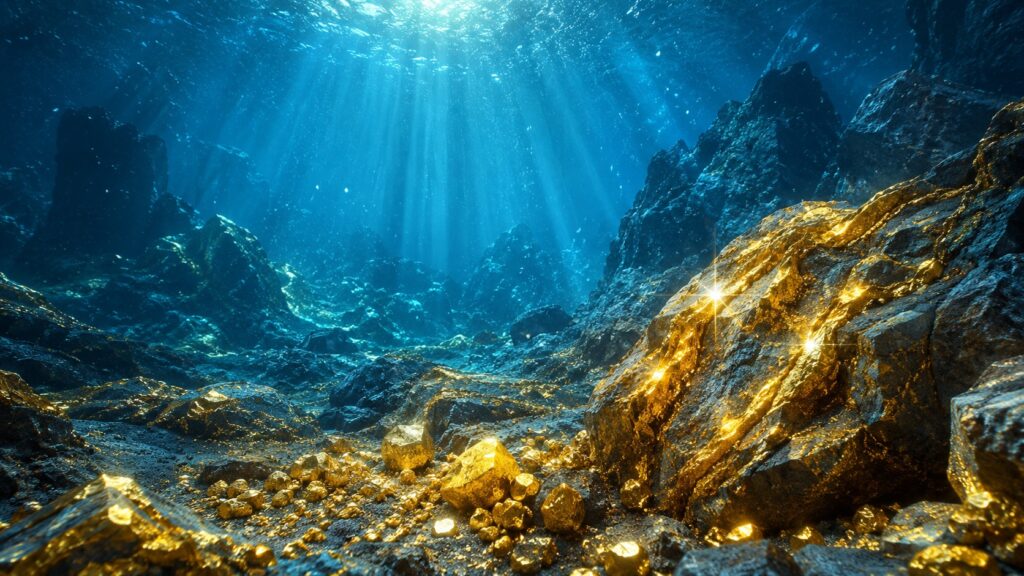
Gold found under Japan’s waters, but in microscopic form
In an underwater volcanic crater off the coast of Japan, researchers have found record-high gold reserves that are impossible to see even under a regular microscope. The precious metal is hidden at the atomic level inside other minerals, forming so-called invisible gold. This discovery makes the region attractive to industrialists but is raising alarms among environmentalists.
How Gold Forms in Underwater Volcanoes
On the ocean floor, where hot thermal springs break through the Earth’s crust, hydrothermal vents known as black smokers form. They release streams of fluids saturated to the limit with various metals. As these substances cool, they settle on the seabed and form sulfide minerals, the most common of which is pyrite.
Due to its characteristic luster and yellowish tint, pyrite has been called fool’s gold for centuries, as inexperienced prospectors often confused it with the real precious metal. However, new research has shown that this mineral is far from simple.
Using secondary ion mass spectrometry, Japanese researchers discovered that real gold is hidden inside pyrite in the form of nanoparticles. In some cases, it is even represented by individual atoms that are firmly embedded in the chemical structure of the rock.
Why the Higashi-Aogashima Crater Is of Interest to Scientists
The Higashi-Aogashima hydrothermal field was discovered in 2015 in Japan’s exclusive economic zone, approximately 350 kilometers south of Tokyo. Scientists from several leading Japanese universities collected rock samples from this submerged volcanic crater and conducted thorough chemical analysis.
It turned out that pyrite from the Higashi-Aogashima crater has the highest gold concentration in the world among all known underwater deposits. Furthermore, this section of the ocean is located at a relatively shallow depth compared to other zones typically considered for potential extraction.
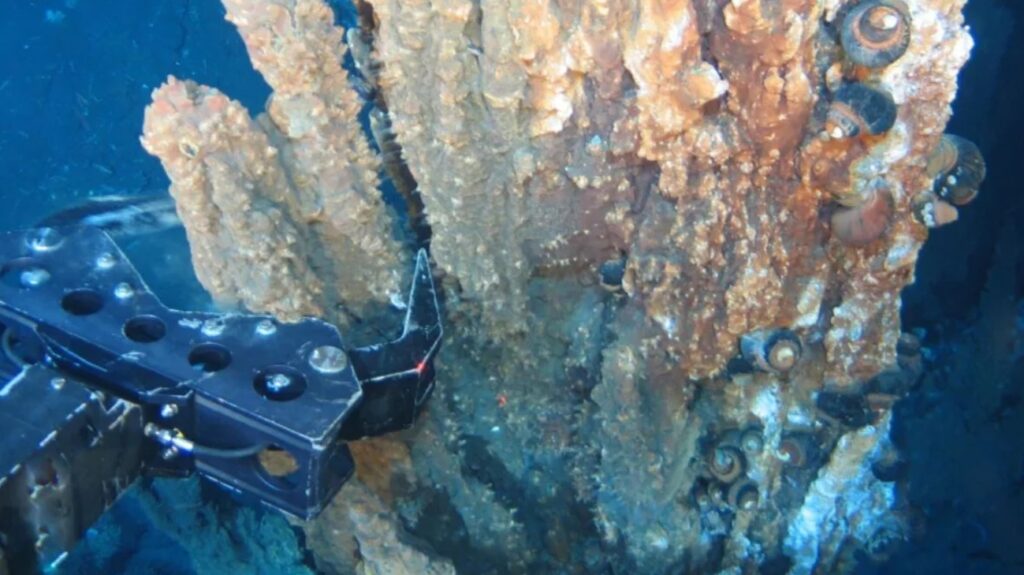
A robotic arm breaks off a piece of mineral-rich rock deep underwater
The high precious metal content and relative accessibility make this crater extremely attractive for creating the world’s first underwater mine. However, engineers still need to solve several technological challenges:
- learn to extract gold from the atomic structure of pyrite without enormous energy costs;
- create reliable robotic equipment for heavy work at depth;
- develop a system for safely transporting ore to the surface of ships.
The Dangers of Deep-Sea Mining
Despite the tempting prospects and advanced technologies, there is currently not a single operating commercial mine on the ocean floor anywhere in the world. The main obstacle remains serious environmental risks. Active hydrothermal sources are full-fledged oases of life in the cold ocean abyss.
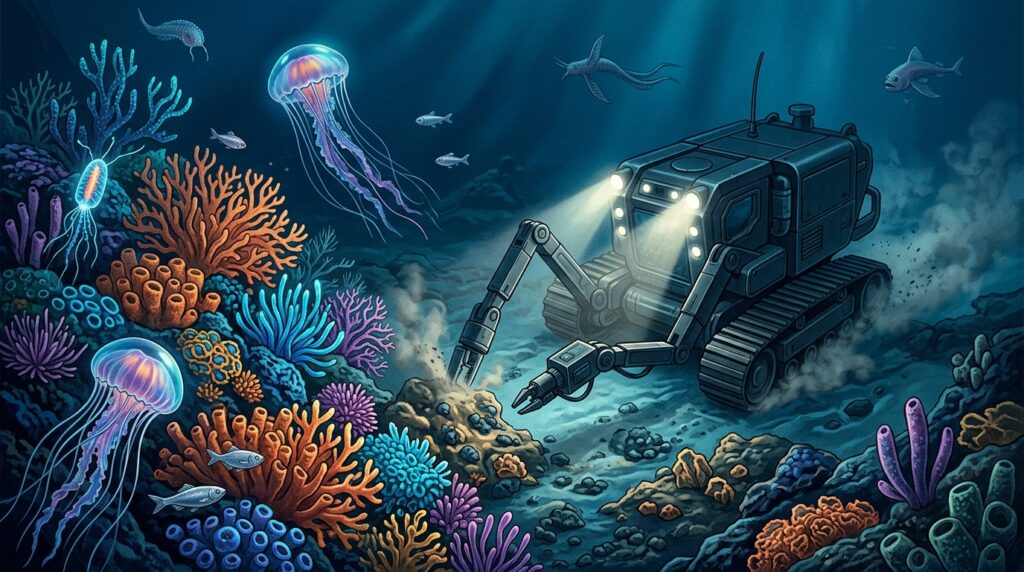
Deep-sea mining could disrupt the balance of unexplored ecosystems
Unique ecosystems independent of sunlight form around thermal vents. They are home to specific species of crustaceans, giant tube worms, sponges, and deep-sea octopuses. Commercial exploitation of the seabed could destroy these habitats before biologists have a chance to fully study them and understand the survival strategies of local species.
History already has examples of failed attempts to invade ocean depths. Several years ago, a project to create an underwater mine off the coast of Papua New Guinea ended in financial collapse and massive environmental protests. As a result, the island nation lost approximately 85 million dollars.
Today, many Pacific nations support a moratorium on deep-sea mining at least until 2030 to give scientists time to assess the risks. Nevertheless, Japan continues to actively fund geological research of the ocean floor.