Despite having one fewer rear lens than the iPhone 18 Pro, the foldable iPhone Duo produces daylight photos that most people would struggle to tell apart from the Pro’s. That is the conclusion of professional photographer Tyler Stalman, who shot the same scenes on both phones. The real gaps appear elsewhere: the Duo needs longer exposures in low light, has a weaker front camera, lacks ProRAW and ProRes, and has no telephoto lens at all. Below is what the comparison shows, where the Duo keeps up, and who is likely to notice the difference.
What you need to know
- In a daylight portrait, Stalman found almost no difference in color, skin, or detail between the iPhone Duo and the iPhone 18 Pro. He said the Pro has a bigger, better sensor but most people will not see the difference.
- At dusk, the iPhone 18 Pro shot at f/1.5 and 1/30 s, while the Duo needed 1/15 s at f/1.6, an exposure twice as long and more prone to blur.
- According to Apple, the Duo uses the same 48 MP, 13 mm ultra-wide camera as the Pro models, and Stalman rated its ultra-wide and macro quality as effectively on par with the Pro.
- The Duo has no telephoto lens, relying on a 12 MP 2x crop and digital zoom up to 10x, and it lacks ProRAW and ProRes.
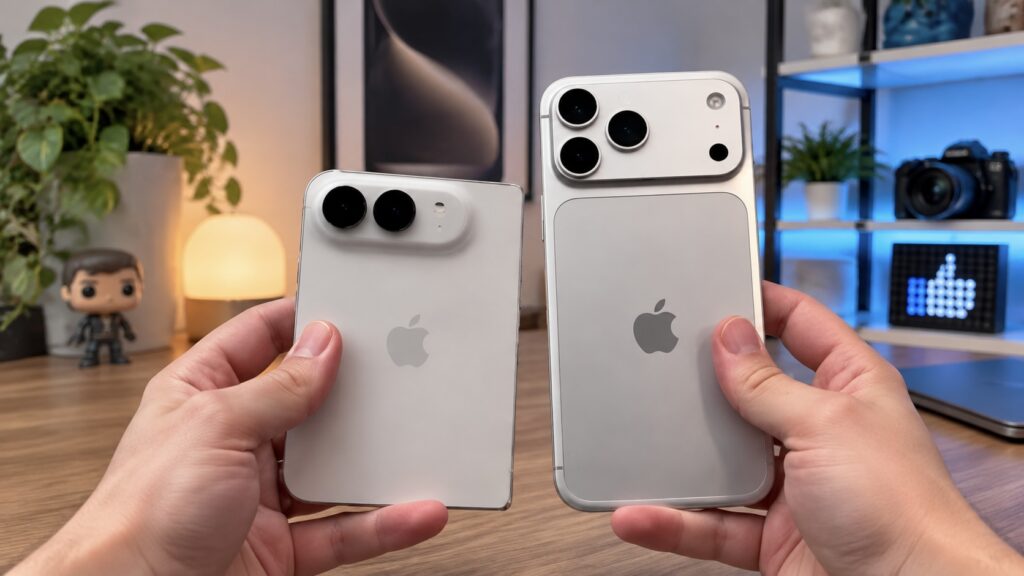
A white iPhone Duo with two cameras and an iPhone 18 Pro with three cameras held in hand, rear view
Two lenses versus three, and that is not the only difference
Stalman compared the Duo with the iPhone 18 Pro, not the Pro Max. Before looking at the photos, it helps to see what each phone actually has on the back.
| Camera | iPhone Duo | iPhone 18 Pro |
|---|---|---|
| Main | 48 MP, 26 mm, f/1.6 | 48 MP, 24 mm, variable aperture f/1.48-f/4 |
| Ultra-wide | 48 MP, 13 mm, f/2.2 | 48 MP, 13 mm, f/2.2 |
| Zoom | 2x crop from the main camera (12 MP) | Dedicated telephoto, 4x and 8x |
| Front | 12 MP, f/2.2, Center Stage | 18 MP, Center Stage |
| ProRAW and ProRes | No | Yes |
On paper, the gap looks significant. The Duo has no telephoto lens, no variable aperture, which Apple introduced for the first time in the 18 Pro, and a lower-resolution front camera.
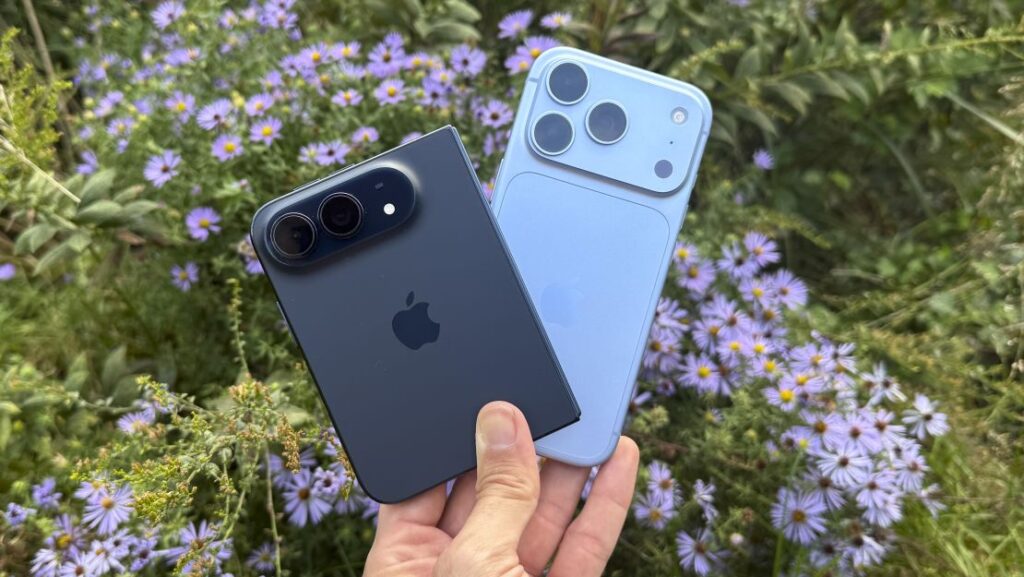
A dark blue iPhone Duo and a light blue iPhone 18 Pro held in hand against blooming asters
However, according to Apple, the ultra-wide camera is the same one used in the 18 Pro lineup. This is where the spec sheet starts to diverge from what the actual photos show.
In daylight, you have to zoom in to find the Pro’s advantage
Stalman’s first scene was an ordinary one: a portrait in a bright room of a man in a blue jacket, in front of a concrete column and a staircase. On the iPhone 18 Pro, he set the aperture to f/1.8, which resulted in a 1/129-second shutter speed. The Duo shot at its fixed f/1.6 with a 1/121-second shutter speed. The numbers are nearly identical, and so are the images.
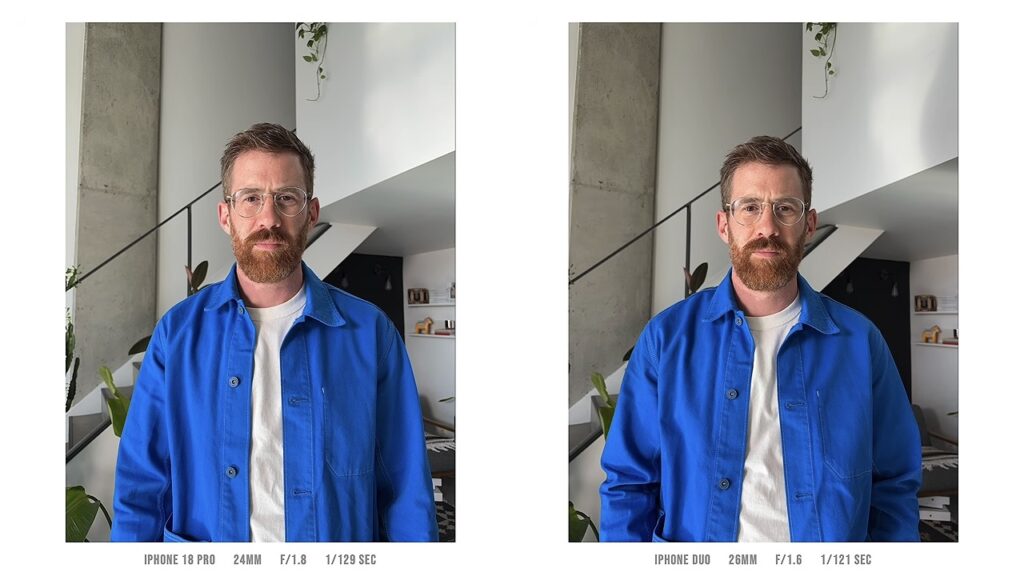
Portrait of a man in a blue jacket in a bright room: iPhone 18 Pro shot on the left, iPhone Duo on the right
The most visible difference here is focal length. The Duo’s main camera is 26 mm rather than 24 mm, so its frame is slightly tighter: the column on the left falls outside the edge, and the subject fills more of the shot. In the jacket’s color, the skin, and the beard, there is almost no difference. Stalman says plainly that the 18 Pro has a larger, better sensor, but that most people simply will not see the difference.
Reviewers at The Verge did note that the Duo applies more sharpening to compensate for its more modest hardware, so fine details look slightly “crunchy.” This is not noticeable on a phone screen; it shows up only at high magnification or on a large monitor.
After sunset, the Duo needs twice the exposure time
At night the picture changes, not so much in how bright the final frame is as in what it takes to get it. Stalman photographed a backyard at dusk: a wooden fence, string lights, and a fire pit in the middle of the lawn. The iPhone 18 Pro opened its aperture to f/1.5 and managed 1/30 of a second. The Duo, at f/1.6, needed 1/15 of a second, an exposure twice as long.
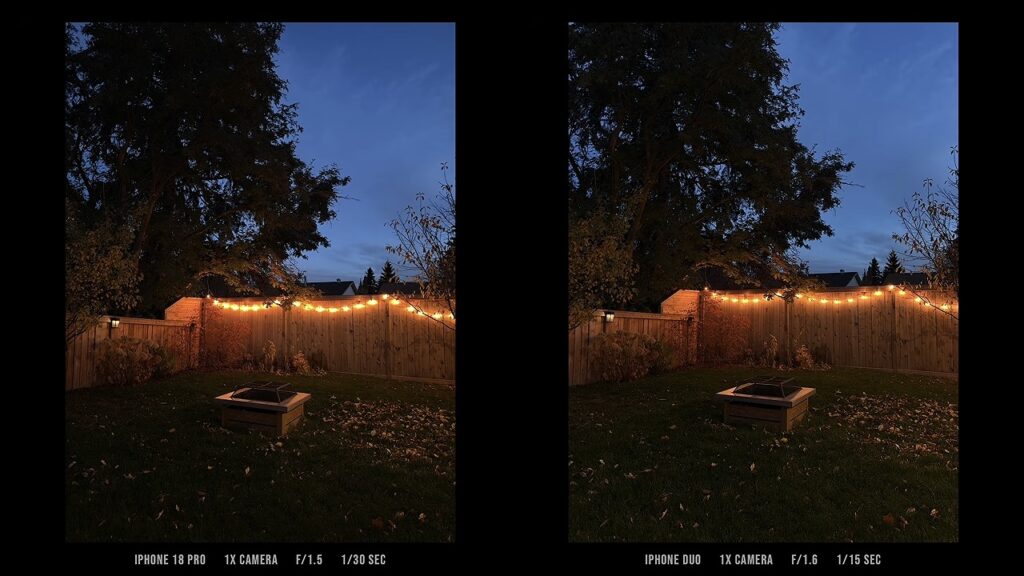
A backyard at dusk with string lights on a wooden fence: iPhone 18 Pro shot on the left, iPhone Duo on the right
At first glance, the final images look similar. Both show a blue sky, the string lights are not blown out, and the leaves on the grass are visible. But 1/15 of a second is borderline for handheld shooting: if your hand shakes, a branch sways, or someone walks through the frame, detail gets smeared. The Pro gains that margin from its larger sensor and the brightest aperture ever fitted to an iPhone. That is why Stalman says the Pro is better in the dark, while immediately adding that most owners are unlikely to notice the difference.
For a static scene like this one, the Duo is more than adequate. But if you often photograph children or pets indoors in the evening, the longer exposure will get in the way more often than you would like. For night landscapes, it is easier to rest the phone on something stable, and the Duo can stand on a table by itself when half-folded.
Same ultra-wide camera, and macro shows it best
The most surprising part of Stalman’s video concerns the ultra-wide camera. According to him, the Duo’s quality here is effectively the same as the Pro’s. That matches Apple’s information: the company uses the same 48-megapixel, 13 mm module in the foldable iPhone as in the Pro models. And since the ultra-wide camera handles macro shots, close-ups from the two phones come out at the same level.
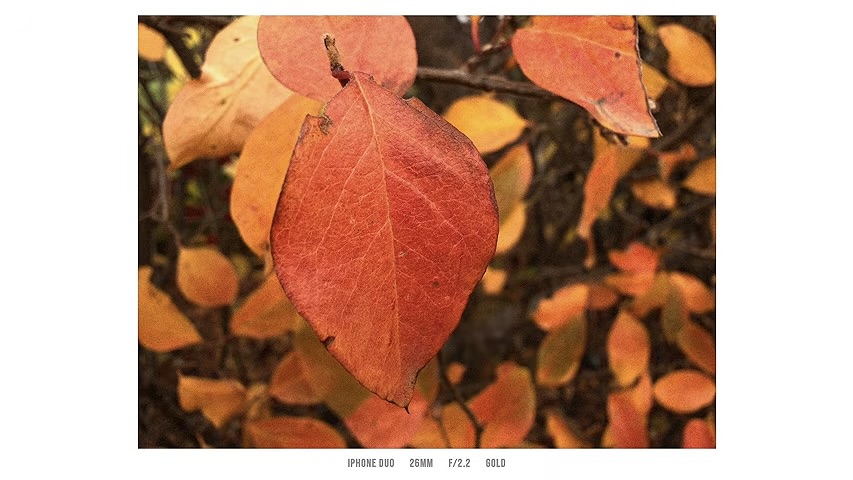
Close-up of a red autumn leaf, shot on iPhone Duo with the Gold style
In this shot, Stalman photographed an autumn leaf. The metadata lists 26 mm, but the f/2.2 aperture indicates that it was actually the ultra-wide camera working in macro mode, with the camera cropping the frame to the familiar field of view. The veins and the fine hairs along the leaf’s edge are visible, and the background falls into soft blur. The photo was taken with the Gold style from the third generation of Photographic Styles, which is why the orange and red tones are so rich.
Another moment in the video concerns white balance. Stalman showed a pile of fallen leaves on a lawn in two versions. With automatic white balance, the iPhone dutifully “corrected” the warm light, and the leaves turned into a pale beige mass. With daylight white balance, the golden color that made the scene worth photographing was preserved.
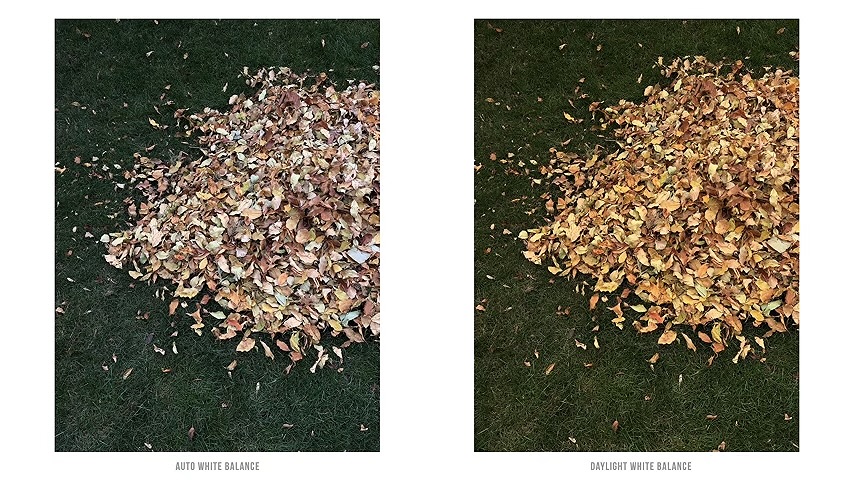
A pile of fallen leaves on a lawn: automatic white balance on the left, daylight white balance on the right
The takeaway is simple and applies to any iPhone: if an autumn photo looks dull when the scene was vivid in real life, do not rush to blame the camera. Try a warm Photographic Style or adjust the tone in the editor to recover much of the original look.
The front camera is weaker, but the Duo needs it less
The Duo’s front camera is clearly worse. Instead of the 18 MP found on the iPhone 17 Pro and 18 Pro, it has 12 MP. In Stalman’s assessment, selfies come out at roughly the level of iPhones before the 17 series. On the plus side, Center Stage is present, and automatic framing works in any orientation. As for the camera under the inner display, Marques Brownlee went as far as calling it garbage for photos, best left for FaceTime.
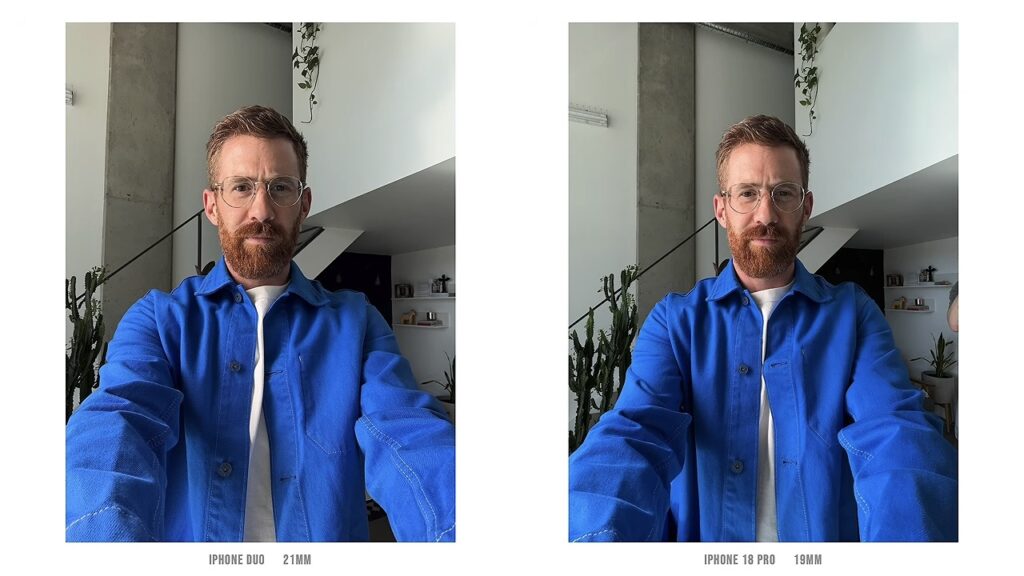
Selfie of a man in a blue jacket: iPhone Duo front camera on the left, iPhone 18 Pro on the right
The comparison also shows that the Duo’s front camera is slightly narrower: 21 mm versus 19 mm on the Pro. The 18 Pro fits more of the room into the frame, which matters for group selfies of three people. Skin tones on the Duo came out slightly pinker, though that is a matter of taste.
But the foldable iPhone has an advantage the Pro physically cannot offer. Thanks to its second screen, you can take selfies with the main or ultra-wide rear camera and frame the shot using the outer display. That means 48 MP and a very different level of quality. In the shot below, Stalman photographed himself with the ultra-wide camera: the metadata shows 14 mm and f/2.2, and the entire room fits in the frame, from the ceiling light to the wardrobe.
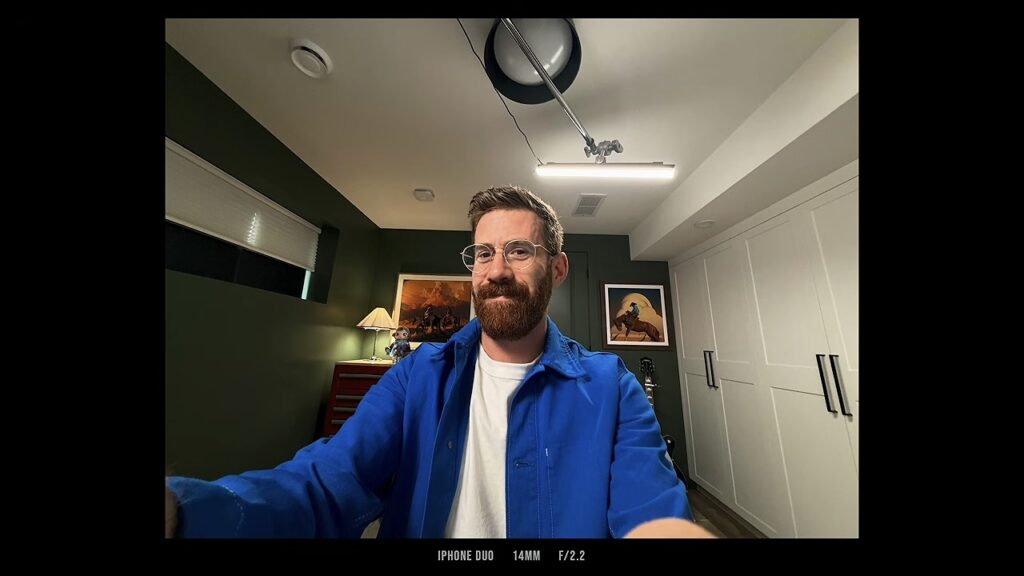
A man photographing himself with the iPhone Duo’s rear ultra-wide camera in a room with green walls
Stalman calls this a genuine advantage of the Duo. The outer screen also works the other way: a feature called Duo Preview shows the person you are photographing how they look in the frame. They can fix their hair or step back on their own, without waiting for you to turn the phone around and show them the result.
The missing telephoto lens matters more than the sensor
The Duo’s biggest loss is not main-camera quality but the absence of a telephoto lens. The 2x crop from the main sensor delivers a respectable 12 MP, but beyond that it relies on digital zoom up to 10x. The 18 Pro has a dedicated module with 4x and 8x for this. At a concert, with a child on stage, or with a bird on a branch, the foldable iPhone will lose outright.
The second limitation affects serious shooters. The Duo has no ProRAW or ProRes, and reviewer David Imel called this a disappointment for a $2,000 smartphone. For a creator who edits videos with color grading, this is a strong argument in favor of the Pro. For everyone else, the omission will barely register.
Who each phone suits
Based on Stalman’s comparison, the Duo suits people who mostly photograph people, interiors, food, and outings in decent light. In those conditions, it is barely distinguishable from the 18 Pro, and for selfies taken with the main camera it can even be more convenient. The Pro is the better choice if you often shoot moving subjects in the evening, rely on zoom, or work with RAW files.