The Xiaomi Watch S5 does not reach the 21 days of battery life Xiaomi advertised, but it still lasts about two weeks with sleep tracking, heart-rate monitoring and regular workouts. The source author reached that conclusion after five months with the watch. The author also found its heart-rate sensor and GPS far more accurate than expected at its price. The trade-offs come from Xiaomi’s own operating system: no third-party apps, no message replies, and no ECG.
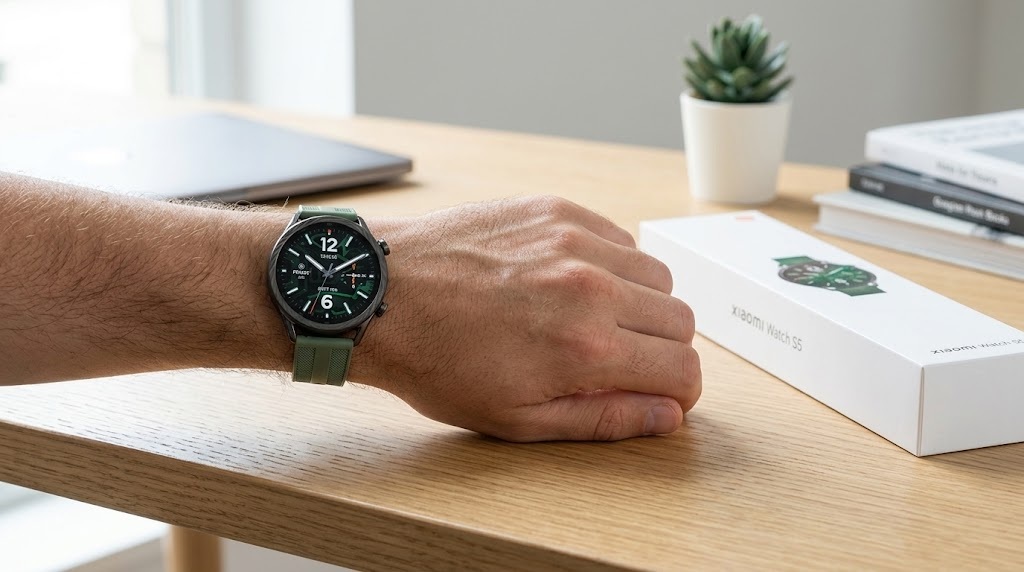
Xiaomi Watch S5 with its box
What you need to know
- Xiaomi advertises up to 21 days of battery life. The company itself says to expect about 14 days with typical use and about 9 with the always-on display enabled. The source author got about 15 and 10 days respectively.
- The source author reports that resting, average and maximum heart rate matched a Polar H10 chest strap. The author also says GPS tracks were close to those from a Garmin Forerunner 970.
- The watch runs Xiaomi’s own system rather than Wear OS. It has no third-party apps, no message replies, no chest-strap pairing, and no ECG, blood pressure or temperature measurement.
- In Europe, the black and silver versions cost €179.99. The Jungle Green and Ceramic Blue versions cost €199.99.
What Xiaomi promised and what the watch costs
When the Watch S5 launched globally in the spring, it looked close to ideal on paper. Its headline features were:
- up to 21 days between charges;
- a 46 mm stainless steel case;
- a 1.48-inch AMOLED display rated at 2,500 nits;
- an 815 mAh battery;
- dual-band GPS;
- a new heart-rate sensor.
It was also priced noticeably below Wear OS competitors. In Europe, the black and silver versions cost €179.99, while the Jungle Green and Ceramic Blue versions cost €199.99.
All four versions have identical internals and differ only in bezel finish and strap. The source author would not pay extra for a colour. The watch uses standard 22 mm straps, and straps from the previous Watch S4 also fit, so the look is cheap to change later.
Size is a bigger consideration. The watch comes only in a 46 mm case. The author says it looks substantial on a larger wrist but may feel too big on a slim one.

Battery life: about two weeks is the honest figure
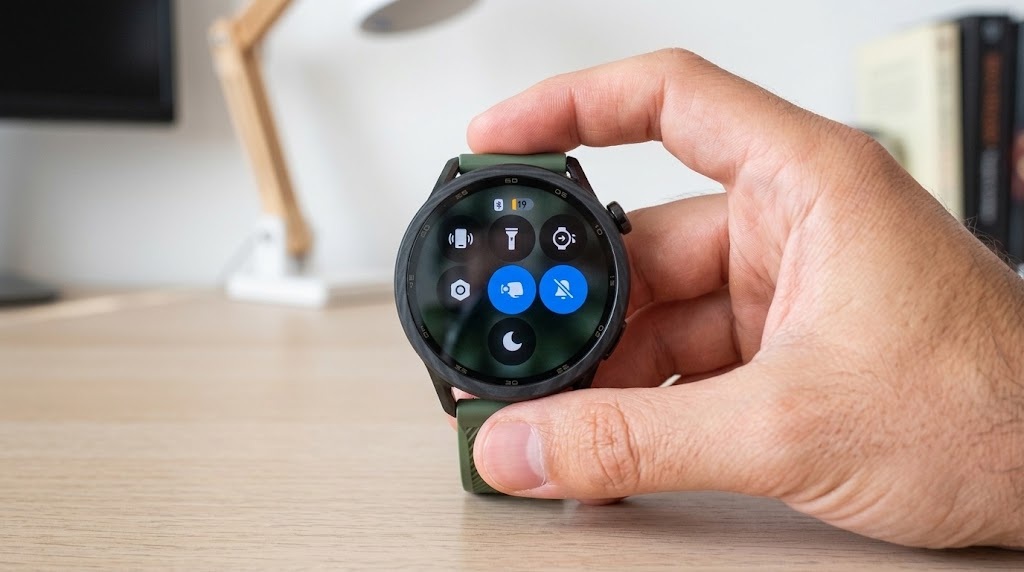
Remaining battery charge after a week of active use
According to the source author, the 21-day figure applies to a mode in which the watch does almost nothing. Xiaomi itself notes that typical use should give about 14 days, and about 9 days with the always-on display. The author reports these real-world results:
- Worn around the clock with sleep and heart-rate tracking and several workouts a week, the watch lasted about 15 days.
- With the always-on display enabled, it lasted about 10 days.
- After about four hours of GPS running and walking in a week, more than 10% charge remained on the eighth day.
In the author’s view, that is several times longer than Wear OS watches, which need charging every day or two. The author calls it the strongest argument for the Watch S5, since charging comes up only a couple of times a month.
The one thing the author would change is the cable. The magnetic charging puck uses a USB-A connector, so a modern USB-C charger requires an adapter. The watch charges almost fully in about an hour and reaches 100% in about 80 minutes.
Display: readable in sunlight, with a few caveats
The author considers the display one of the watch’s strengths. Brightness comes close to the claimed 2,500 nits, so the screen is easy to read in sunlight. Touch input works even with wet fingers, and a rotating crown allows scrolling, like on a traditional watch.
There are drawbacks:
- Night brightness: the minimum brightness of about 7 nits could be lower for night use.
- Flicker: at reduced brightness, the screen flickers at 60 Hz. Most people will not notice, but the author advises keeping this in mind if flicker tires your eyes.
- Glass: the cover glass is ordinary rather than sapphire, and the author recommends a screen protector against scratches.
Heart-rate and GPS accuracy
This is where the Watch S5 surprised the source author most. The author reports that resting, average and maximum heart rate matched a Polar H10 chest strap down to the beat, and that blood oxygen readings matched a medical pulse oximeter. These are the author’s own comparisons, not a formal validation study.

The author expected only rough accuracy at this price and instead found what they describe as nearly sports-grade precision. The sensor responds slightly more slowly to sudden heart-rate spikes, which the author considers unimportant for running, cycling and walking.
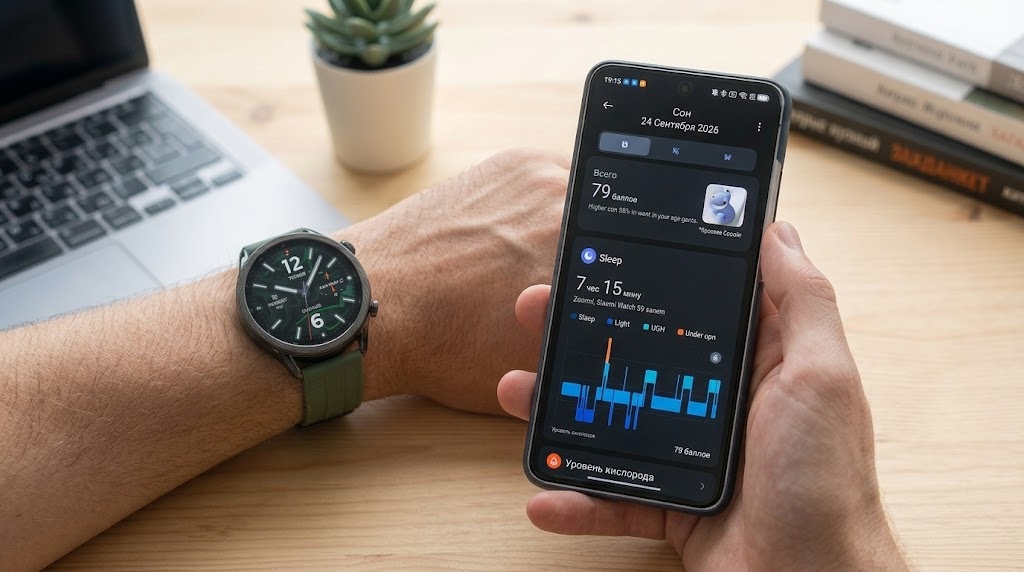
Sleep quality analysis from a Xiaomi smartwatch
The author also stresses that fit matters. If the strap is loose, any sensor will produce errors.
The author reports similar results for navigation. The watch acquires satellites in 6–7 seconds, and its tracks look almost the same as those from the Garmin Forerunner 970, a sports watch that costs several times more.
Runners also get metrics the author describes as rare at this price:
- ground contact time;
- vertical oscillation;
- cadence.
Sleep tracking is detailed. At the end of each week, the watch assigns you a “sleep animal”. The author finds these ratings sometimes debatable and treats the feature mostly as entertainment.

What the Watch S5 cannot do
The Watch S5 runs Xiaomi’s own operating system rather than Wear OS. That explains both its battery life and these limitations:
- third-party apps cannot be installed, so you are limited to what ships on the watch;
- messages can be read but not replied to;
- a chest heart-rate strap cannot be paired;
- there is no ECG, blood pressure or temperature measurement;
- offline maps are basic and lack detailed hiking trails.
The watch has NFC, but according to the source it works only with Visa and Mastercard cards.
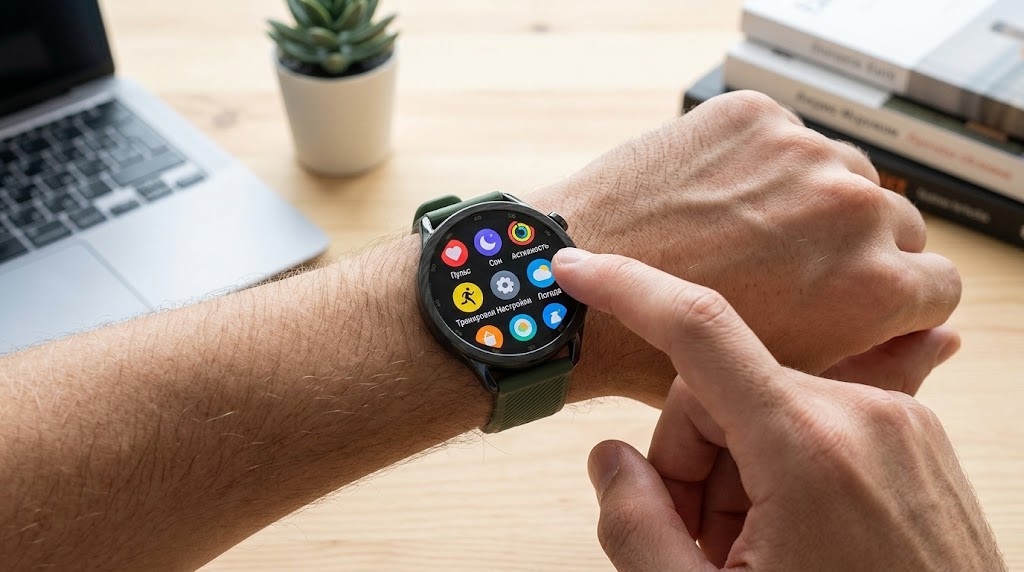
The menu on the Xiaomi Watch S5
The author says the watch handles everyday basics well. Notifications arrive reliably, and you can answer calls from your wrist. The watch works with both Android phones and iPhones through the Mi Fitness app.
Who the Watch S5 suits
The source author calls the Watch S5 the best watch in its price range, and not only because of the battery. It combines a steel case, a bright display, about two weeks between charges, chest-strap-level heart-rate readings in the author’s tests and GPS close to a Garmin sports watch. The author recommends it for people who:
- are tired of charging a watch every evening;
- run, walk or cycle and want accurate data without extra hassle;
- want to track heart rate, sleep and workouts rather than install apps;
- want a watch that looks more expensive than it is.
If apps, message replies and ECG matter most, the author suggests paying more for a Wear OS model such as the OnePlus Watch 4. The trade-off is charging it several times more often.