Apple has sent out invitations for a Mac and iPad mini press event on Wednesday, October 28, and reports ahead of it point to the company’s first MacBook Pro that can be controlled by touch. That would reverse a position Apple has defended since 2010, when Steve Jobs argued that vertical touchscreens simply do not work. According to Bloomberg’s Mark Gurman, Apple’s approach is designed to address that old objection, with touch added as a supplement to the keyboard and trackpad rather than a replacement. The invitation itself is confirmed. The touchscreen model, its name, its features, and its release date have not been announced, so they should be treated as reports until Apple publishes details.
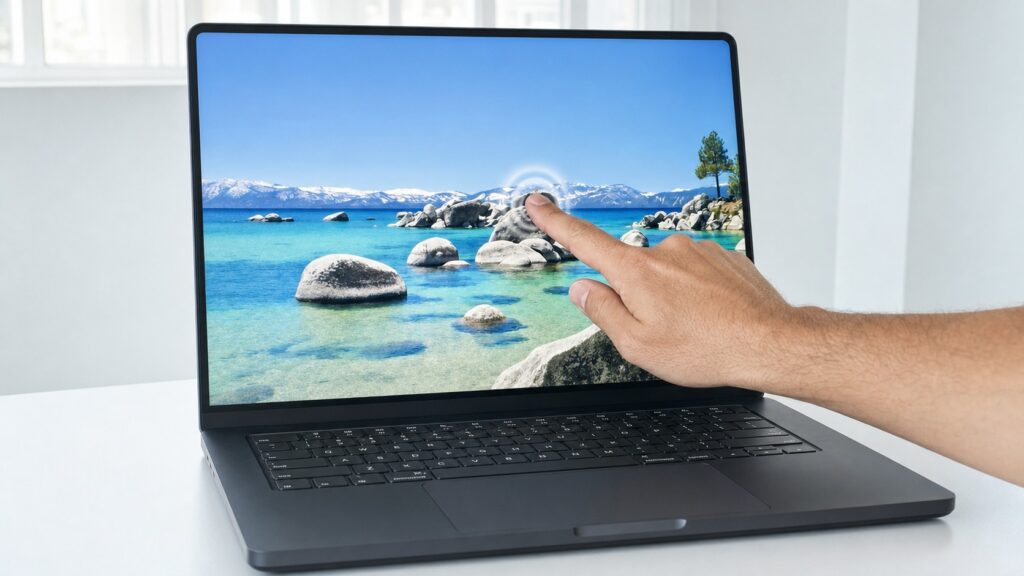
A finger touching a MacBook Pro screen
What you need to know
- Apple sent out invitations on October 19 for a hands-on press event in Los Angeles on Wednesday, October 28, starting at 10:00 a.m. Pacific time.
- Reports say touch support will be limited to new 14- and 16-inch MacBook Pro models with OLED screens, a Dynamic Island, and M5 Pro and M5 Max chips.
- Bloomberg’s Mark Gurman reports that tapping a button or slider will bring up a contextual menu around the user’s finger, and that menu bar items will enlarge when touched.
- Sales could begin on Friday, November 6, but that date is a forecast based on a reported Apple Store reset scheduled for the evening of November 5.
Steve Jobs’ case against the touchscreen Mac
In October 2010, at Apple’s Back to the Mac event, Steve Jobs explained why the Mac had no touchscreen. He said Apple had run extensive user testing and the conclusion was clear: vertical touchscreens do not work. They look great in a demo, he argued, but the user’s arm soon gets tired, and after a while it feels like it wants to fall off. Apple invested in large multi-touch trackpads instead, which the original report’s author calls the best on the market.
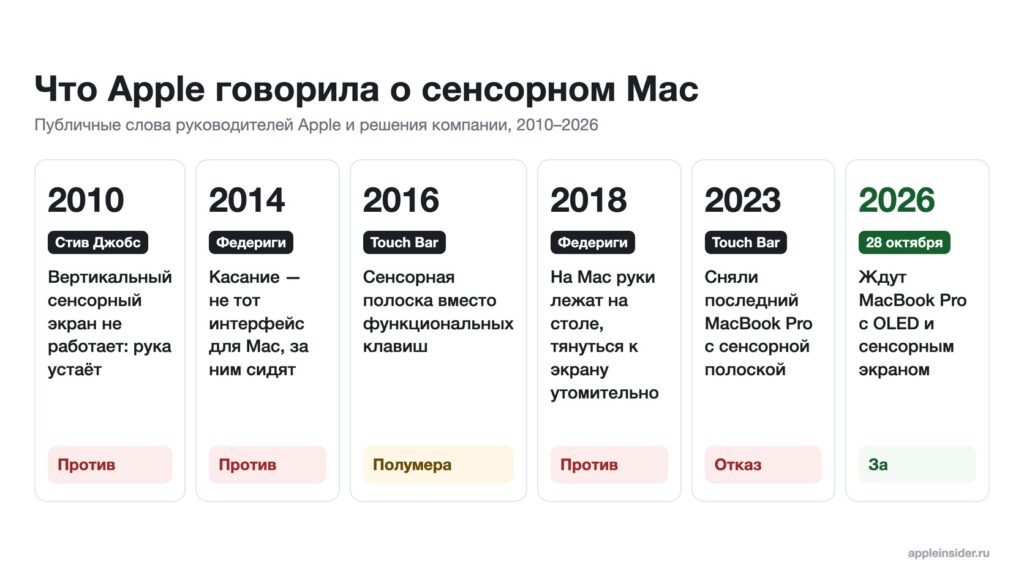
Timeline of Apple’s statements on a touchscreen Mac
Apple kept that position for years after Jobs. In 2014, Craig Federighi, Apple’s head of software, said the company did not consider touch the right interface for the Mac, because a Mac is something you sit at rather than hold. In 2018, he made the same point in different words: on a Mac, your hands rest on the desk, and reaching up to the screen is tiring.
The Touch Bar: Apple’s only concession
The one exception was the Touch Bar. In 2016, Apple replaced the function-key row on the MacBook Pro with a touch-sensitive strip, which was not a touchscreen. It never really caught on. Apple dropped it from the 14- and 16-inch models in 2021, and the last 13-inch MacBook Pro with a Touch Bar was discontinued in October 2023. After that history, a touchscreen MacBook looked unlikely.
The invitation: a hands-on event, not a keynote
Apple sent invitations to journalists on October 19. Greg Joswiak, Apple’s head of marketing, also posted a video with a caption saying he couldn’t wait to “pro and tell” next week. The phrase is a play on “show and tell,” the school activity where children bring an object to class and talk about it. The event takes place on Wednesday, October 28, in Los Angeles, starting at 10:00 a.m. Pacific time.
Apple’s invitation to the October 28 event
This is not expected to be a conventional presentation. There will most likely be no big stage and no video stream. Apple has invited journalists to try out new Macs and an iPad mini, and the products themselves are expected to be announced through press releases, as Apple did with HomeView on October 13. The announcements will probably appear on Apple’s website around the time the event begins.
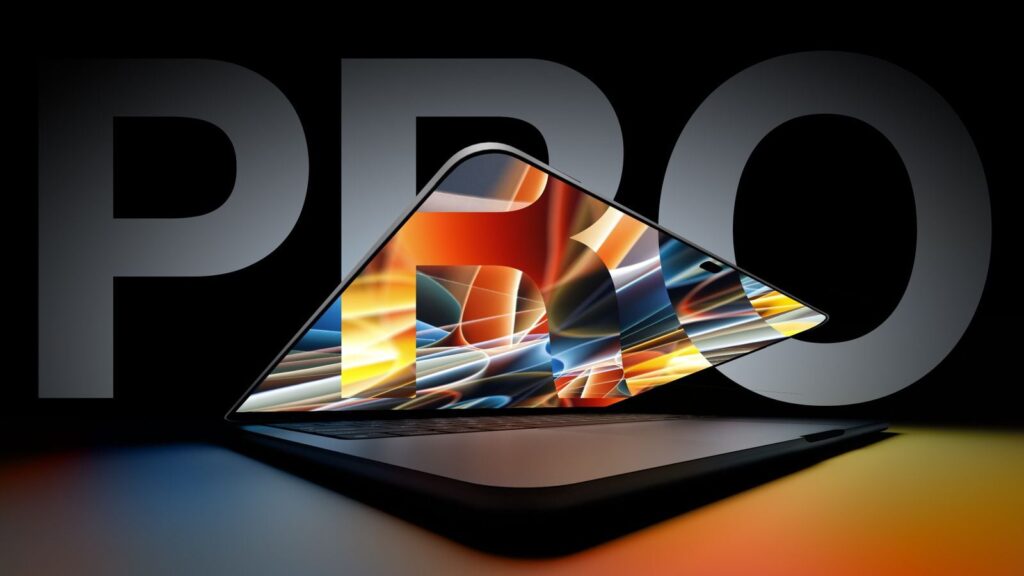
Render of an OLED MacBook Pro, partly open
The tagline also hints at the product name. Rumors throughout the year have called the touchscreen model the “MacBook Ultra,” but the word “Pro” in the invitation suggests the existing name will stay. The original report points to a similar case with the iPhone, where an “iPhone Ultra” was expected but the product arrived as the iPhone Duo. This is an interpretation of the tagline, not an Apple confirmation.
What Apple is expected to announce
The expected lineup has changed little since Bloomberg first reported the date of Apple’s second October event. According to those reports, it includes:
- 14- and 16-inch MacBook Pro models with OLED screens and touch support. They would be the first to use a Dynamic Island instead of a notch, would be noticeably lighter than current models, and would use M5 Pro and M5 Max chips.
- A standard 14-inch MacBook Pro with an M6 chip and an unchanged exterior.
- An iMac with an M6 chip, also without a redesign.
- An iPad mini with an OLED screen, new speakers, and a relocated front camera.
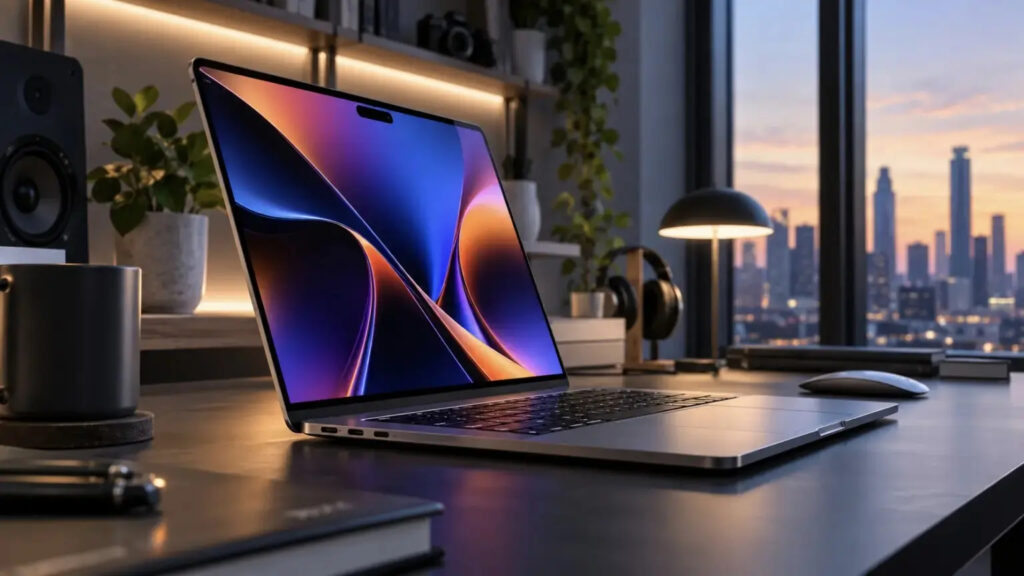
Render of an OLED MacBook Pro with Dynamic Island
Touch only on the high-end models
If these reports are accurate, touch will be available only on the higher-end models. The entry-level MacBook Pro would not get it, although it would have a newer chip than the more expensive versions. Rumors also say the laptop’s Dynamic Island will be slightly smaller than the iPhone’s and will not include Face ID, so unlocking would still rely on Touch ID. The new iPad mini is also expected to be noticeably more expensive, possibly costing more than the iPad Air.
Possible release date
The new devices could go on sale as early as Friday, November 6. According to Bloomberg’s Mark Gurman, Apple has scheduled a reset of its retail stores for the evening of November 5, which is typically how stores prepare displays for new products. Until Apple makes an official announcement, this remains a forecast, though a gap of about one week between announcement and sales is common for Macs.
How Apple plans to answer Jobs’ “tired arm” problem
The key question is how Apple intends to avoid the arm fatigue Jobs described. The keyboard and trackpad are expected to stay, with touch complementing them rather than replacing them. According to Gurman, when a user taps a button or slider, a new menu with relevant commands will appear around their finger. Tapping the menu bar at the top of the screen will enlarge its items so they are easier to hit.
Signs of preparation are already visible in Apple’s software. macOS 27 added touch input in Sidecar, pull-to-refresh for lists, and larger menu bar items, and touch gestures for finger control were found in the macOS 27.2 beta. In the original author’s view, Apple is reworking the operating system in advance so that it does not have to explain why the screen is there on launch day.
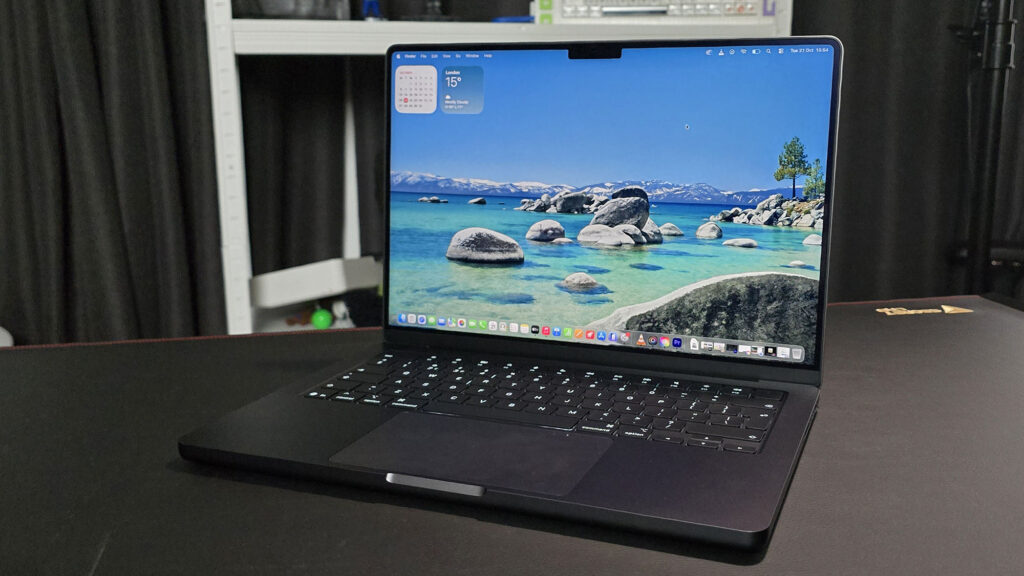
The current MacBook Pro with a mini-LED display
The original author argues that Jobs was only half right. Nobody will hold an arm up to a screen all day, but tapping a Send button, scrolling through photos, or nudging a window with a finger, without hunting for the cursor, is simply convenient on a laptop. The author adds that in the 16 years since 2010, people have developed a habit of touching every screen they see, from ATMs to car dashboards.
Why waiting may make sense
The original author advises against buying in the first days. Apple’s first-generation ideas do not always work out, and the Touch Bar is one example. A model that combines a touchscreen, an OLED panel, and a new chassis means that early buyers, not press releases, will reveal any problems. Rumors also suggest that Apple could release a more affordable version of the new design with an M7 chip in spring 2027, which would widen the choice.
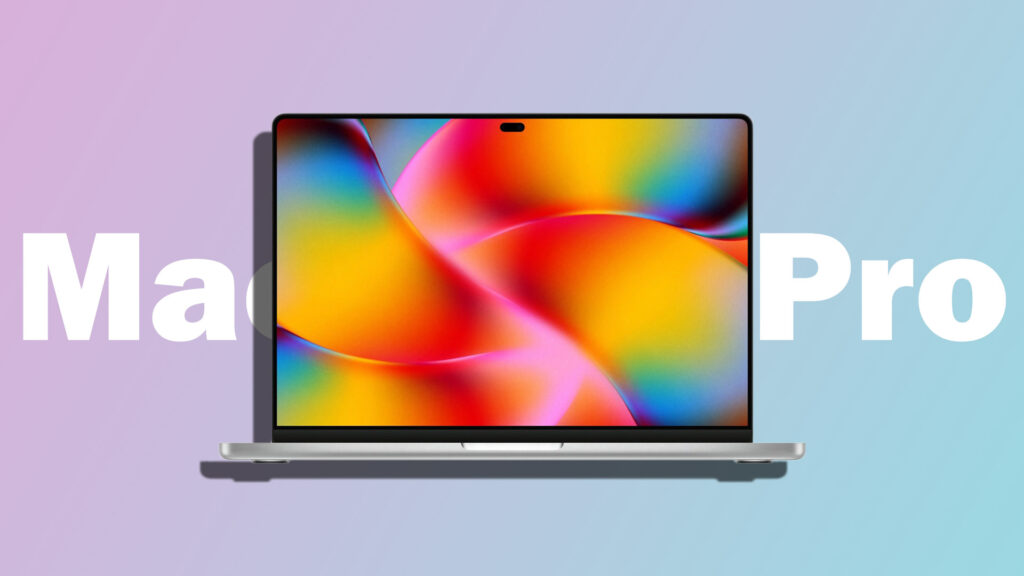
A possible design for the OLED MacBook Pro
The original author’s overall view is that Apple has finally done something long overdue, in its own way: rather than turning the Mac into an iPad with a keyboard, it appears to be adding touch where it saves a few seconds. The author suggests that if the approach succeeds, a non-touch laptop screen could feel as dated within a couple of years as a push-button phone. That remains an opinion. Whether Apple’s design actually solves the ergonomic problem Jobs identified will only become clear once the devices are officially announced and in users’ hands.