Scientists revealed a cosmic mystery: what actually causes mass extinctions on Earth
When it comes to mass extinctions, the first thing that comes to mind is the asteroid that killed the dinosaurs. But not every extinction has its own crater, and this has long troubled scientists. A new study offers an unusual explanation: some catastrophes may have been caused not by impacts from space, but by gravitational tides from large bodies that flew close to Earth.
Dwarf Planets as a New Hypothesis About Mass Extinctions
The idea was proposed by Daniele Fargion, a theoretical physicist from the University of Rome, in a preprint — meaning a paper that has not yet undergone full peer review. An important caveat right away: this is a hypothesis, not a proven fact, and it should be treated with caution.
Here’s the gist. In the distant reaches of the Solar System, there exists a vast population of objects the size of dwarf planets — the most famous being Pluto. There could be thousands or even tens of thousands of such bodies, and they move along highly elongated orbits. Gravitational perturbations can sometimes send some of them into the inner Solar System — closer to Earth.
A head-on collision is extremely rare. It’s far more likely that such a body would simply fly past Earth. According to the author, it’s precisely such a close flyby that could have left a noticeable mark on the planet’s history.
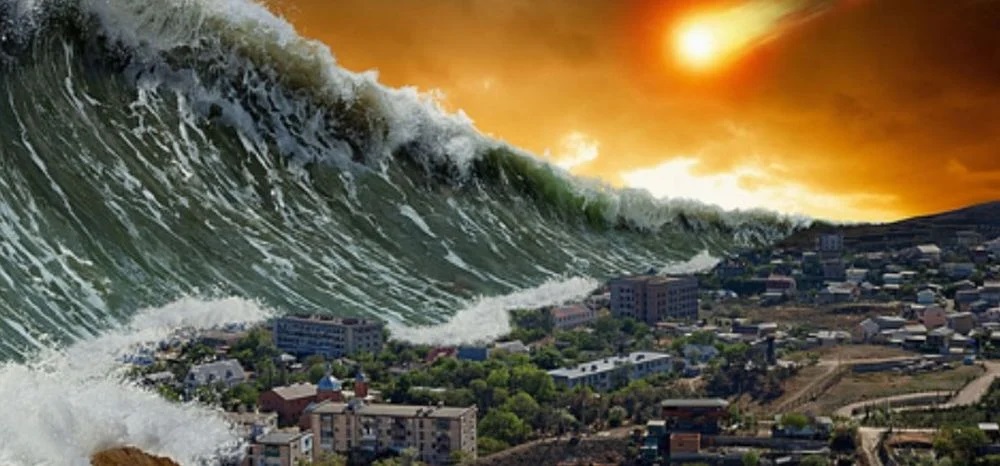
Illustration of a massive tidal wave resulting from the flyby of a planetary-mass object.
What Happens to Earth During a Close Flyby of a Large Body
The main mechanism here is tidal forces. It’s the same physics by which the Moon controls ocean tides, only on a much rougher and more destructive scale. When a body the size of a dwarf planet passes nearby, its gravity literally pulls at Earth’s water, crust, and interior.
Fargion lists the consequences such a flyby could have left behind:
- giant waves and global tsunamis that could circle the planet and persist for years
- massive volcanic eruptions due to crustal deformation and interior heating
- drastic sea level changes and ocean retreat
- severe climate disruptions
- coordinated meteor showers
Tidal heating of the interior is a key detail: when a planet is “squeezed” by another body’s gravity, heat is generated inside, and this can trigger massive volcanism. According to the author, such tidal effects could have contributed to several major extinctions over the past 600 million years — hinted at, as he believes, by strange coincidences in the geological record.
The Permian Extinction Without a Crater or Asteroid Evidence
The most interesting argument relates to a gap in science. With the dinosaurs, everything is clear: there’s the Chicxulub crater and the so-called iridium anomaly — a thin layer of a rare metal that arrived on Earth with the asteroid, confirming the impact roughly 64–66 million years ago.
But with other catastrophes, there’s less clarity. The Permian-Triassic extinction about 251 million years ago was the largest in the history of life: by various estimates, 80 to 95% of all species disappeared. But neither an iridium anomaly nor a suitable crater has ever been found for this event.
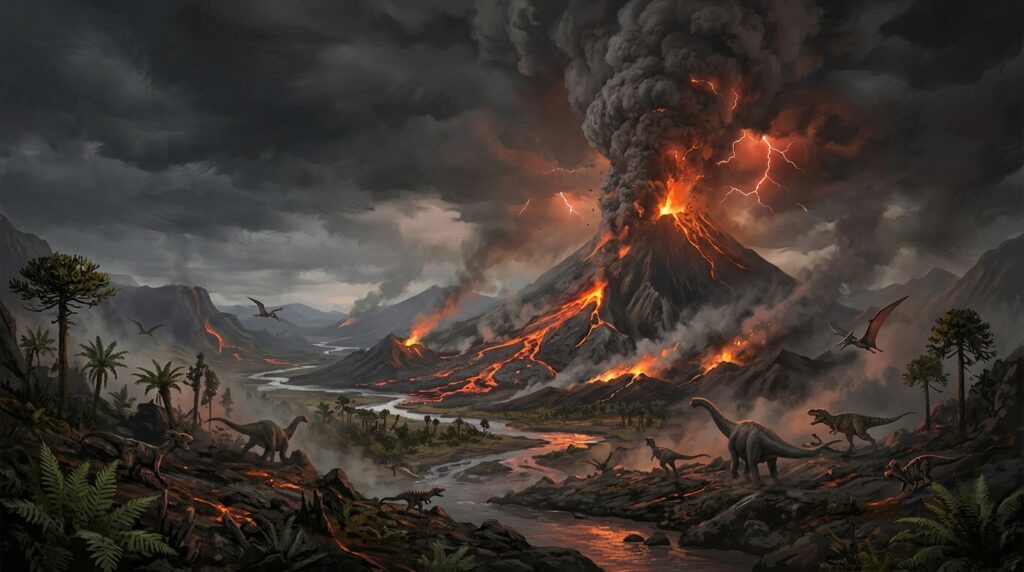
Massive volcanic eruptions — one of the possible traces of a gravitational flyby
This is exactly where Fargion fits his idea: tidal effects from a flyby of a massive body could simultaneously explain the volcanism, the climate shifts, and the ocean retreat — that is, the entire complex picture that is difficult to reduce to a single impact.
Tilted Planetary Axes and a Suddenly Distant Moon
To keep the hypothesis from hanging in thin air, the author presents circumstantial evidence from the Solar System itself. Many oddities are easier to explain through flybys, captures, or collisions with bodies from its outer regions.
- Uranus literally “lies on its side” — its extreme axial tilt could have resulted from a collision
- Triton, Neptune’s largest moon, resembles a captured Kuiper Belt object
- several moons have retrograde orbits — they rotate “the wrong way,” and this still lacks a clear explanation
- the Late Heavy Bombardment could have been caused by perturbations from a massive body’s flyby
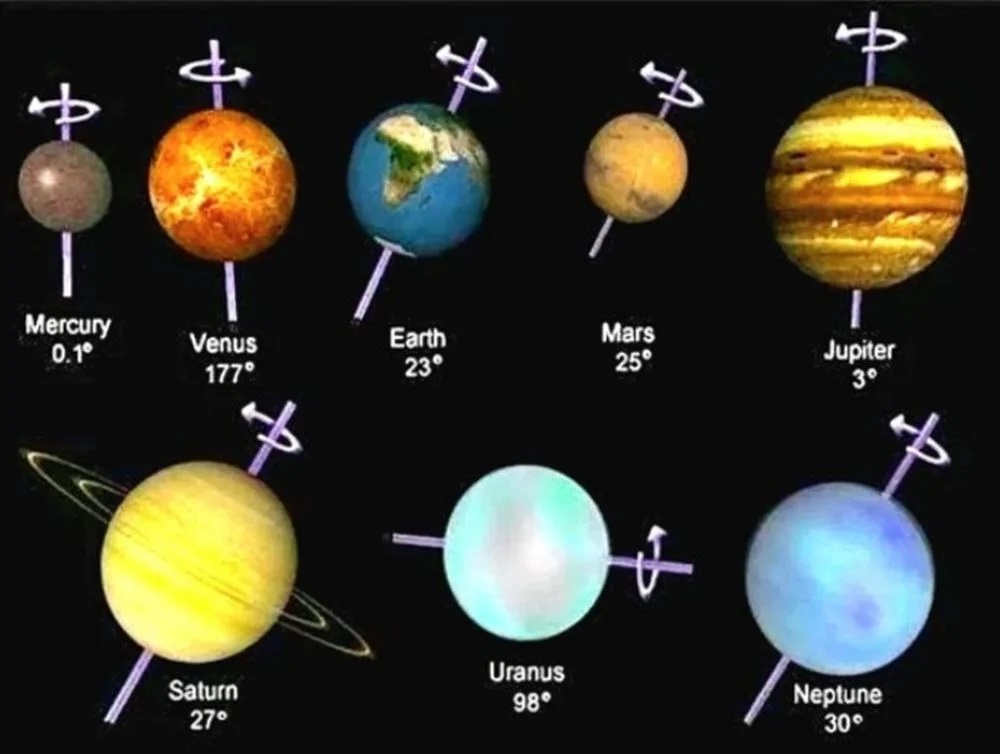
Collisions with planetary-mass objects could have caused planets to rotate off their axes.
But the most striking argument involves the Moon itself. Fossil corals preserve a record of day length: their annual growth rings show how many days there were in a year during different epochs. And at the end of the Devonian period, the rate at which the number of days per year was decreasing suddenly slowed sharply.
Since days lengthen due to the well-understood tidal braking of Earth by the Moon, such a sudden change in pace means that the distance between Earth and the Moon abruptly increased. A collision would have produced an instantaneous effect and wouldn’t fit, but a smooth yet powerful gravitational tug from a passing body — quite possibly.
Could a Cosmic Catastrophe Happen on Earth Again
If it happened before, it could happen again. And the main danger, according to Fargion, is not the impact itself, but giant tidal waves that could circle the planet and persist for years, preventing life from recovering.
Hence the author’s practical conclusion: you can’t prepare for a planetary-mass body the same way you would for an ordinary asteroid. We need to proactively scan the distant skies for the faintest and most remote sources — future dwarf planets — and warn of their approach as early as possible.
The hypothesis also has an unexpected twist toward the Fermi paradox — the question of why, given the enormous number of stars, we still haven’t encountered extraterrestrials. Fargion cautiously suggests that the answer may be grim: life in the Universe is unstable and short-lived, and cosmic catastrophes like tidal extinctions regularly cut short its development.
Evidence and Weak Points of the New Hypothesis
It’s important to be honest about the emphasis. Fargion’s work is a preprint presented at a conference in 2025, and it is built primarily on correlations and circumstantial evidence. The author himself acknowledges that finding a definitive connection between extinctions, climate, volcanism, and impacts is harder than noticing their temporal coincidence.
There are also some rather bold calculations. For example, the author estimates that Jupiter has experienced 16 collisions with bodies of about half Earth’s mass over its history, and links this to its axial tilt and mysterious excess heat. These are interesting estimates, but they are precisely that — estimates, not established facts.
The idea offers a fresh perspective on an old mystery — extinctions without craters. Whether it should be accepted will be shown by further research into the geological record and observations of distant Solar System bodies. For now, it serves as a reminder: even in Earth’s seemingly well-studied history, there is still room for major discoveries.