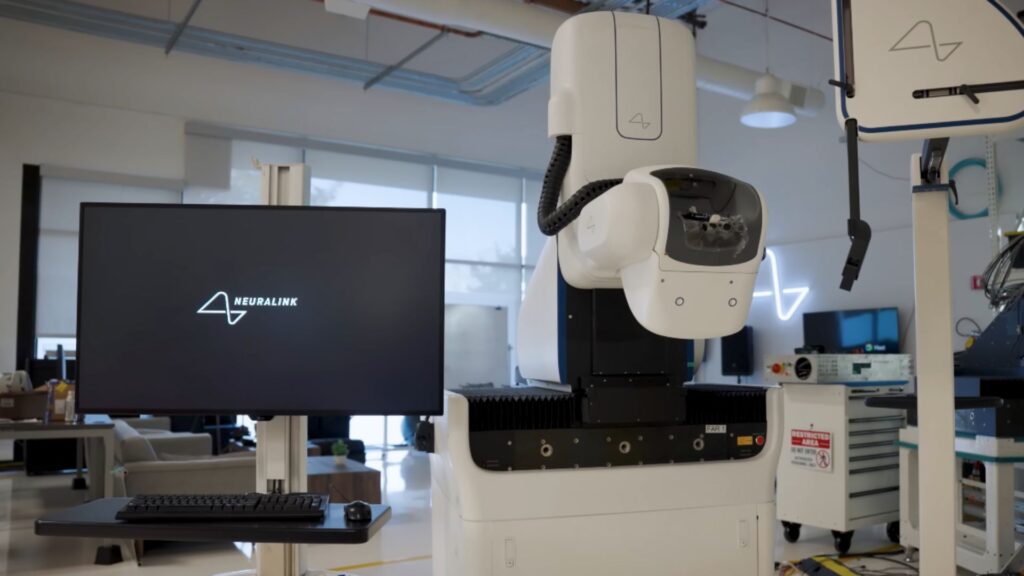
Neuralink’s robot for brain chip implantation
Neuralink, the company that implants chips into human brains, has unveiled a surgical robot that takes over the most complex stages of brain chip implantation. The machine, equipped with eight cameras and a tomographic scanner, implants electrodes thinner than a human hair with precision unattainable by a surgeon’s hands. If the company’s plans come to fruition, the procedure will transform from a multi-hour operation into a quick clinic visit.
What the Neuralink Surgical Robot Can Do
The main problem the new robot solves is working with incredibly thin electrodes. Neuralink engineers developed a special surgical technique: the thin, flexible threads of the implant must be carefully inserted directly into brain tissue, with each thread thinner than a human hair and passing through living tissue hundreds of times without causing damage. Manual surgery simply cannot handle such a task at the required level of precision.
After the surgeon makes the initial incision in the skull, the robot takes over. It is equipped with eight cameras and an optical coherence tomography scanner — this allows real-time observation of what’s happening beneath the brain’s surface. The robot picks up each thread, places it at the required point, and carefully secures it.
The current model of the robot features a five-axis system, allowing it to adapt to any entry point on the patient’s skull. The manipulator has become significantly more compact thanks to numerous design refinements, making the system faster and easier to use. In essence, the robots don’t replace surgeons but take on all the repetitive high-precision operations where humans cannot ensure consistent results time after time.
How the Neuralink Robot Implants a Chip
One of the key innovations is the elimination of the need to remove the dura mater. This is a dense protective membrane that surrounds the brain and spinal cord. Previously, a surgeon had to carefully remove this layer to gain access to brain tissue. Now the robot simply pierces it and inserts the device. This saves an entire stage of the operation, speeds up the process, and makes the entire procedure easier to replicate.
Why is this so important? Every additional incision means a risk of infection and additional time under anesthesia. Elon Musk himself called this solution a significant breakthrough: the device’s threads pass through the membrane without the need for its removal. In the future, this could make implantation similar to a short outpatient visit rather than a full-scale neurosurgical operation.
How Neuralink Is Transitioning to Mass Chip Implantation
Elon Musk stated that Neuralink will begin large-scale production of neural interfaces and transition to a nearly fully automated surgical procedure in 2026. This is a fundamental shift: the company is moving from individual clinical experiments to an industrial approach.
By the end of 2025, around twelve people worldwide had received an implant, and by now that number has grown to approximately twenty. One Neuralink patient is already editing videos on YouTube using the power of thought. The company has completed the expansion of a new facility in Austin, Texas, investing over $16 million in the production of brain chips and surgical equipment. Neuralink is also expanding clinical trials beyond the United States: the first implantation surgeries took place in Canada in 2025, and the technology is also being tested in the United Kingdom.
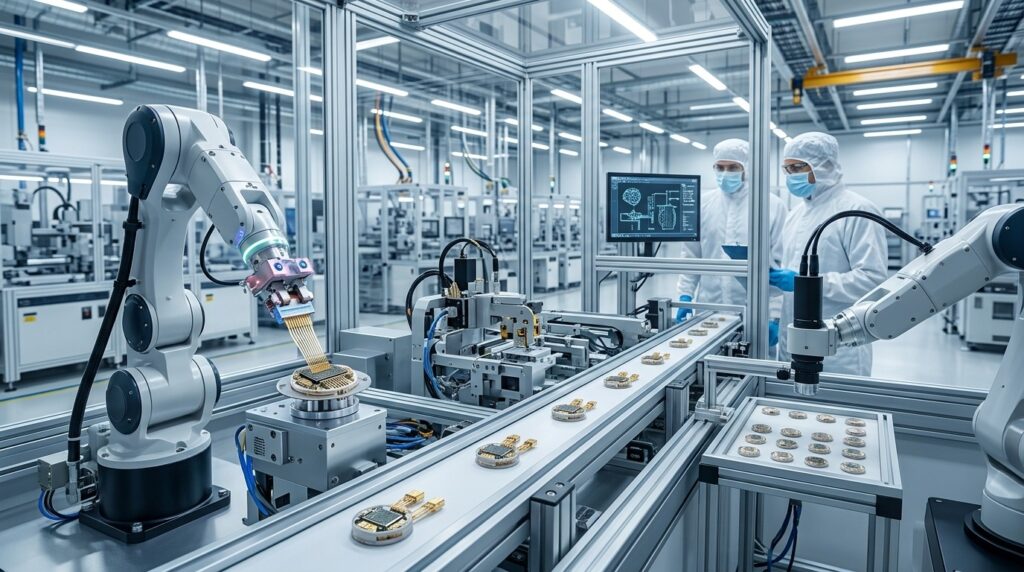
Neuralink factory preparing for mass production of brain implants
The Main Unsolved Problem with Neuralink Chips
Despite all the successes, Neuralink faces a serious biological challenge worth knowing about. When a foreign object enters the brain — in this case, an implant with electrodes — nervous system cells (astrocytes) switch to a defensive mode and form a dense sheath around the foreign object. This scar becomes a structural and biochemical barrier between the electrodes and nerve tissue, weakening signals and degrading contact quality.
Imagine trying to listen to a conversation through thick glass: the sound gets through but becomes increasingly muffled. That’s roughly how the glial scar gradually dampens the electrical signal between the electrodes and neurons.
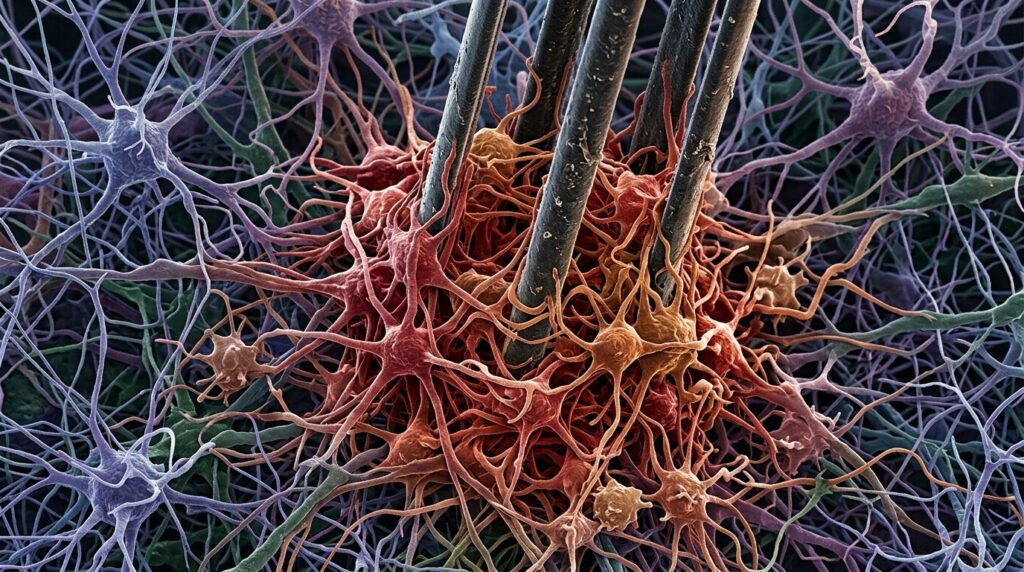
Glial cells forming a scar around an electrode in brain tissue
This problem is not unique to Neuralink — it affects all brain implants, even those developed by competitors. Research shows that beyond material flexibility, the size and shape of electrodes play a key role in designing the next generation of implants. Neuralink uses ultra-thin flexible polymer electrodes, which should theoretically reduce the immune response, but definitive data on long-term stability in humans is not yet available.
Neuralink’s achievements, as reported by Interesting Engineering, are impressive: from the first individual surgeries to a surgical robot capable of implanting electrodes with superhuman precision. But between a technology demonstration and its mass medical application lies a distance that will be determined not only by engineers but also by biology — the brain’s ability to accept a foreign device over the course of years. That is exactly what’s worth watching in the coming years.