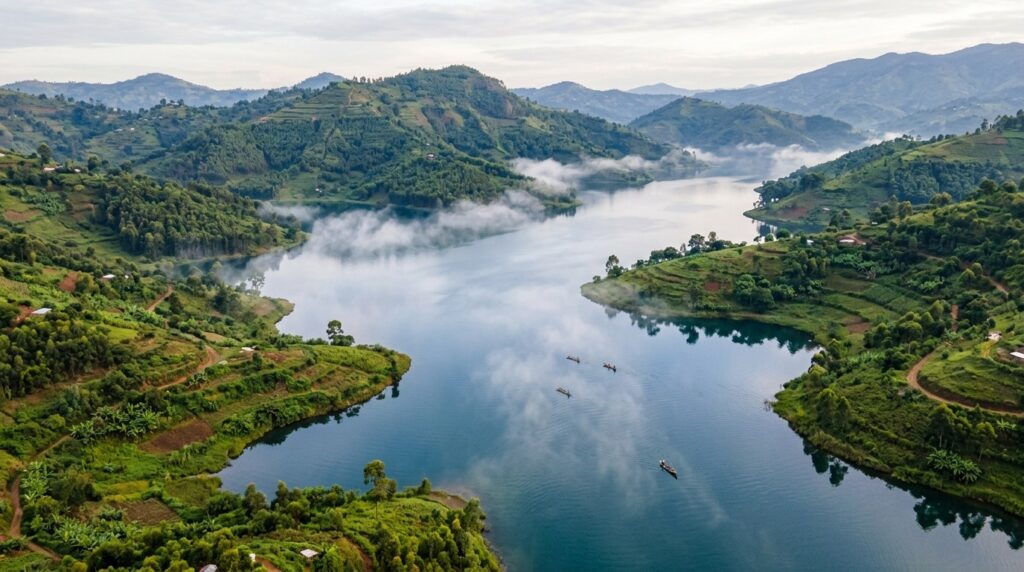
Lake Kivu could destroy people living nearby
On the border of the Democratic Republic of the Congo and Rwanda lies Lake Kivu. It is one of three bodies of water on Earth capable of literally exploding. Beneath its calm surface, colossal volumes of carbon dioxide and methane are dissolved, and an active volcano stands nearby. What does this mean for the two million people living on its shores?
The Limnic Disaster at Lake Nyos
To understand why Lake Kivu is dangerous, we need to go back to 1986. On August 21, 1986, a limnic eruption occurred at Lake Nyos in Cameroon — a sudden release of dissolved carbon dioxide. It killed 1,746 people and 3,500 head of livestock. The gas cloud rose at a speed of nearly 100 km/h, and then, being heavier than air, descended upon surrounding villages and suffocated people and animals within a 25-kilometer radius.
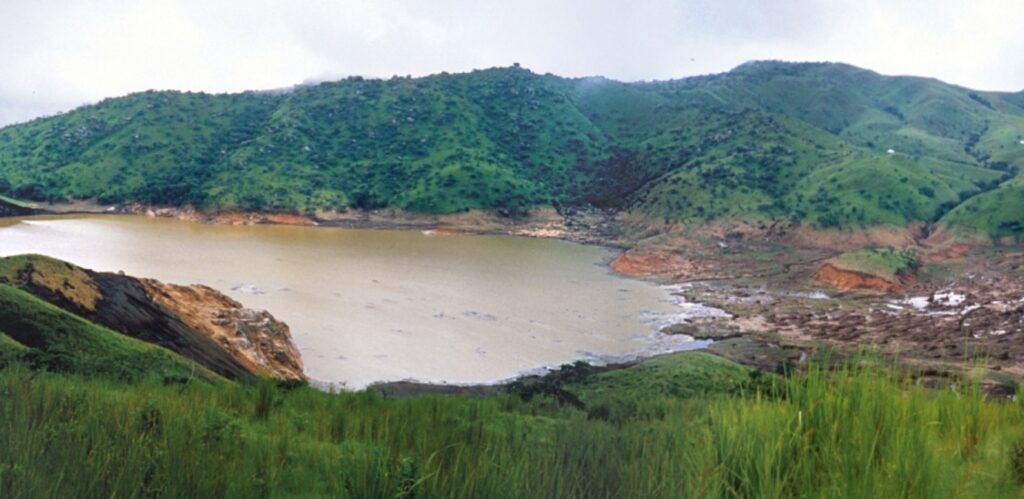
Lake Nyos one week after the disaster. Image source: wikipedia.org
People simply fell asleep and never woke up. The bodies of the victims showed no signs of injury or struggle — people died where they were. It was the first large-scale death by natural gas asphyxiation in modern history. After the catastrophe, a degassing system was installed on the lake to reduce the concentration of CO₂ in the water and minimize the risk of repeated releases.
But scientists who studied the event turned their attention to another body of water, and it turned out to be incomparably more dangerous.
Why Lake Kivu Is a Thousand Times More Dangerous Than Lake Nyos
Lake Nyos is a small crater lake. Lake Kivu is 2,000 times larger, and it was also found to be supersaturated with gases. But scale is not the only difference.
In the depths of Kivu, approximately 300 cubic kilometers of carbon dioxide and 60 cubic kilometers of methane are dissolved. This is the same natural gas that powers our gas stoves. Carbon dioxide is lethal but not flammable, while methane is a combustible gas, and Lake Kivu contains a colossal amount of it.
The lake is located in the East African Rift Zone — a region where the Earth’s crust is literally splitting apart. The local volcanoes are among the most active in the world. Right on the shore of Kivu stands the city of Goma with a population of about 1.2 million people, and behind it rises Nyiragongo — an active volcano that has erupted about half a dozen times over the last century.
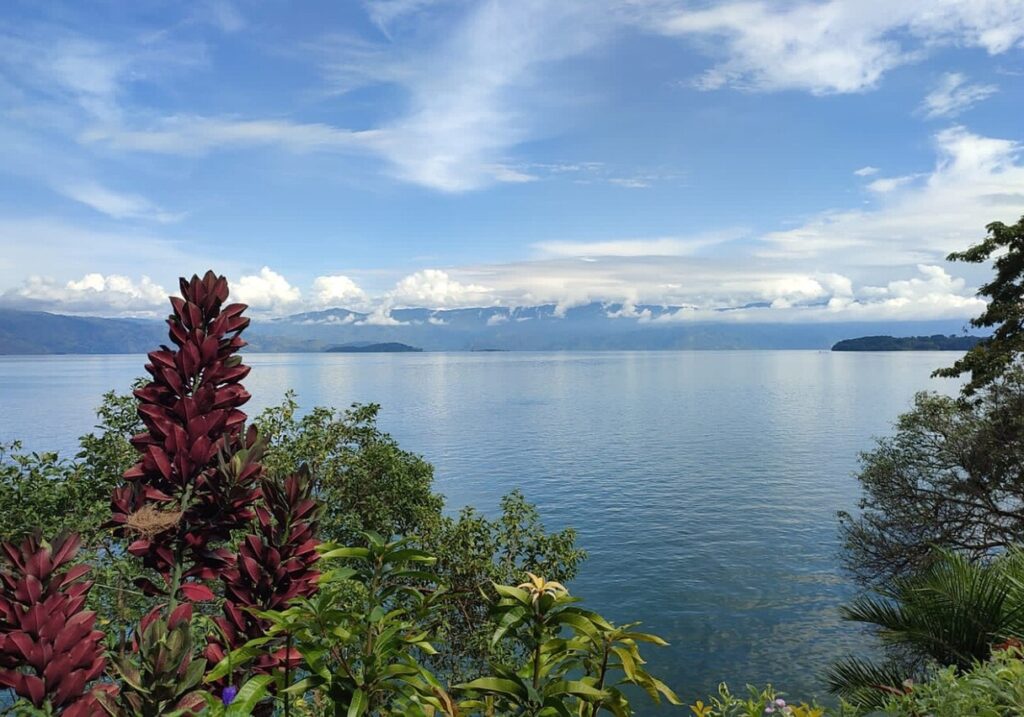
Lake Kivu. Image source: wikipedia.org
What Is a Limnic Disaster
A limnic eruption is easiest to understand through an analogy with a bottle of soda. Before a lake reaches saturation, it behaves like a sealed bottle of carbonated water: carbon dioxide is dissolved thanks to high pressure. When the pressure drops, the gas comes out of solution as bubbles that rise to the surface.
In its normal state, Lake Kivu is stratified — that is, divided into layers. The upper 60 meters are regularly mixed, while below, the water is layered: at the bottom — warm, salty, gas-saturated water; on top — cool and fresh water. As long as the layers remain stable, the gases stay at depth under the pressure of the water column.
But if something disrupts this stratification — an earthquake, a lava flow, a landslide — the gas-saturated water can rise higher. At shallower depths, the pressure no longer holds the gas in solution. Bubbles make the water even lighter, it rises even higher, more gas is released, triggering a self-sustaining chain reaction. The result is a powerful gas release at the surface, capable of generating a tsunami wave and a deadly cloud.
Methane in Lake Kivu That Could Explode
At Lake Nyos, carbon dioxide caused the deaths — being heavier than air, it spreads along the ground and displaces oxygen. But Lake Kivu also contains methane, and that is a qualitatively different threat.
Professor of lake ecology Robert Hecky explained in an interview with the BBC: methane won’t explode on the surface by itself, but there are plenty of ignition sources around the lake. Physicist and limnologist Alfred Johny Wüest from the Swiss institute EAWAG emphasized in the journal Nature that methane is the main problem — it is less soluble than CO₂, and water cannot hold it in the same quantities.
According to calculations by engineer Philip Morkel, in the event of an eruption, Lake Kivu would release the equivalent of 2–6 gigatons of carbon into the atmosphere within 24 hours. That is about 5% of the world’s annual CO₂ emissions — in one toxic “exhale.” The gas cloud would linger over the lake for days or weeks, and anyone caught in it would die within a minute.
The eruption of Nyiragongo in 2002 sent a lava flow into the lake, raising fears of a gas release, but the lava stopped well short of the deep layers where gas is held by water pressure. Next time, luck may not help.
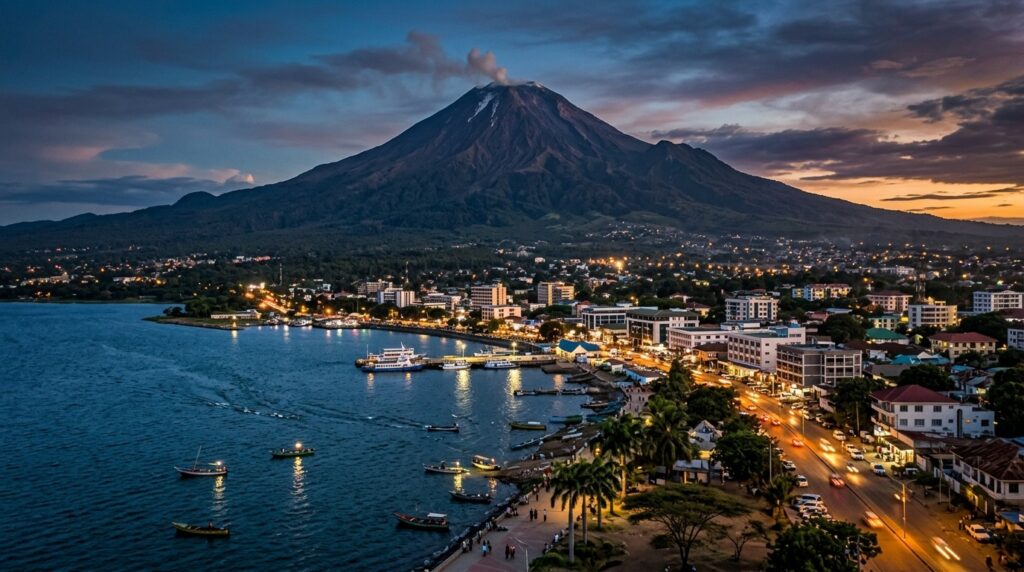
The Nyiragongo volcano looms over the city of Goma on the shore of Lake Kivu
Methane Extraction from Lake Kivu
One solution looks elegant: extract the methane from the lake and use it to generate electricity. Since 2016, the KivuWatt project has been extracting methane from Lake Kivu and producing 26 megawatts of electricity for the local population. The technology resembles opening a bottle of champagne: the 3,000-ton KivuWatt barge, moored 13 km from shore, draws gas-saturated water from a depth of 350 meters, and as it rises, the gas separates from the water on its own due to decreasing pressure.
For Rwanda, this is significant — by 2024, methane from Lake Kivu already provided 14.3% of the country’s electricity. The company plans to increase capacity to 100 megawatts.
However, there is no scientific consensus on how safe this is. Some worry that large-scale extraction could destabilize the lake’s stratification, while others argue that gas extraction actually reduces the risk. Limnologist Sergei Katsev warns that if degassed water is returned too high, it creates a downward flow that mixes the layers vertically. And vertical mixing is precisely the mechanism that triggers a limnic eruption.
What Would Happen If Lake Kivu Exploded
Even without methane extraction, the lake remains dangerous. Samples of bottom sediments have shown that catastrophic events that destroyed living organisms in and around the lake occurred approximately every thousand years.
When the lake reaches 100% gas saturation, an eruption will occur spontaneously, without an external trigger. Currently, the lake is more than 60% saturated. However, a 2020 study found errors in earlier estimates and concluded that the risk of a gas eruption at Lake Kivu may not be increasing over time. The scientific debate continues.
By estimates, the lake contains 60 billion cubic meters of methane and 300 billion cubic meters of CO₂ at a depth of 350 meters. At the current rate of gas accumulation, the gases are expected to fully saturate the lake within 50–200 years, creating an eruption threat for more than two million people on its shores.
Lake Kivu is a rare case where a natural threat is simultaneously a resource. Extracting methane potentially makes the lake safer and provides electricity to one of the poorest regions in the world. But scientists emphasize that current extraction rates are insufficient to prevent a catastrophe in the event of a major earthquake or volcanic event. The question is not whether a release will happen, but whether people will have time to prepare.