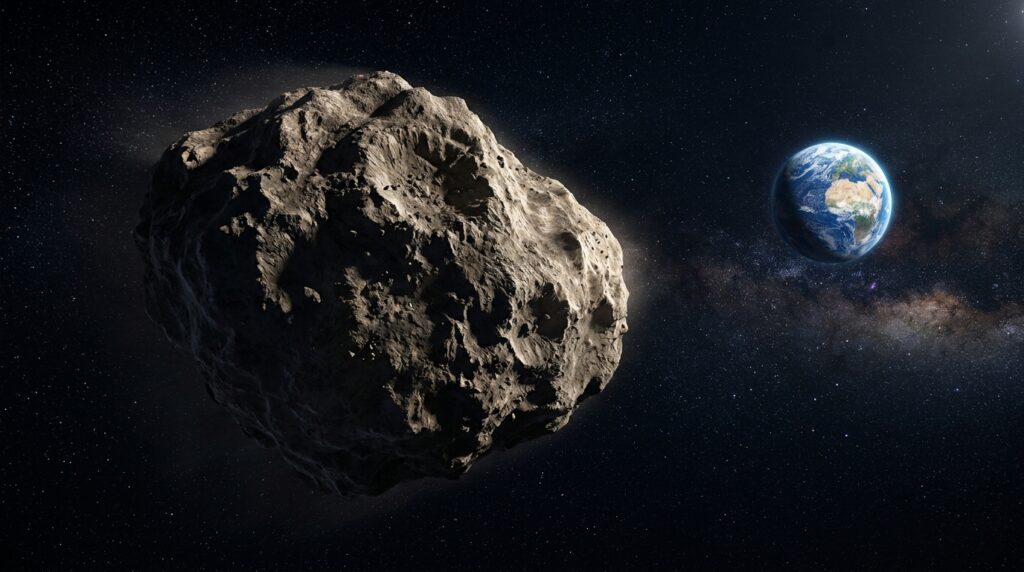
Asteroid 1997 NC1 is heading toward Earth, and it’s a great opportunity for scientific research
In late June 2026, the giant asteroid 1997 NC1 will reach its closest distance to our planet for the first time in over four centuries. This event poses no threat to humanity but gives scientists a rare chance to peer into the history of the Solar System and test the accuracy of planetary defense models in real time. On June 27, the space rock will fly past Earth. Dozens of observatories and radar systems around the world are tracking its movement. After this visit, the asteroid will once again retreat into the depths of space, and the next similar close approach won’t occur until 2133.
Asteroid 1997 NC1’s Approach to Earth
Asteroid 1997 NC1 belongs to the Aten group. This means its orbit crosses Earth’s, but it spends a significant portion of its time closer to the Sun than our planet. Such objects are constantly monitored by astronomers.
Calculations show that the minimum distance to Earth will be 2.56 million kilometers. That’s roughly 6.5 times farther than the distance from Earth to the Moon. By cosmic standards, that’s very close, but from a safety standpoint, the orbit is configured so that any chance of collision is completely ruled out.
What interests scientists is not the threat, but the rarity of the event. Orbital modeling shows that this object hasn’t come this close to Earth since at least the year 1600. The gravity of planets slowly but surely adjusts the trajectories of small bodies, and each such flyby allows for a better understanding of celestial mechanics.
Why the Exact Size of Asteroid 1997 NC1 Is Still Unknown
According to Daily Galaxy, despite the object having been discovered quite some time ago, its dimensions are still a matter of debate. Unlike situations when asteroids the size of a small house approach Earth, here the scale is in the hundreds of meters. Currently, the object’s size is estimated between 900 meters and 1.5 kilometers, and such a large margin of error arose due to observational challenges.
The issue is that optical telescopes only detect reflected sunlight. In astronomy, a surface’s ability to reflect light is called albedo. If a rock’s surface is dark, it reflects little light and may appear tiny through a telescope lens. If the surface consists of light-colored rock, even a small piece of stone will shine like a massive object. This is precisely why scientists cannot rely solely on brightness.
How Scientists Study the Structure of Asteroids
To overcome the limitations of optics, powerful radars such as the Goldstone Solar System Radar (GSSR) come into play. Unlike conventional telescopes, they don’t wait for the Sun’s favor — instead, they send radio waves toward the passing body and catch the reflected signal.
This observation method is extremely informative. With its help, radio waves will allow scientists to recreate an accurate 3D model of the asteroid, independent of how dark or light it is.
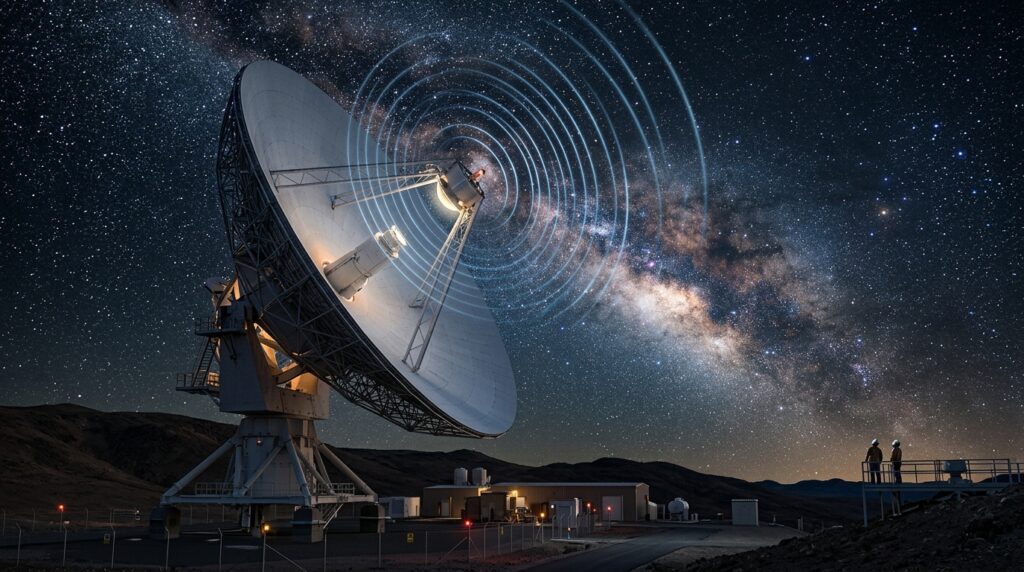
Radio telescopes send signals to the asteroid to create its detailed model
Radar observations will help astronomers determine several important parameters at once:
- the true diameter and shape of the cosmic visitor;
- its rotation speed around its own axis;
- surface terrain and the presence of structural anomalies.
This data is critically important for understanding how asteroids respond to the Sun’s thermal radiation. Even slight heating on one side can microscopically shift an object’s orbit over time, and this effect must be accounted for in long-term predictions.
Can You See the Asteroid Through an Amateur Telescope?
At the moment of closest approach, the apparent magnitude of 1997 NC1 will reach a value of about 10. This means that the flyby can be observed through small amateur telescopes, although it will remain invisible to the naked eye.
The best observation conditions during the first days of closest approach will favor residents of the Northern Hemisphere. Amateur astronomers should take the Moon’s phase into account, as its bright light can reduce the contrast of the night sky. The object will move across the sky slowly enough to be tracked over several consecutive nights.
For those without equipment, the Virtual Telescope project will organize live broadcasts. Peak observations are planned for June 26 and 27, when independent astronomical groups will share images in real time.
How Scientists Will Test Asteroid Defense Systems
The flyby of 1997 NC1 near Earth will allow testing of planetary defense systems. Global near-Earth object monitoring networks use such events to compare theoretical calculations with harsh reality.
Sometimes science revises old hypotheses based on new data. For example, it was recently discovered that scientists were wrong about the duration of the nuclear winter after the Chicxulub asteroid impact. But in the field of orbital calculations, modern astronomy has achieved incredible accuracy. Each new flyby only confirms that our planetary defense algorithms work reliably.
Asteroid 1997 NC1 reminds us of how vast and measured the mechanics of the Solar System are. After its visit in June 2026, it will calmly continue on its way, leaving astronomers with terabytes of data that will make our forecasting of cosmic threats even more precise.