MediaTek has announced the Dimensity 9600 Pro, its new flagship smartphone processor and the company’s first chip built on a 2-nanometer process. According to the launch figures cited in the source, the move from 3nm to 2nm brings roughly 14% more performance and 23% lower power consumption at the same workload, while the CPU’s fastest cores reach 4.55 GHz, a record for MediaTek mobile chips. The first phones to use it, vivo’s X500 Pro and X500 Pro Max, are scheduled to be unveiled on September 21, 2026, followed by the OPPO Find X10 Pro Max a day later. The source author argues that this makes the Dimensity 9600 Pro a contender for the most powerful Android chip on the market right now, though that is the author’s assessment rather than a benchmarked comparison.
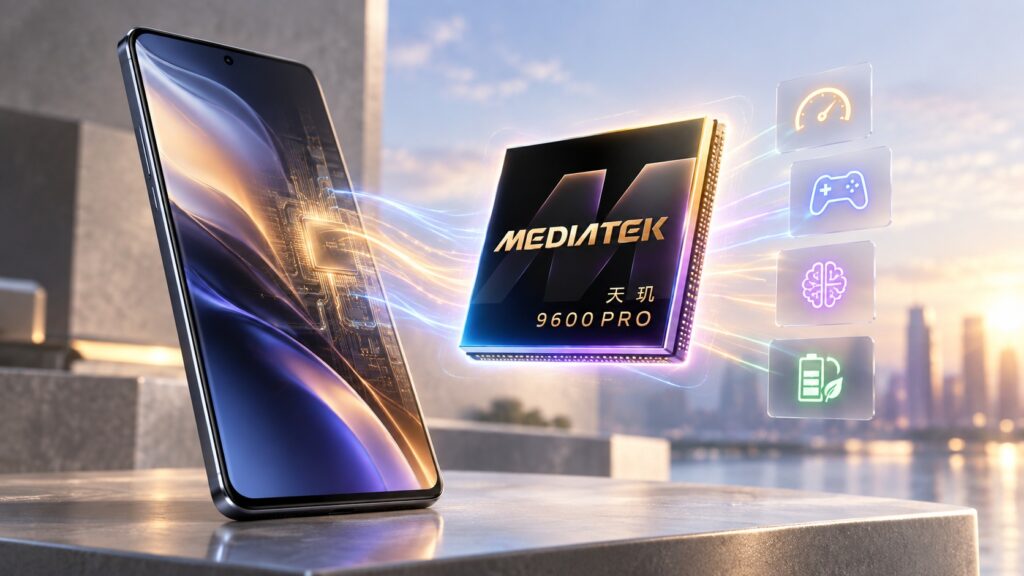
What the Dimensity 9600 Pro brings to smartphones
What you need to know
- The Dimensity 9600 Pro is MediaTek’s first 2nm chip, with more than 33 billion transistors; the source cites +14% performance and −23% power draw versus 3nm.
- CPU: two cores at 4.55 GHz, three at 4.35 GHz, three at 3.1 GHz; single-core performance is up 17% and multi-core up 15% over the Dimensity 9500.
- Supports LPDDR6 memory (33% faster than LPDDR5X), UFS 5.0 storage (twice as fast), 4K video at 240 fps, H.266 encoding, and displays up to 185 Hz.
- Confirmed launch devices: vivo X500 Pro / X500 Pro Max (September 21, 2026) and OPPO Find X10 Pro Max (September 22, 2026).
Why 2nm matters
A processor is made up of billions of tiny switches called transistors. The smaller they are, the more of them fit on a single chip, and generally the faster and more efficiently the chip runs. The “nanometer” figure refers to this manufacturing scale. The previous Dimensity 9500 was made on a 3nm process; the Dimensity 9600 Pro moves to 2nm. The source notes Samsung had previously announced a 2nm mobile chip of its own, so MediaTek is not the only vendor at this node.
According to the figures cited in the source, the 2nm process delivers, relative to 3nm chips:
- +14% performance on the same task;
- −23% power consumption, meaning less heat and longer battery life;
- a higher transistor count: more than 33 billion.
In other words, the new chip is meant to be both faster and more frugal than its predecessor at the same time.
How the chip is built
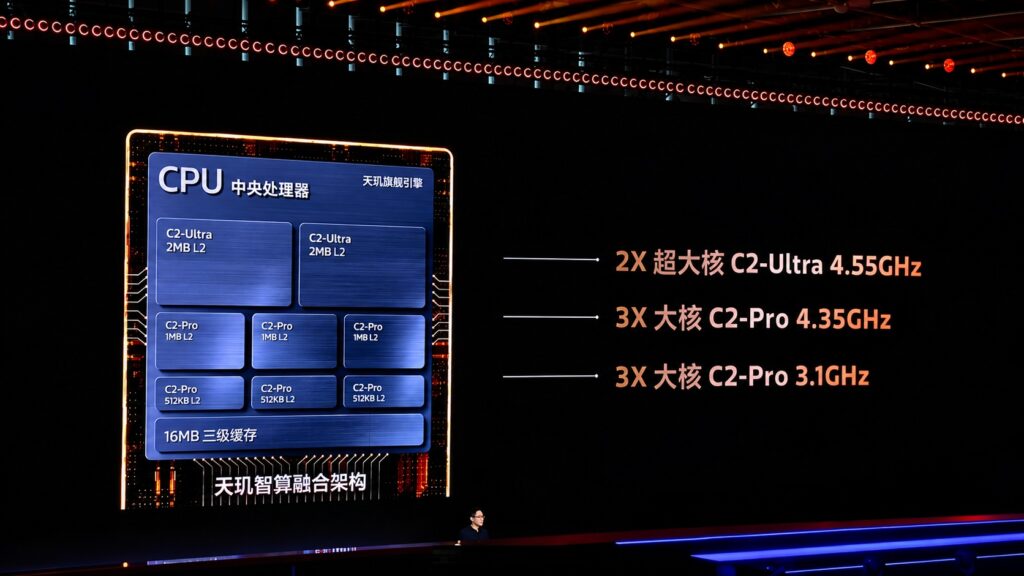
Structure of the Dimensity 9600 Pro processor

CPU
The processor is split into blocks with distinct roles:
- Two top-tier cores run at 4.55 GHz, a new high for MediaTek mobile processors.
- Three more cores run at 4.35 GHz.
- The remaining three run at 3.1 GHz and handle background work.
Compared with the previous generation, single-threaded performance is up 17% and multi-threaded performance up 15%. In everyday terms, that should mean faster app launches, a smoother interface, and fewer stalls on heavy tasks.
Memory and storage
The chip supports the new LPDDR6 memory standard, which the source says runs 33% faster than LPDDR5X, and UFS 5.0 storage, described as twice as fast as the previous generation. These gains are most noticeable when recording video, handling large files, and installing apps.
Graphics and video
The GPU is a 12-core Mali G2 Ultra NX. The source reports it is 27% faster and 24% more efficient than the graphics unit in the Dimensity 9500. It can drive games on displays with refresh rates up to 185 Hz, which is why upcoming flagships on this chip are expected to ship with panels at that rate. Third-generation ray tracing is supported for more realistic in-game lighting.
On the camera side, the chip supports 4K video at 240 fps and 4K at 120 fps in Log format, a professional-grade recording standard. It also adds support for the H.266 compression codec, which promises better quality at smaller file sizes.

Which phones get it first

The vivo X500, the first phone to get the Dimensity 9600 Pro
Several manufacturers have officially confirmed the chip for their upcoming flagships:
- vivo X500 Pro and X500 Pro Max — billed as the first phones in the world on the Dimensity 9600 Pro, launching September 21, 2026. vivo and MediaTek co-developed AP Demura 2.0, a chip-level display brightness uniformity technology. The phones also support 4K video at 120 fps with 10-bit Log output directly from the device.
- OPPO Find X10 Pro Max — launching September 22, 2026. OPPO adds its own Tide Engine to handle AI workloads and high-refresh-rate gaming simultaneously, and claims up to 8 hours of continuous play at full frame rate in demanding games. The phone is said to carry an 8,000 mAh battery based on spherical silicon-carbon chemistry.
Other 2026 flagships are expected to use Qualcomm’s competing part, the Snapdragon 8 Elite Gen 6 Pro. The Xiaomi 18 Pro is expected in late September 2026, and, according to reports cited by the source, the iQOO 16 (September 29) and OnePlus 16 (October) are also slated to get the Qualcomm chip. Treat those dates as reports rather than confirmed launches.
Is it worth upgrading?
Coming from a Dimensity 9500: the source author expects a noticeable difference, particularly in gaming, video recording, and battery life.
Coming from a Snapdragon 8 Elite Gen 5: the picture is less clear. The author’s view is that Qualcomm and MediaTek are currently roughly on par, and real-world differences in daily use are minimal.
The key argument for the Dimensity 9600 Pro, per the source, is energy efficiency. It cites a 37–61% reduction in power consumption in CPU tasks versus the Dimensity 9500, which the author attributes to the 2nm transition rather than marketing. If that holds up in shipping devices, a phone with the same battery capacity should last longer than its predecessor. Keep in mind these are launch figures as reported by the source, not results from retail units.