An insider’s theory holds that Apple could make its large iPhones shorter without narrowing them or reducing the usable screen area, by removing the status bar strip at the top of the display. The idea depends on the front camera shrinking to a single small hole or moving under the display. Even the insider has asked readers not to take the prediction too seriously, and current rumors suggest Apple is not planning a shorter iPhone for 2027.
The source frames the problem around one-handed use. Apple’s phones get bigger almost every year, but their owners’ hands do not. Many people with large iPhones still have to shift their grip to reach the top corner of the screen, and Apple shows no sign of abandoning large displays.
What you need to know
- A Chinese insider suggests that once the front camera becomes a single small hole or moves under the display, Apple could remove the status bar strip and make the iPhone shorter at the same width.
- Moving from today’s roughly 19.5:9 aspect ratio to about 18:9 would cut nearly 8% of the screen’s height without changing its width.
- Sources disagree on timing. One display analyst expects 2028 Pro models to keep a centered camera hole and move only Face ID under the display.
- A roughly 7-inch display Apple reportedly tested for its largest 2027 model keeps the 19.5:9 ratio, so a shorter iPhone does not appear to be planned for that year.
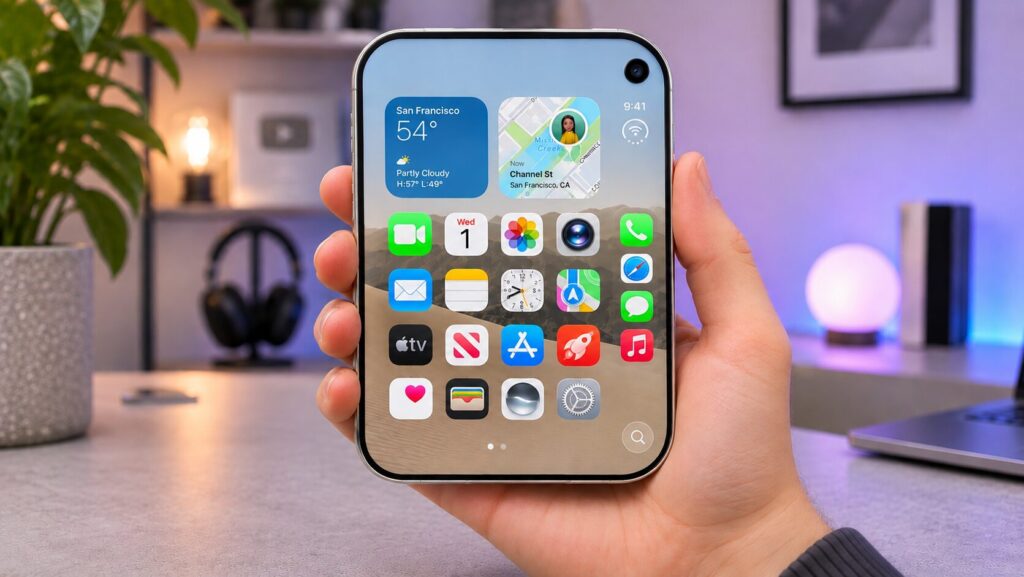
Concept of a shorter iPhone: the camera sits in the corner of the screen, with the time and Wi-Fi icon stacked in a column to the right of the widgets
The same screen, minus the strip at the top
The prediction comes from a Chinese insider who has previously shared details about upcoming iPhones. This time, according to the source, the forecast is based on simple reasoning rather than factory leaks.
The argument goes like this. Once the display has only one small camera hole, or the front camera is hidden entirely under the display, Apple could remove the full height of the status bar. The phone’s width would stay the same, but the iPhone itself would become shorter.
What the numbers mean
Current iPhone screens have an aspect ratio of about 19.5:9, according to the source. That ratio arrived with the iPhone X in 2017, when Apple dropped the Home button and almost all of the bezels.
Removing roughly one status-bar row from the top would bring the proportions close to 18:9. That sounds like a small change, but the source calculates it as almost 8% of the screen’s height at the same width. That would mean a noticeably shorter body.
The source suggests a simple way to feel the problem. Hold your iPhone in one hand and try to reach the opposite top corner with your thumb without shifting your grip. On 6.9-inch models, the source jokes, only basketball players can manage it.
18:9 is not new
The market has seen 18:9 screens before. The source points to the LG G6 and Google Pixel 2 XL, both released in 2017, whose displays looked elongated at the time. Next to today’s iPhones, those proportions look almost square. A return to 18:9 would therefore be a step toward compactness, not a step backward, the source argues.
Time and icons could share a row with app controls
Removing the status bar raises an obvious question: where would the clock, battery indicator, and network icon go?
According to the source, Apple has already solved a similar problem in the foldable iPhone Duo. On its outer screen, a compact status bar is squeezed into a corner, and the Dynamic Island runs vertically along the side edge.
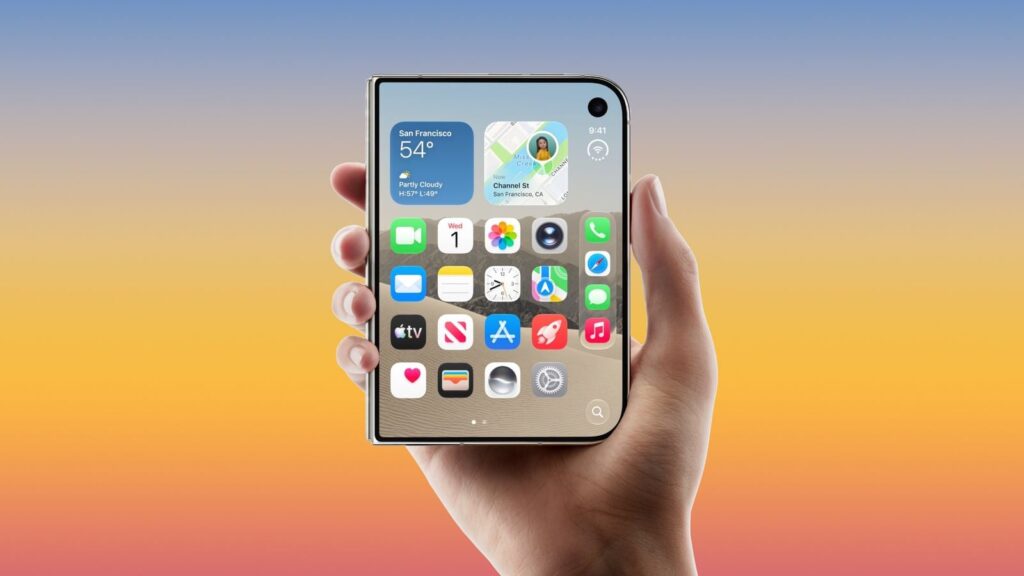
The iPhone Duo’s outer screen in hand: the camera is in the top-right corner, with the time and Wi-Fi icon below it
For a regular iPhone, the insider describes a different approach. Controls that currently sit below the status bar, such as in-app navigation buttons, would move into the same row as the time and system indicators.
The screen would be shorter, but it would not show less information. What disappears is the strip that today holds only the clock and a few icons.
Signs of groundwork
The source argues that Apple may already be preparing for this change. It says the Dynamic Island on the iPhone 18 Pro became noticeably smaller while gaining capabilities. It can now show up to three Live Activities at once, compared with two on earlier models.
In the source’s view, Apple is gradually shrinking everything at the top of the screen, which makes removing the status bar a logical next step.
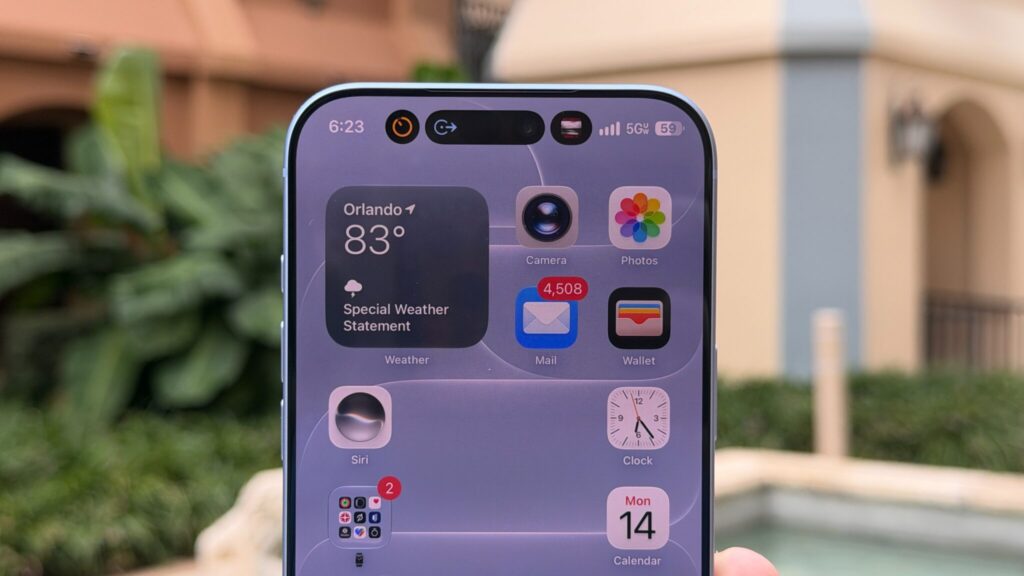
Dynamic Island with three activities at once: two are shown as circles on either side of the island
The front camera is the sticking point
Everything depends on the front-facing camera. According to the source, a fair amount is already known about the displays of the anniversary iPhone 20 lineup, and the camera does not disappear even there.
Another well-known insider claims Apple is testing an under-display camera. As an interim option, however, the company is reportedly considering a design with a visible hole, similar to the iPhone Duo.
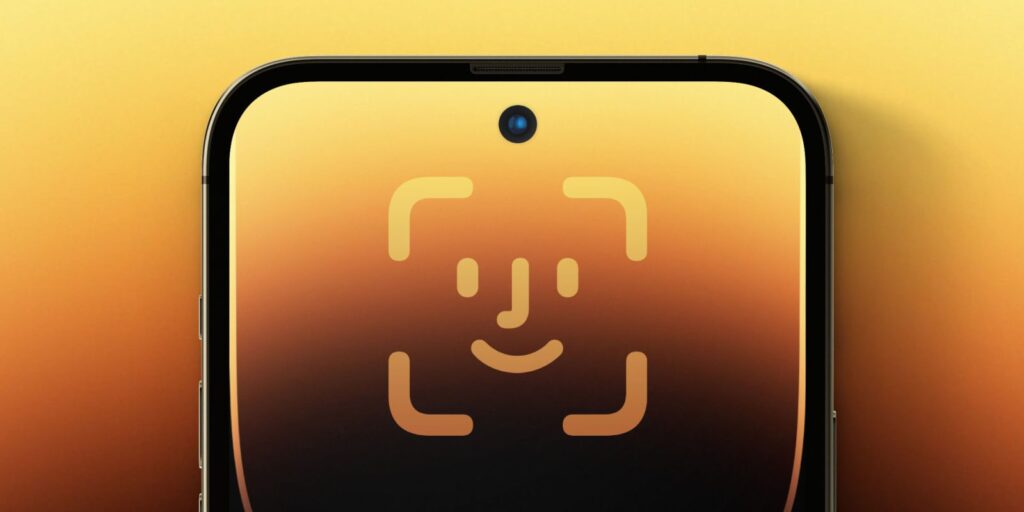
Concept of an iPhone with a single front camera hole in the center of the screen and a Face ID icon
Conflicting timelines
The timing is very unclear, and the available claims point in different directions:
- One person responding to the insider is confident that the cutout and the 19.5:9 ratio will remain in both 2027 and 2028.
- The insider replied that, according to some information, the cutout could disappear in 2028.
- A former display market analyst, whose forecasts about Apple’s screens have usually proved accurate according to the source, is more skeptical. He expects the 2028 Pro models to keep a camera hole in the center of the screen, with only Face ID potentially moving under the display.
A thought experiment, not a leak
The insider has asked people not to take the suggestion too seriously. It is better understood as thinking out loud about what Apple could do once the technology matures.
The source still finds the reasoning coherent. As long as there is a hole in the middle of the screen, the top strip is needed. Once that hole is gone, there would be little reason to keep it.
iOS could change along with the hardware
In a separate post, the insider said he increasingly feels that iOS will change significantly after the anniversary iPhone launches in 2027. He expects changes both in how it looks and in how people interact with it. The source describes this as a much bigger shake-up than the next scheduled update.
The source notes a precedent. When the iPhone X dropped the Home button in 2017, iOS 11 arrived with a new swipe-up gesture. The hardware changed, and the software had to retrain millions of people.
A screen without a status bar would likely have a similar effect, according to the source: developers would need to redesign the top of every app.
What earlier rumors say about 2027
The anniversary iPhone has previously been reported to feature glass that curves at the edges and thinner bezels. The Pro models are said to be getting their most significant redesign since the iPhone X.
For the largest version, Apple reportedly tested a display of about 7 inches with the same proportions as the iPhone 17 Pro Max. That is still 19.5:9, which suggests nobody plans to shorten the iPhone in 2027.
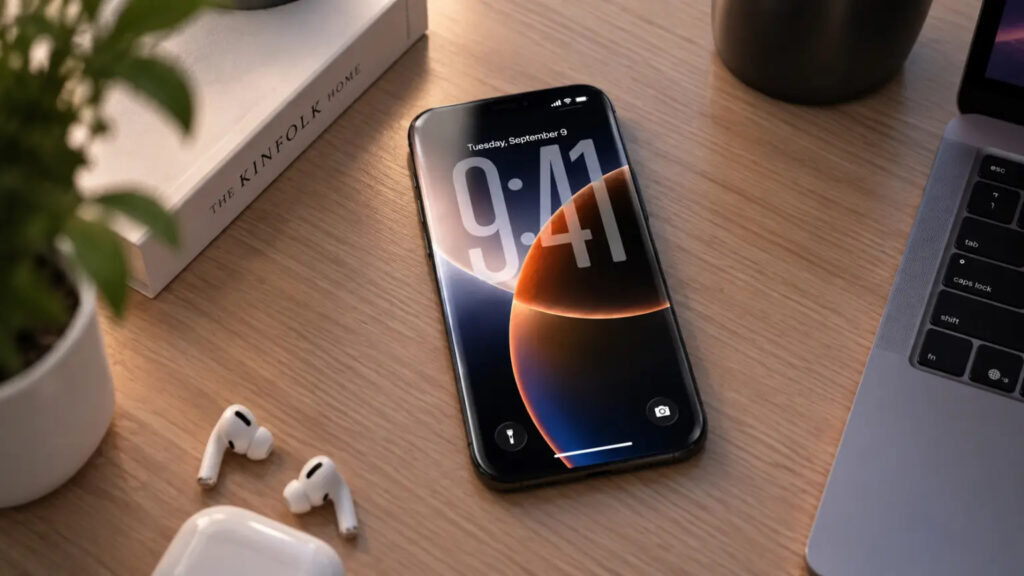
Concept of an iPhone with curved-edge glass and thin bezels on a table next to AirPods Pro
The bottom line
A shorter iPhone remains an attractive theory, not an Apple plan. In the meantime, the source points to MagSafe rings and holders as an inexpensive way to hold a large phone securely in one hand.
If the front camera ever does move fully under the display, removing the empty strip at the top would be the most obvious next step. That would let Apple make the phone smaller without making the screen smaller.