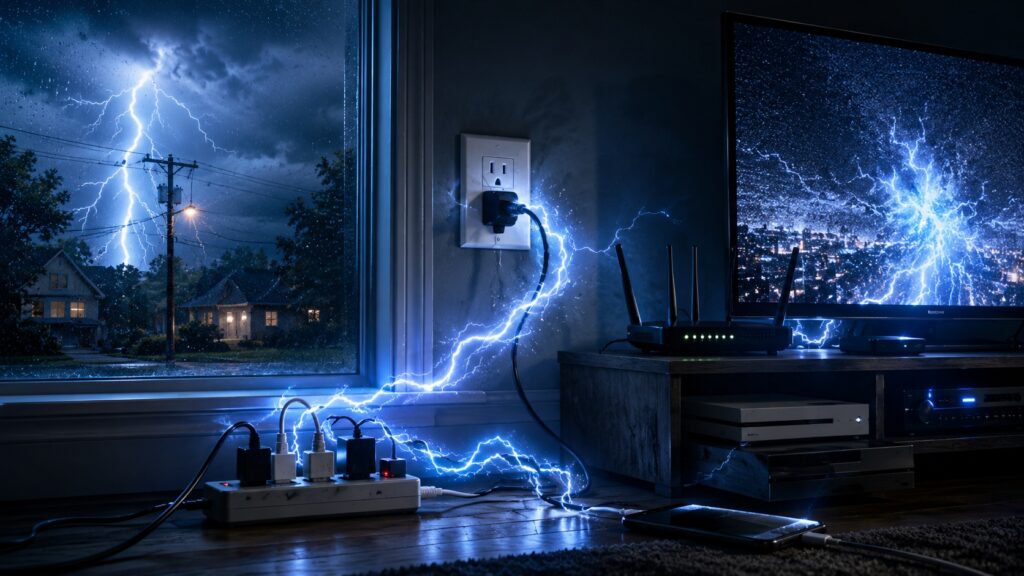
Lightning can damage electronics, but you can protect yourself from it
Lightning doesn’t have to strike your house directly to turn your TV into a pile of scrap metal. A strike on a power pole a couple of blocks away is enough, and the electrical surge will travel through the wires straight to your outlet. That’s because you pressed the off button on the remote, but didn’t unplug the cord from the wall. The device simply went to sleep but stayed connected to the grid. And for lightning, that’s more than enough to destroy your electronics.
Can Lightning Enter a House Through an Outlet
When we hear the phrase about lightning from an outlet, our imagination paints a fantastic picture where a fiery flash bursts right out of the wall. In reality, the process looks different, but that doesn’t make it any less destructive. A lightning strike on a home doesn’t happen directly but through a long network of utilities.
Any outlet is just the endpoint of a massive conductive system. Electrical wires stretch along streets, connecting to transformers, distribution panels, and grounding circuits. If lightning strikes a power line pole or even just the ground near a cable, a powerful electromagnetic pulse is generated.
Long outdoor wires act like giant antennas. They pick up this pulse and transmit it through the circuit directly to your home’s electrical panel. From there, the current spreads to every room. This is exactly how thunderstorms and outlets become a dangerous combination for any electronics that are physically connected to the grid.
How Dangerous Is a Voltage Surge from Lightning
Standard household appliances are designed to operate at 220–230 V. All internal electronics, power supplies, and delicate microchips are built with a small safety margin for normal grid fluctuations. But during a lightning strike, we’re talking about thousands of volts.
Such a brief voltage surge is like a sledgehammer blow to fragile circuit boards. The current is so powerful that it easily breaks through the basic insulation inside the device. As a result, motherboards fail, contacts melt, and network ports and HDMI connectors burn out.
The most frustrating part of such a situation is that repairing electronics after a lightning strike is practically impossible. Replacing a burned-out control board on a modern TV or washing machine often costs almost as much as a new device. That’s why surge protection is a truly necessary thing for stormy weather.
Why Electronics Burn Out During a Thunderstorm
Many people are surprised how a TV can burn out when the screen wasn’t on and the device was turned off. The problem lies in modern technology, because the vast majority of our home electronics never fully shuts down.
Devices remain in standby mode. Inside a TV, microwave, or coffee machine, a built-in power supply, remote signal sensors, or a Wi-Fi module continue to operate. In other words, the physical connection to the power grid is maintained every second as long as the plug is in the wall. While you might not know which appliances to unplug in everyday life, during a thunderstorm the rule is simple — unplug everything valuable.
Even if you power off a device using a mechanical switch on its body, during a direct and powerful impulse, the current can jump across the millimeter-wide gap of a disconnected contact. The only guaranteed way to break the circuit is to pull out the plug.
Which Devices Should Be Unplugged During a Thunderstorm
If a storm is only approaching, it’s worth walking through the house and disconnecting the most vulnerable and expensive electronics. The more smart electronics a device contains, the higher the chance it won’t survive the impulse.
Here’s a list of what to unplug first:
- Computers, laptops on chargers, monitors, and external hard drives;
- TVs, gaming consoles, soundbars, and smart speakers;
- Smart kitchen appliances: coffee machines, microwaves, multicookers with electronic displays;
- Washing machines and dishwashers, especially if the storm promises to be prolonged;
- Antennas, satellite receivers, and TV cables.
Large appliances without complex electronics, like older refrigerators, are often left running to prevent food from spoiling. However, if you have a modern refrigerator with a touchscreen and an inverter compressor, during a severe storm in a private house it’s better to unplug it too, if time permits.
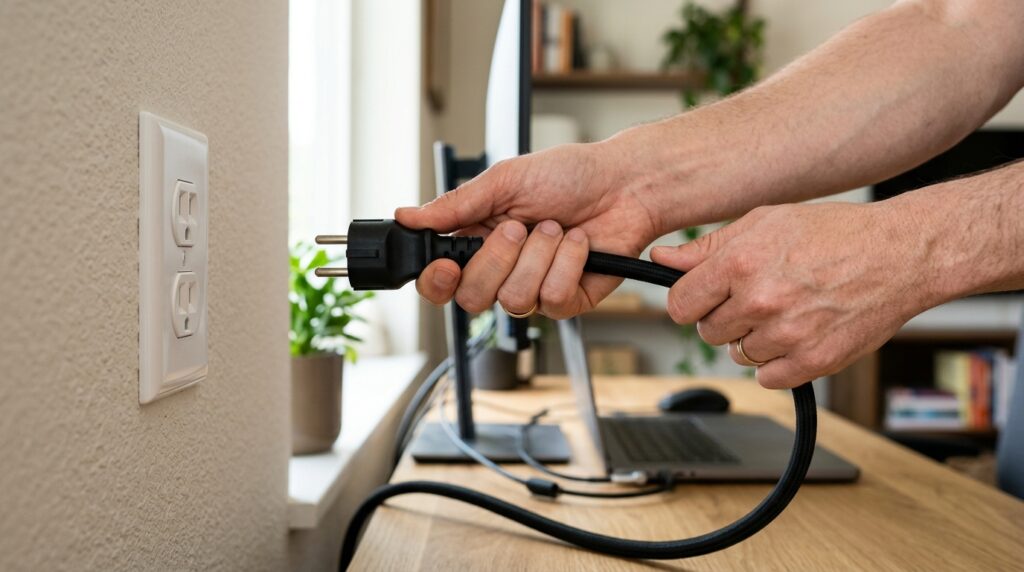
Physically unplugging is the most reliable way to protect your electronics
Should You Unplug Chargers and the Router During a Thunderstorm
Special attention should be given to devices that connect your home to the internet. Wi-Fi routers and modems burn out among the first because the strike comes not only from the power outlet but also through the internet provider’s cable, which often runs along rooftops and building facades. If the router stays plugged in, the impulse can pass through it and via the Ethernet cable strike directly into the motherboard of a connected computer.
As for smartphones, many people wonder whether it’s safe to use a phone during a thunderstorm. The answer is yes, you can, as long as it’s not connected to a charger. A mobile phone in your hands doesn’t attract lightning by itself, but if it’s charging from the wall, it becomes part of the home electrical network. Unplug charging blocks from outlets and use your gadgets on battery power.
Do Power Strips and Extension Cords Help During a Thunderstorm
There’s a popular myth that a regular plastic extension cord with a glowing red button will protect your electronics. In reality, cheap extension cords are simply power splitters — they have no protection against powerful impulses.
More expensive devices — genuine surge protectors with SPD (Surge Protection Device) functionality — can indeed smooth out minor surges. However, no household surge protector can fully absorb the energy of a direct or very close lightning strike.
Reliable protection should be built on multiple levels. For a private home, this means an external lightning rod, proper grounding, installation of a powerful SPD directly in the electrical panel, and only then — quality surge protectors for individual computers and TVs. But even with such a system, physically unplugging the cord remains the safest method.
How to Behave at Home During a Severe Thunderstorm
The main safety rule is to do everything in advance. You should unplug electronics while the thunder is still approaching. If the storm is already raging directly above your house, lightning is flashing, and thunder claps sound without delay, reaching for outlets and wires with your hands is absolutely prohibited.
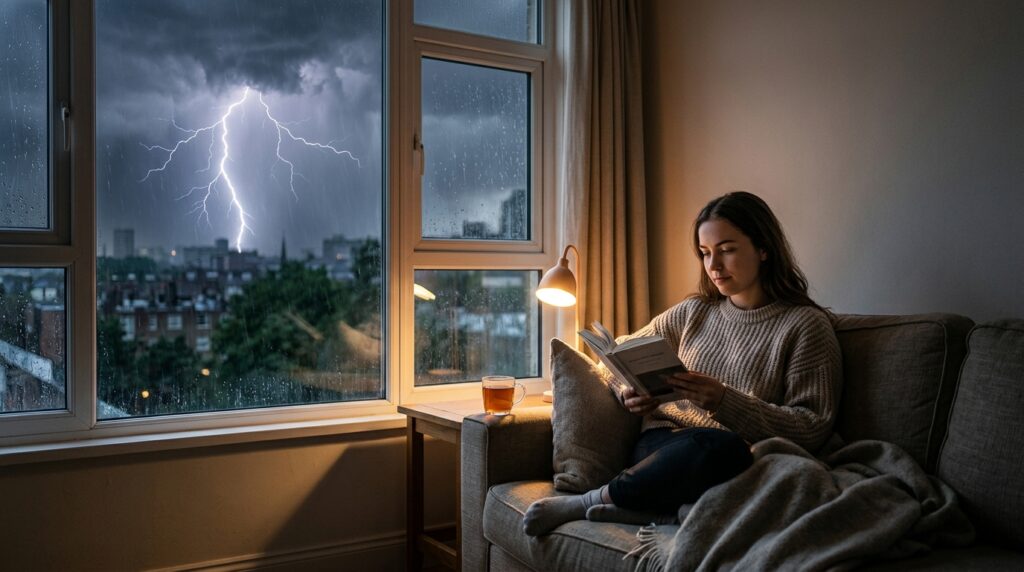
During a thunderstorm, it’s better to stay away from windows, outlets, and plumbing
Emergency services and meteorologists provide clear recommendations on how to behave indoors. According to the National Weather Service, at the peak of a storm it is recommended to stay away from outlets, panels, and any cables. It is also not recommended to take a shower, wash dishes, or touch metal pipes and faucets, since plumbing is closely connected to the home’s grounding system and can conduct electricity.
Stay in the center of the room, don’t stand near open windows or on the balcony. If a thunderstorm catches you off guard, just leave your electronics as they are — your life and health are more important than any burned-out TV. Wait out the storm, read a book, and wait until at least 30 minutes have passed after the last clap of thunder.