A silly exercise from the Japanese helps you fall asleep faster
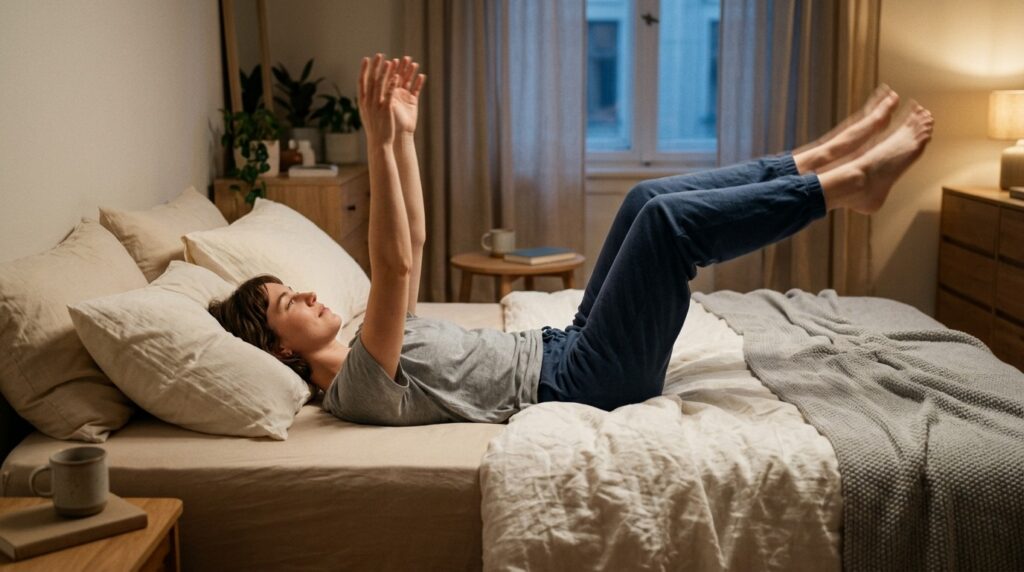
In Japan, a method for falling asleep quickly has been known for almost a hundred years, and it looks frankly ridiculous from the outside. You need to lie on your back, raise your arms and legs up, and then shake them for half a minute. Because of the pose, the exercise has been nicknamed “the cockroach.” At first glance it seems like eccentricity, but the method actually helps people with sleep problems. It’s a good alternative to other methods for falling asleep quickly.
Japanese Exercise to Fall Asleep Quickly
The method comes from the Japanese Nishi health system, which was developed in the 1920s–1930s by Katsuzo Nishi — an engineer who designed the Tokyo subway and also an aikido instructor. Among his recommendations for a healthy lifestyle was this exercise, which in Japanese is called ゴキブリ体操 — literally cockroach gymnastics.
How to do the cockroach exercise before bed:
- Lie on your back on a flat surface — a bed or a mat on the floor will work;
- Raise your arms and legs up, perpendicular to your body. You can slightly bend your knees and elbows;
- Gently shake your hands and feet for 20–30 seconds. The movements should be light, without tension, as if you’re shaking water off your hands;
- Lower your limbs, relax, and lie still for a while.
That’s it. No equipment, no apps, no expenses. It’s precisely the simplicity that makes this method so appealing — literally anyone can try it.
How Body Temperature Affects Sleep
To understand what shaking limbs has to do with anything, we need to look at physiology. Sleep and body temperature are tightly connected. Over the course of a day, our core temperature fluctuates: it’s slightly higher during the day and drops closer to nighttime. And it’s precisely this drop that the brain reads as a “time to sleep” signal.
The body doesn’t cool down on its own — it releases heat outward, through the palms and feet. Blood vessels in the hands and feet dilate, blood rushes to them, and heat escapes through the skin, like through a radiator. The core temperature drops, and then the brain receives a chemical signal and initiates the process of falling asleep.
In 1999, a study published in the journal Nature demonstrated exactly this. 18 volunteers were observed under controlled conditions: skin temperature, heart rate, melatonin levels, subjective sleepiness — everything was recorded. It turned out that the best predictor of falling asleep quickly was warm feet. Not overall fatigue, not overall body temperature, but foot temperature.
Why Shaking Arms and Legs Helps You Relax
This is where the cockroach method stands on its own feet — or rather, raises them. When you hold your arms and legs up and shake them, several things happen at once.
First, blood actively rushes to the hands and feet. Small blood vessels dilate, and the extremities warm up. When you lower your arms and legs back down, the warm blood begins releasing heat through the skin, triggering that same cooling mechanism that signals the brain it’s time for sleep.
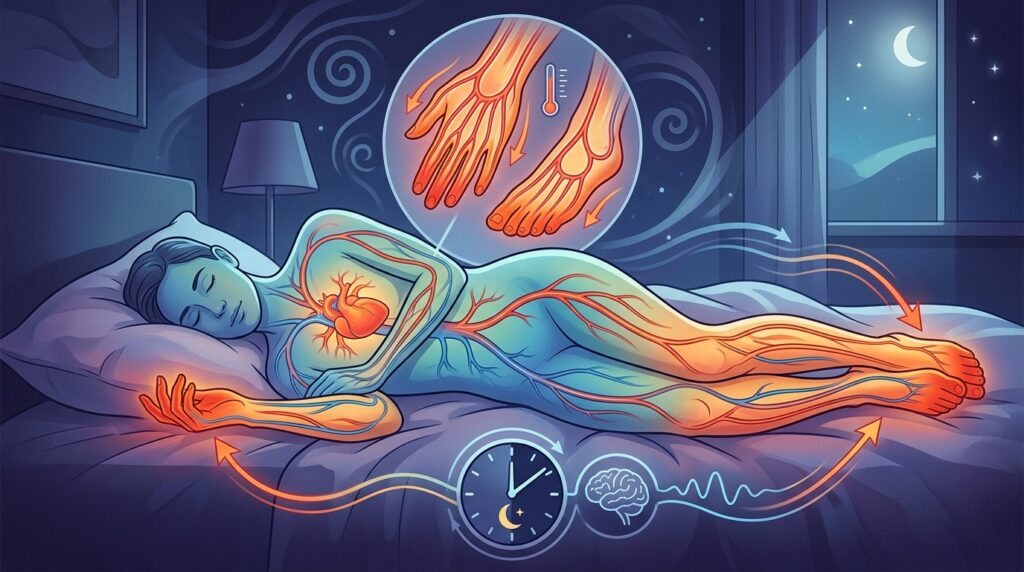
Blood flow to the hands and feet helps the body release excess heat and prepare for sleep
Second, gentle shaking relieves muscle tension. After a day at the computer or on your feet, arm and leg muscles often remain “clenched” even after you’ve already gone to bed. Small vibrating movements release that tension. Essentially, it’s the same effect as stretching after sitting for a long time.
Third, the movement itself — rhythmic, monotonous, requiring no mental decision-making — acts as a primitive form of meditation. Attention shifts from the mental carousel into the body, and that alone brings more calm.
Is There Scientific Evidence for the Cockroach Exercise?
Here it’s worth being straightforward: there are no peer-reviewed studies of the cockroach exercise specifically, which is part of the Katsuzo Nishi health system. Nobody has set up two groups and compared who falls asleep faster — those who shake their legs or those who don’t.
The Nishi system has barely undergone scientific testing because it’s a folk health practice, not a clinical protocol. But the individual building blocks it rests on are supported by science:
- The connection between extremity temperature and speed of falling asleep was proven in the 1999 Nature study;
- A 2019 review published in Sleep Medicine Reviews confirmed that a warm bath or shower one to two hours before bed helps you fall asleep faster, precisely through the same heat dissipation mechanism;
- Dilation of blood vessels in the extremities does indeed contribute to lowering core body temperature.
So the basic logic behind the exercise exists, but direct evidence of its effectiveness is still lacking. It’s worth keeping in mind that we’re dealing with a plausible hypothesis, not a proven method for treating insomnia.
Who Should Not Do the Cockroach Exercise
For most healthy people, the cockroach is a harmless activity, no harder than a regular warm-up. But there are a couple of caveats.
If you have vascular problems like varicose veins, thrombosis, and the like, it’s better to ask your doctor first. Raised legs and active shaking change blood flow patterns, and that’s not always appropriate. The same goes for serious spine or joint problems: lying on your back with arms and legs raised may simply be uncomfortable or painful.
The key condition for good sleep is a calm environment and a relaxed body
If you have chronic insomnia that has lasted for weeks, one exercise won’t solve the problem. In such cases, it’s better to see a doctor, because the causes can vary widely — from stress to hormonal imbalances.
Other Ways to Fall Asleep Without Pills
The cockroach is far from the only way to fall asleep quickly. There are several simpler methods that rely on the same principle or similar ones:
- A warm shower or bath 1–2 hours before bed. The skin heats up, then the body actively releases heat, and the core temperature drops right around the time you need to fall asleep;
- Socks at night. It sounds old-fashioned, but warm feet dilate blood vessels and speed up heat dissipation. That very Nature study showed that foot temperature is one of the best predictors of falling asleep quickly;
- A cool bedroom. Optimally around 20 degrees Celsius. In a cool room, it’s easier for the body to shed excess heat;
- No screens for an hour before bed. Blue light from phones and laptops disrupts melatonin production — the very hormone responsible for falling asleep;
- Breathing techniques. The 4-7-8 breathing method can help, where you inhale for 4 counts, hold for 7, and exhale for 8. This activates the parasympathetic nervous system — the division responsible for relaxation.
All these methods have one thing in common: they are free, safe, and don’t require a doctor’s prescription. As for popular supplements like melatonin and magnesium, convincing evidence of their effectiveness isn’t as abundant as one might hope.
The “cockroach” exercise won’t make a breakthrough in sleep medicine and is unlikely to end up in clinical guidelines. But the physiological logic behind it is quite real: warm hands and feet do indeed help the body switch into sleep mode faster. It takes half a minute, costs nothing, and in the worst case will just make your partner laugh. If you have trouble falling asleep, trying it certainly won’t hurt.