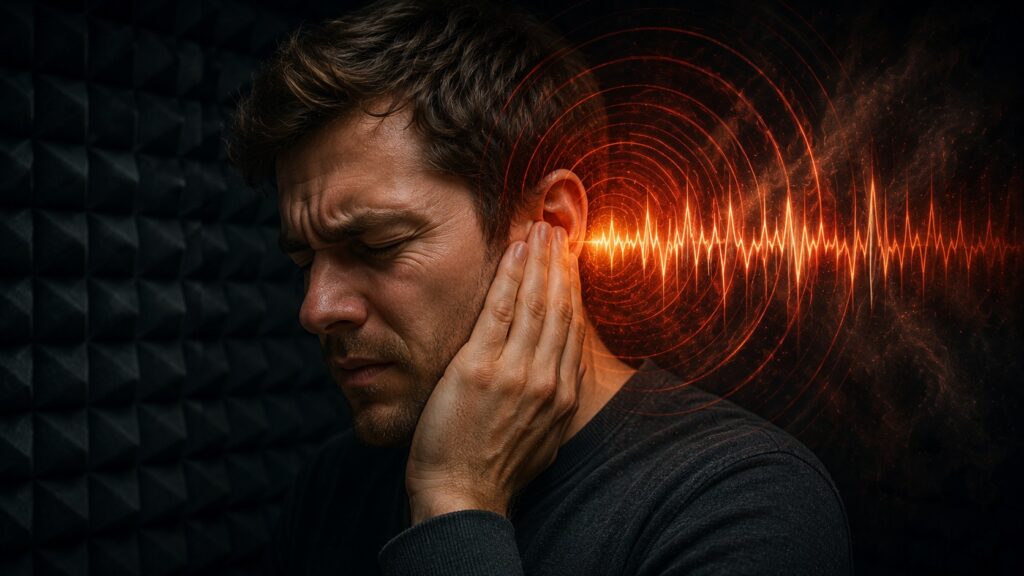
Ringing in the ears can occur even in a healthy person, but sometimes it’s a serious reason to see a doctor
If you find yourself in a truly quiet place, for example, in a special echo-free chamber, you will almost certainly hear a faint ringing or humming. And this doesn’t mean there’s something wrong with your ears. In complete silence, the human brain starts inventing sounds that don’t actually exist.
What Is Tinnitus in Simple Terms
Ringing, squeaking, or humming in the ears that you hear without an external sound source is what doctors call tinnitus. Essentially, it’s a phantom sound that exists only in your head, with no actual air vibrations occurring.
Generally speaking, this is a very common complaint. Most often, it accompanies other conditions, from a simple earwax plug to age-related hearing loss. But even a perfectly healthy person can experience ringing in the ears when they find themselves in complete silence.
Interestingly, deaf people most frequently complain about constant ringing and auditory hallucinations. Even those who were born completely deaf sometimes report hearing loud voices in their head. This suggests that the ringing originates not in the ear, but in the brain.
What a Person Hears in Complete Silence
To study how humans react to absolute silence, scientists built anechoic chambers. These are rooms whose walls are made of sound-absorbing materials and don’t reflect any sound at all. This is one of the few places on Earth where you can experience true silence, because in everyday life we are surrounded by noise literally everywhere, even in a remote village.
In a Brazilian study from 2008, 68% of participants began hearing ringing in their ears when placed in complete silence, even though they had never experienced tinnitus before. This means the ringing doesn’t arise from illness, but simply as the brain’s response to the disappearance of sounds.
Sometimes it goes beyond just ringing. People in silence begin to hear actual auditory hallucinations, up to and including music. One of the most famous cases happened with journalist Jad Abumrad, who sat in an anechoic chamber and heard a song by the band Fleetwood Mac that he had been listening to in everyday life.
Similar stories are told by those who spent long periods in complete silence outside of a chamber: hikers in remote forests or people drifting in the ocean. Sometimes these sounds from nowhere cause intense fear. Fortunately, most of us will never encounter such silence outside of a laboratory. In real life, we are surrounded by noise everywhere — even power lines produce loud sounds.
Why the Brain Creates Sounds on Its Own
To be honest, scientists still don’t know exactly why the brain reacts to silence with ringing. But there are several plausible explanations.
The thing is, our brain is not at all like a machine with rigidly laid wiring. Its connections are flexible, and nerve impulses can travel almost anywhere. This is well known, for example, to people with epilepsy. Sometimes this flexibility is precisely what produces strange sensations.
One popular theory suggests that in silence, the brain gets confused and misreads where signals are coming from, mistaking the results of its own activity for actual sound. Another idea is that without the usual flow of sensory information, the brain’s “wires literally get crossed.”
Put simply, when a sense is switched off, the brain fills the void on its own. This is the same logic by which a person who has lost a limb feels phantom pain, blind people sometimes “see” flashes of light, and deaf people hear ringing, voices, or music. This isn’t a malfunction, but a perfectly natural reaction to emptiness. And as soon as sounds return, tinnitus symptoms in most people quickly disappear without consequences.
When Ringing in the Ears Is a Serious Symptom
The ringing you hear at night in absolute silence is most likely that same normal brain reaction, and there’s no need to be alarmed by it. It’s a different matter if tinnitus appeared suddenly and interferes with your life. In that case, it’s worth seeing a doctor.
Tinnitus is almost never an independent disease, but rather a symptom of something else. A doctor can immediately resolve a simple problem — for example, remove an earwax plug if home remedies haven’t helped. A mild plug can sometimes be washed out with warm water, but in more serious cases, manual cleaning by a specialist is needed.
However, the cause may not be earwax at all. Sometimes ringing in the ears is a consequence of sinusitis, an inflammation of the nasal sinuses. And sometimes it’s a sign of brain injury or other disorders. The list of possible causes is long, and that’s exactly why it’s important to figure out what’s behind your specific case.
So, ringing in the ears in complete silence is a normal reaction of the brain, which fills in sounds on its own when there are no external signals. Scientists haven’t yet determined the exact cause of ringing in the ears, but there’s nothing dangerous about this unusual phenomenon. However, if your ears are ringing in everyday surroundings, constantly or increasingly louder, that’s already a signal to check your health.