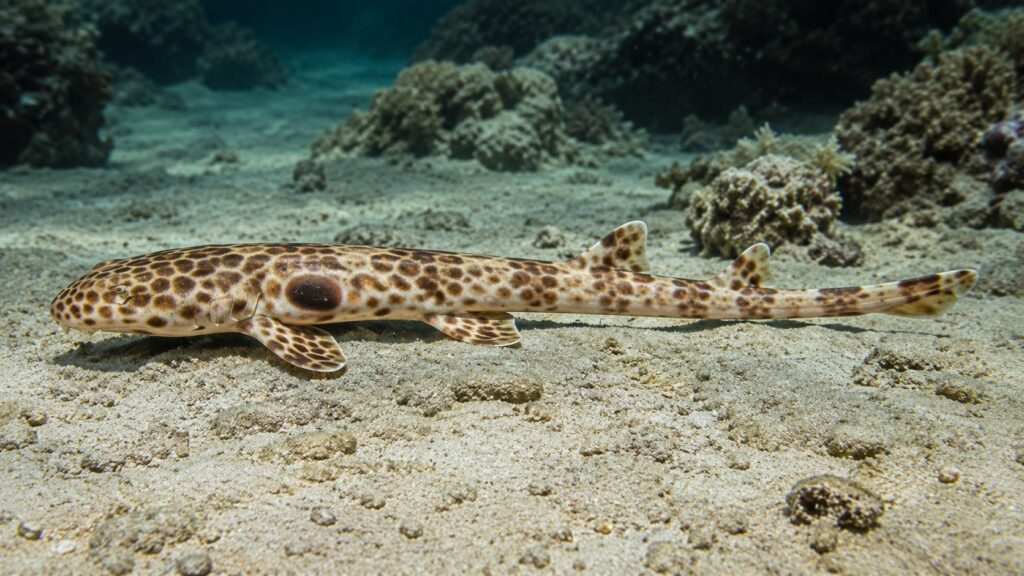
Walking shark of the species Hemiscyllium dudgeonae
Off the coast of Papua New Guinea, a new species of “walking” shark has been discovered that moves across reefs using its own fins. This amazing discovery proves that even in well-warmed shallow waters, there are many creatures unknown to science capable of surviving in the most extreme conditions. This creature is far from being the scariest shark, and the predator actually looks quite cute.
How and Why Sharks Walk Along the Bottom
Marine biologists have described a new species given the Latin name Hemiscyllium dudgeonae. Unlike large and swift ocean predators, these small fish prefer to spend their entire lives on shallow coral reefs. And the most striking thing about them is their ability to “walk” along the sea floor, deftly leaning on their pectoral and pelvic fins as if on four legs.
This unusual method of locomotion becomes critically important during low tides. When the water recedes, many sections of the coral reef become isolated from the deep ocean. Under these conditions, the shark literally has to crawl across exposed shallows and small pools in search of prey.
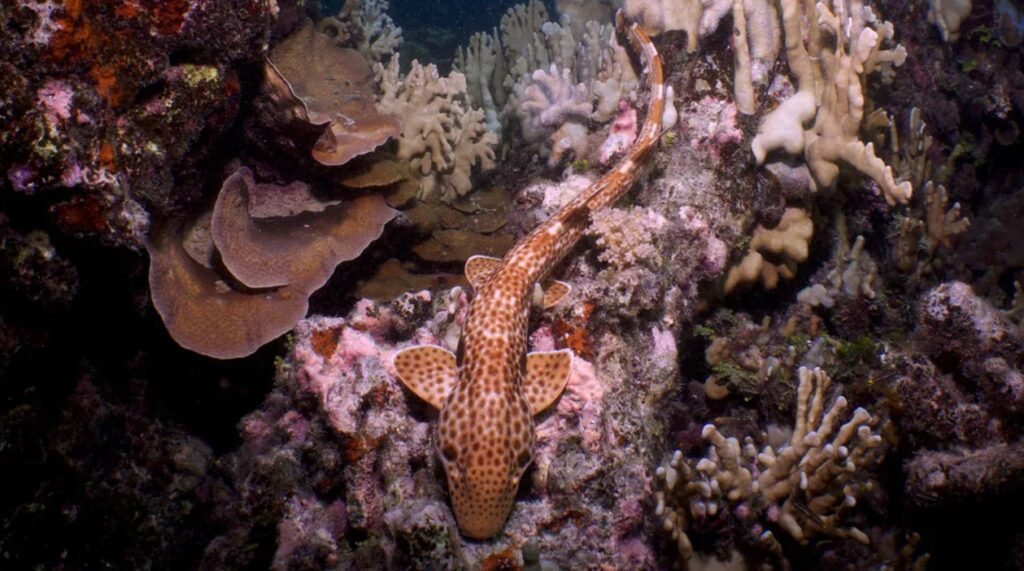
Shark Hemiscyllium dudgeonae. Image source: Live Science
Scientists believe that this physiological feature evolved as a response to the harsh and variable conditions of tropical reefs. During low tide, oxygen levels in isolated pools drop rapidly. However, research shows that walking sharks can withstand oxygen deprivation for several hours. The internal mechanisms of their survival have not yet been fully studied, but it is precisely these mechanisms that allow these fish to remain active and hunt where others would suffocate.
Where Scientists Find New Fish Species
Typically, new species of marine creatures, including rays and sharks, are discovered at great depths that underwater vehicles previously couldn’t reach. However, this species was found in Milne Bay at a depth of less than one meter. Biologists were greatly surprised, as it turned out that shallow waters harbor enormous biodiversity about which we know almost nothing.
The ocean regularly surprises researchers — for example, not long ago a shark was discovered in the Caribbean Sea that can live for several centuries. But in the case of the inhabitant of Papua New Guinea, scientists had to work hard to prove its uniqueness.
Researchers conducted a thorough DNA analysis in an Australian laboratory. They compared the genetic material of the found specimens with samples from other related species. The results put everything in order. Before them was indeed the tenth species of walking shark ever identified, possessing its own genetic profile and a unique pattern of spots on its body. This was reported by the authors at Live Science.
What Makes the Walking Reef Shark Vulnerable
To date, representatives of the new species H. dudgeonae have been encountered at only three locations off the coast of Papua New Guinea. As biologists note, most species of walking sharks typically don’t travel far. They spend their entire lives on the home reef where they were born and practically never migrate to other waters.
This attachment to a single location makes them extremely vulnerable to any ecological changes. If their home reef is damaged, the sharks cannot simply swim away and colonize new territories. Among the main threats to such species, experts identify:
- habitat destruction due to human activity and ocean pollution;
- rising water temperatures caused by global climate change;
- overfishing, which disrupts food chains in coastal zones.
Since the species’ geographic range is severely limited, any local disaster could deal an irreparable blow to the entire population. Species with narrow habitats are traditionally the first to end up on endangered lists.

Divers with the new shark species. Image source: Live Science
Scientists plan to continue expeditions in the region to better study the behavior and lifestyle of the walking shark. This discovery once again reminds us that only a few shark species pose a danger to humans. For the most part, they are an incredibly diverse and eclectic group of animals that continues to amaze science with its ingenuity in survival.