Someday Pluto may become a planet again
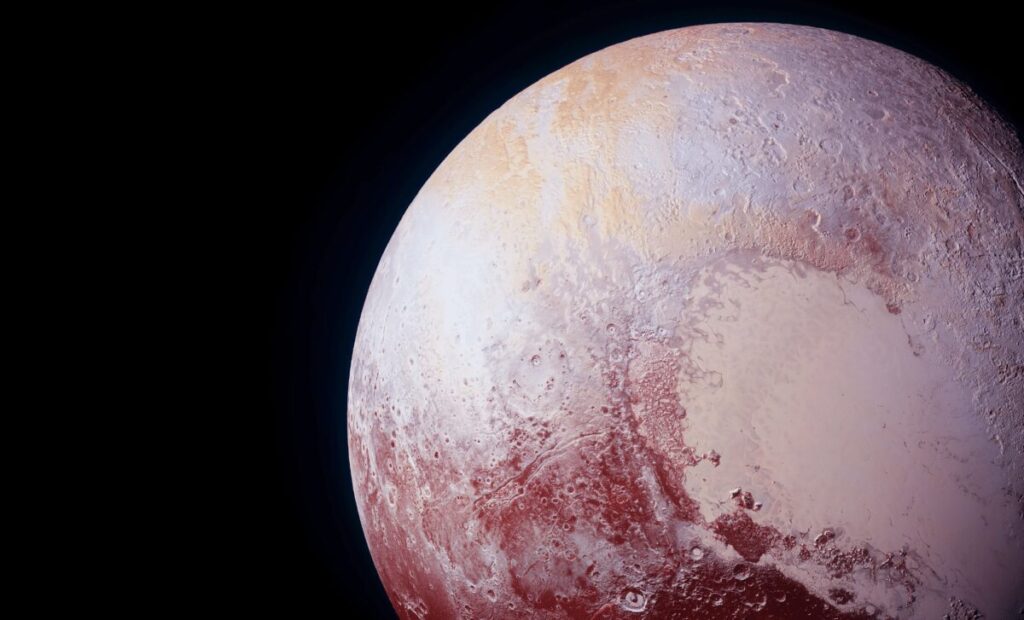
If you remember learning about nine planets in school, it looks like that story might be rewritten. NASA Administrator Jared Isaacman has stated that he supports restoring Pluto’s status as a full-fledged planet, and the agency is already preparing scientific publications on the matter. The statement came amid discussions of a budget that could nearly halve NASA’s science programs, and it has once again split the astronomical community.
What the NASA Administrator Said About Pluto’s Status
Speaking on April 28, 2026, before the Senate Subcommittee on Commerce, Justice, Science, and Related Agencies, Isaacman openly supported the idea of revisiting Pluto’s classification. He didn’t limit himself to generalities: according to him, NASA is already preparing scientific publications that should serve as the basis for discussion within the scientific community.
Isaacman emphasized that this is a coordinated effort, not a symbolic gesture. He stated that the agency wants to revisit this discussion and make sure that Clyde Tombaugh receives his deserved recognition. Tombaugh was the American astronomer who discovered Pluto in 1930.
It’s important to understand that the final decision on Pluto’s planetary status is not made by NASA, but by the International Astronomical Union (IAU) — the organization that “demoted” Pluto twenty years ago. But when the world’s largest space agency begins preparing publications in support of a reclassification, it creates serious pressure on the scientific community.

Clyde Tombaugh, who discovered Pluto
Why Pluto Stopped Being Considered a Planet in 2006
To understand why Isaacman’s statement caused such a stir, it’s worth recalling how Pluto lost its status. The IAU defined a planet by three criteria: it must orbit the Sun, be massive enough to assume a spherical shape, and have cleared its orbital neighborhood of other objects.
Pluto failed the third condition, since it shares space in the distant Kuiper Belt with many other dwarf planets. The Kuiper Belt is a region of icy bodies beyond Neptune’s orbit — a kind of “cosmic outskirts” of the Solar System.
Imagine the eight planets as large landowners who completely control their stretches of road: all rocks and debris in their path have been either absorbed or swept away. Pluto, on the other hand, is more like one of many travelers on a crowded trail rather than the master of its own territory. Its mass is only 0.07 of the total mass of other objects on its orbit, whereas Earth exceeds everything on its orbit by 1.7 million times.
But supporters of Pluto have a counterargument. Earth also shares its orbital space with numerous asteroids, as does Jupiter, they note. So why was Pluto punished for something that’s forgiven for others?
The Discovery of Eris and a Chain Reaction in Astronomy
The real “killer” of Pluto’s planetary status was the discovery of Eris. Astronomer Mike Brown’s team from Caltech found an object in the Kuiper Belt that turned out to be more massive than Pluto. If Pluto is a planet, scientists reasoned, then Eris should be one too. And after Eris, dozens more similar bodies. The Solar System risked having not nine, but dozens of planets.
In August 2006, the IAU voted to “demote” Pluto. The vote was preceded by a week of debates, and various proposals were considered, including one in which Pluto would remain a planet while Ceres and Charon would be added to the list.
The decision was criticized for low turnout: only 424 astronomers voted out of approximately 10,000 professional astronomers worldwide. This argument is still used by those who consider Pluto’s “demotion” illegitimate.
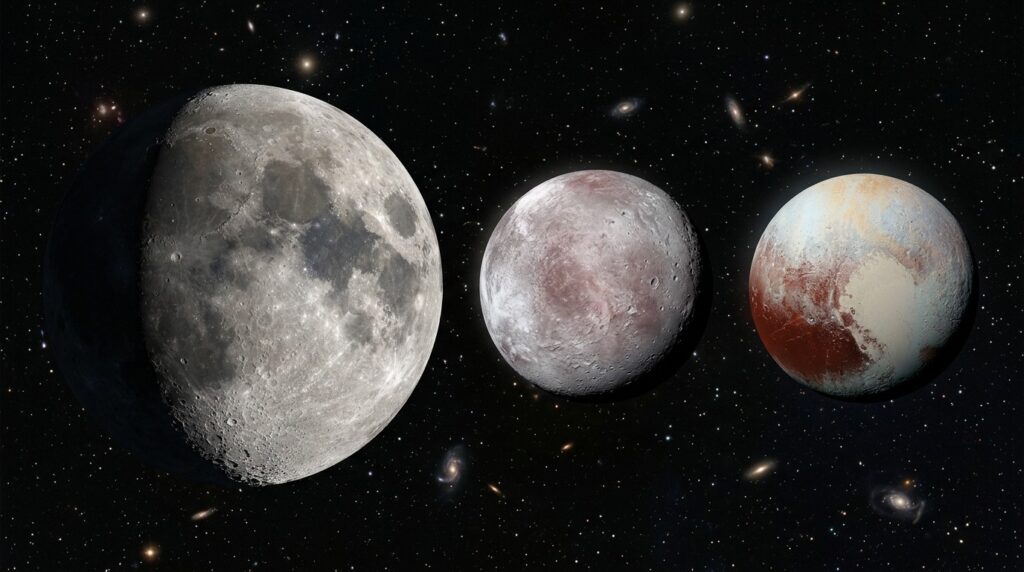
Size comparison of Pluto, Eris, and the Moon
Why the Scientific Community Is Debating Pluto’s Status
Isaacman’s statement provoked polarized reactions. Alan Stern, the principal investigator of the New Horizons mission — the probe that first photographed Pluto up close — has long and consistently advocated for restoring its planetary status. Among the arguments are Pluto’s complex geology, thin atmosphere, and geophysical characteristics revealed during the probe’s flyby in 2015.
On the other side is Mike Brown, a professor of planetary astronomy at Caltech, who has been dubbed “Pluto’s killer.” He stated that while NASA administrators indulge in nostalgia for the days when Pluto was a planet, real scientists will continue to classify objects in the Solar System in ways that help us understand the world we live in.
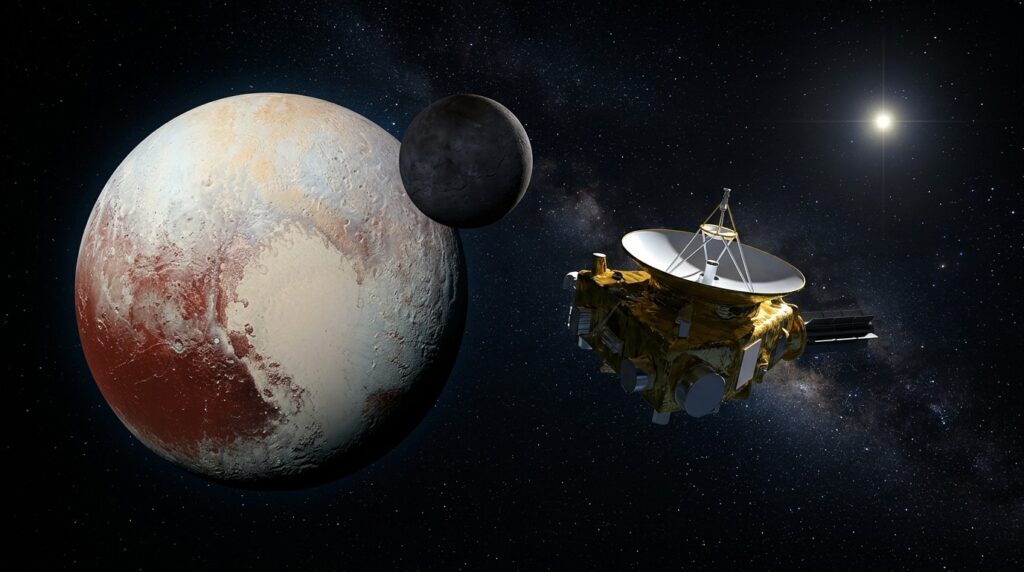
The New Horizons interplanetary station approaching Pluto
Many astronomers are not thrilled that the head of an influential agency is revisiting a scientific decision using a political slogan. Isaacman’s phrase “Make Pluto A Planet Again” indeed echoes a well-known political slogan.
However, the split in the scientific community on this issue existed long before Isaacman’s words. Many planetary scientists continue to consider Pluto and other dwarf planets to be full-fledged planets. The debate is not so much about Pluto as it is about the definition itself: what is a planet and who has the right to determine that.
NASA Budget Cuts and the Question of Priorities
The statement about Pluto came in an ambiguous context. The budget request for 2027 proposes cutting NASA’s total funding by 23% and science programs by 47%. According to the Planetary Society, the budget for NASA’s Science Mission Directorate is proposed to be reduced from $7.25 billion to $3.9 billion — the largest science cut in the agency’s history. If the proposal is implemented, up to 53 scientific missions could be shut down — nearly half of NASA’s entire science fleet.
Against this backdrop, allocating resources to revisit Pluto’s classification seems, in the opinion of some observers, a strange priority. The New Horizons mission itself is also under threat: it could face cuts if the proposed budget is approved.
However, Congress has repeatedly rejected deep cuts to NASA’s science budget, and resistance has already begun this time as well. The House Appropriations Committee has proposed maintaining NASA’s overall budget at $24.4 billion, effectively rejecting the White House’s request.
When the Nancy Grace Roman Telescope Will Launch
In addition to Pluto, Isaacman informed senators that the Nancy Grace Roman Space Telescope could be launched ahead of schedule — in August instead of September 2026. This telescope is designed to study dark energy and search for exoplanets, including potentially habitable worlds.
An early launch is good news for NASA, which has long been criticized for delays and cost overruns on major projects. However, it raises questions for some: were important testing stages skipped to accelerate the schedule?
The hearings also served as a platform for discussing the successful Artemis 2 mission and plans to establish a permanent lunar base. Isaacman confirmed the intention to launch the Space Reactor-1 Freedom mission to Mars in 2028 — the first test of a nuclear fission reactor to power an interplanetary spacecraft.
All of this paints an ambitious picture: NASA is simultaneously trying to advance its lunar program, prepare a Mars mission, launch a new telescope, and revisit Pluto’s status.