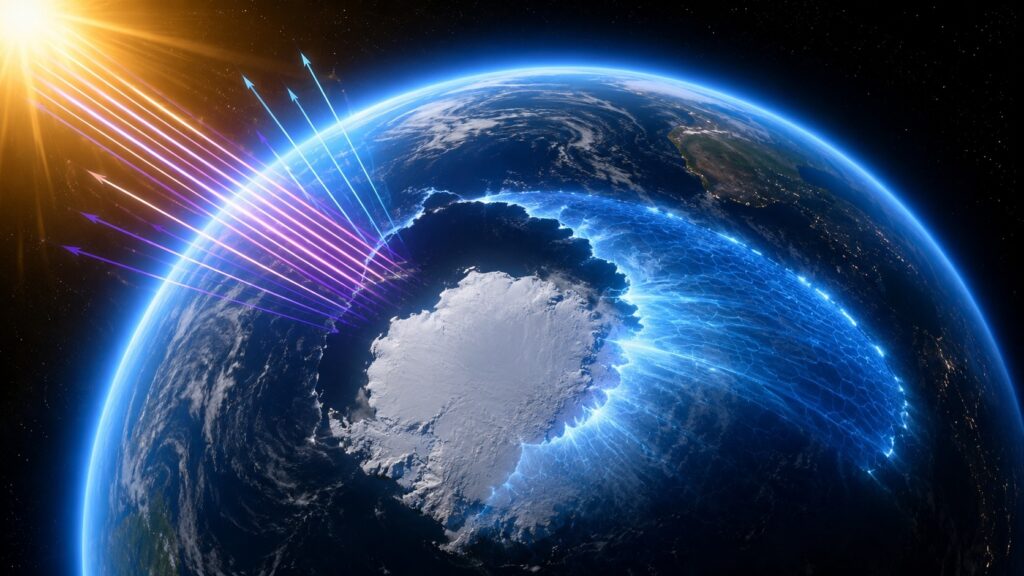
In the 20th century, the ozone layer was in dire condition, but catastrophe was averted
In the late 20th century, humanity faced a threat that seemed irreparable. Earth’s protective ozone layer was being destroyed by substances that people considered completely harmless. But then nearly 200 countries unexpectedly reached an agreement and managed to save the world from catastrophe. This is the only example in history when a global environmental problem was solved through joint efforts.
What Is the Ozone Layer and Why Is It Needed
The ozone layer is located at an altitude of 15 to 30 kilometers above Earth. Essentially, it is a thin layer of ozone in the stratosphere. If all the atmospheric ozone were collected and compressed to sea-level pressure, it would form a layer only about 3 millimeters thick. But it is precisely these millimeters that determine whether life on land is possible.
Ozone acts as the planet’s invisible sunscreen. It absorbs ultraviolet radiation, which is particularly dangerous for living organisms. Without it, cases of skin cancer, cataracts, and immune system disorders would be significantly higher, and ecosystems — particularly marine plankton — would suffer serious losses.
Simply put, without the ozone layer, going outside on a sunny day would be roughly as dangerous as lying under a quartz lamp without protection. Plants, animals, and humans would be defenseless against solar radiation.
What Substances Were Destroying the Ozone Layer
In the mid-20th century, the chemical industry created a group of substances that seemed ideal. These were chlorofluorocarbons (CFCs), also known as freons. They were non-toxic, non-flammable, non-explosive, and inexpensive. Chlorofluorocarbons were once widely used in industry and everyday life for refrigeration, air conditioning, packaging production, and in the manufacture of aerosol cans.
Hair spray, deodorants, refrigerators, air conditioners, foam packaging — CFCs were literally everywhere. And no one suspected that these stable and seemingly harmless substances harbored a colossal threat.
The problem lay precisely in the stability of freons. These substances are inert, meaning they can remain in the atmosphere long enough to reach the stratosphere and destroy the ozone layer. CFC molecules are sufficiently stable in the atmosphere until they rise to the middle layers of the stratosphere, where under the influence of UV radiation they break down, releasing atomic chlorine. And a single chlorine atom can destroy tens of thousands of ozone molecules, triggering a chain reaction.
How Scientists Proved the Danger of Freons
In 1974, Mario Molina and Sherwood Rowland discovered that chlorofluorocarbons (CFCs), upon entering the atmosphere and coming into contact with sunlight, trigger a chemical reaction that destroys ozone. The research results were published in the journal Nature. Even earlier, in 1970, Dutch chemist Paul Crutzen showed that nitrogen oxides are also capable of destroying stratospheric ozone.
Refrigerant manufacturers and some scientists harshly criticized the hypothesis suggesting such a connection, denying the existence of ozone holes. Chemical corporations did not want to lose a multi-billion dollar market, and CFCs at that time were the foundation of entire industries.
The turning point came in 1985. Scientist Joseph Farman discovered the ozone hole over Antarctica. During spring, ozone levels dropped to nearly half the values observed just a few years earlier. This discovery was confirmed by a NASA satellite.
What Is the Montreal Protocol
The response from the international community was surprisingly swift. In 1985, the Vienna Convention for the Protection of the Ozone Layer was agreed upon, and in 1987 the Montreal Protocol was prepared for signing — an addendum to the convention outlining goals and methods for reducing ozone-depleting substances. It entered into force on January 1, 1989.
The Montreal Protocol on Substances that Deplete the Ozone Layer was signed by representatives of 46 countries on September 16, 1987. Initially, the document called for freezing production of the five most commonly used CFCs and halons at 1986 levels, followed by a 20% reduction by 1995 and a 30% reduction by 1998.
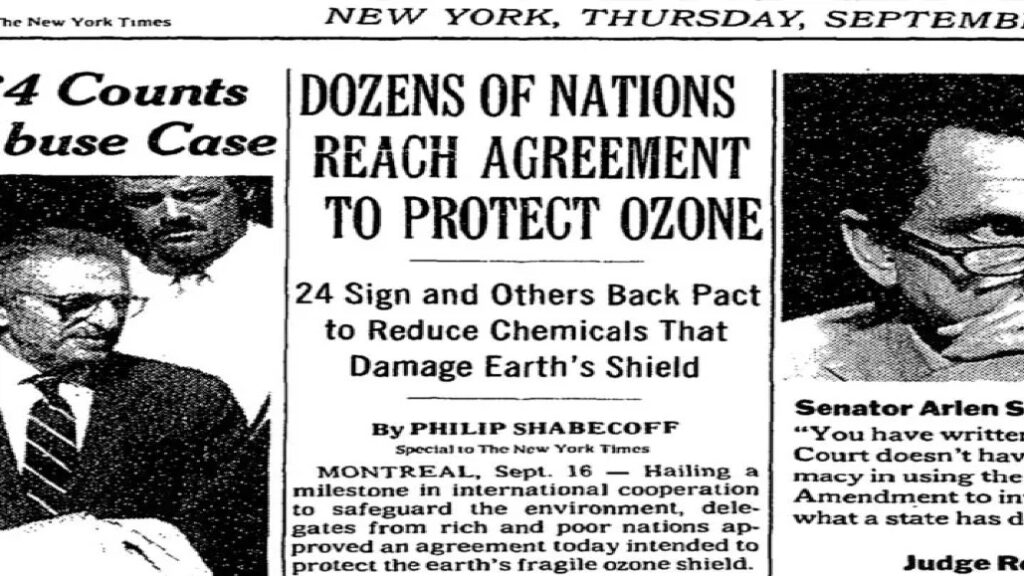
A newspaper article about countries’ readiness to protect the ozone layer
But within a few years, the requirements became stricter and the number of participants grew. All nations ratified the original Montreal Protocol, with a total of 198 parties. This is the first international environmental treaty with universal ratification — not a single state remained on the sidelines.
How Countries Agreed to Ban Freons
At first glance, it seems incredible that nearly 200 countries with different economies and interests agreed to ban profitable chemical substances. Several factors came together to make this possible.
First, the science was convincing and clear. The Antarctic ozone hole was not an abstract model but a concrete, measurable fact confirmed by satellite data. People around the world feared skin cancer — the threat was understandable to everyone.
Second, only 13 years passed from the first scientific publication to a decision at the international level. Scientists, politicians, and diplomats worked in parallel, not waiting until everything was proven.
Third, the document provided for assistance to developing countries in transitioning their industries to ozone-safe substances and technologies. Poor countries were not left alone with the costs of restructuring production — a special multilateral fund was created for financial assistance.
Finally, replacing CFCs proved technically feasible. Industry found alternative refrigerants and propellants, although the transition required time and investment.
How the Ozone Layer Is Recovering
The world has gradually phased out 98% of ozone-depleting substances (ODS) contained in nearly 100 hazardous chemicals. And the ozone layer has indeed begun to recover.
Researchers have found that if current policies remain unchanged, the ozone layer could recover over most of the world by 2040, in the Arctic by 2045, and in Antarctica by 2066. This forecast means the ozone layer would return to its 1980 condition — that is, before the formation of the infamous ozone holes.
Observations for 2024 show elevated ozone levels compared to the 2003–2022 average values for most of the Earth. In Antarctica, depletion was noticeably weaker; the ozone hole formed more slowly and closed faster than in the previous three years.
The recovery of the ozone layer is uneven from year to year, but the overall trend is positive. And the Montreal Protocol itself continues to evolve. On January 1, 2019, the Kigali Amendment to the Montreal Protocol entered into force. Under it, countries pledged to reduce the use of hydrofluorocarbons (HFCs) by more than 80% over the next 30 years. HFCs replaced freons and do not harm the ozone, but turned out to be potent greenhouse gases, so now the protocol also helps combat global warming.
What the Ozone Hole Story Means for Fighting the Climate Crisis
Beyond restoring the ozone layer, the Montreal Protocol carries other benefits for nature. Some CFCs were potent greenhouse gases, and their impact on the climate has now been virtually eliminated. Additionally, the agreement has been able to enhance carbon absorption by vegetation, since the ozone layer protects plants from ultraviolet radiation.
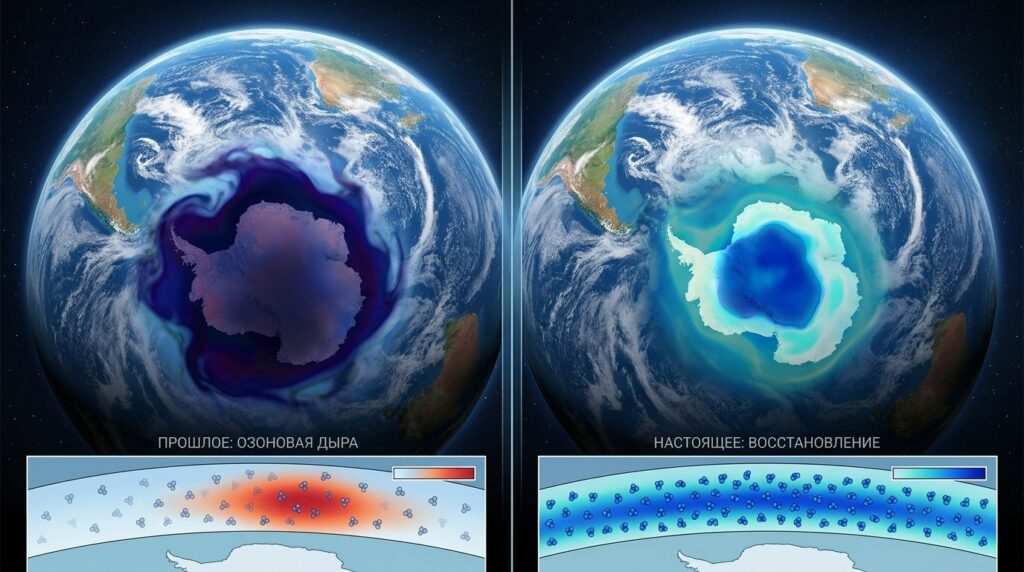
The ozone hole over Antarctica is gradually closing thanks to international efforts
But the problem of global warming is more serious and complex than the formation of the ozone hole. The issue of climate change is linked not to a single group of chemicals but to the harm caused by the entire global energy system. Replacing oil, gas, and coal is harder than replacing freons in refrigerators.