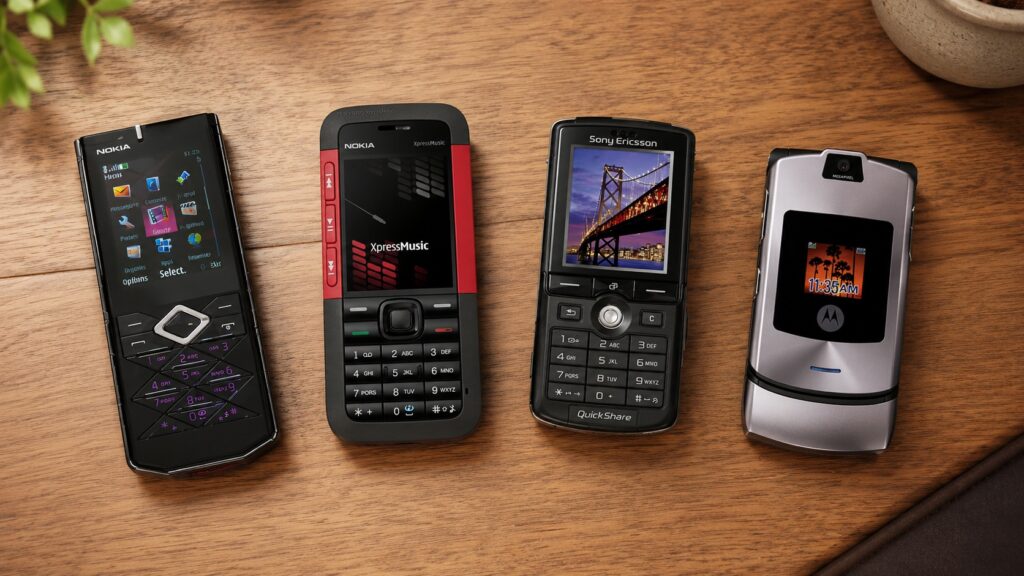
Old phones are back in fashion, but are we ready to give up smartphones?
Lately, you can increasingly see people with button phones. Not elderly people, but quite young ones who have modern smartphones in their pockets, yet they pull out a handset with physical keys. Their sales are growing, and it’s not nostalgia or penny-pinching. There’s a deeper reason why people are consciously choosing old phone models. And recently, I wanted to become one of them.
What Is Digital Fatigue in Simple Terms
Smartphones were conceived as convenient assistants, but imperceptibly turned into generators of continuous noise. We pick up the device for a second to check a message, and come to our senses half an hour later, scrolling through short videos. According to VTsIOM data, the smartphone has filled all the empty spaces in life, and half of users don’t let go of it during rest, work breaks, or even before bed.
Under such conditions, a regular button phone solves the problem radically. It simply doesn’t have a recommendation feed, messengers, or notifications trying to steal your time. Rospotrebnadzor calls this approach digital detox — a temporary rejection of complex devices for the sake of returning to real communication.
The Aesthetics of the 2000s
If a simple calling device used to be considered a sign of lack of money, now its meaning has completely changed. For young people who have been surrounded by smart technology since childhood, it’s a conscious manifesto. Rejecting smartphones and constant online presence has become a fashionable statement, showing that a person controls their life and doesn’t submit to algorithms.
The aesthetics of the 2000s (Y2K) also plays a huge role. Modern gadgets look like identical black rectangles, whereas old Nokias, BlackBerrys, or bright flip phones have physical character — buttons, clicks, and unusual shapes. It’s no surprise that some old mobile phones are now valued precisely for their unique design. Manufacturers have noticed this demand, so the market is actively seeing re-releases of classic models for those seeking a break from the internet.

For zoomers, an old flip phone has become the same kind of accessory as a film camera
A Button Phone Is Safer Than a Smartphone, but Not Completely
There’s a common belief that without the internet and apps, a person is completely safe. Indeed, if a device has no mobile banking, browser, or NFC, it’s much harder for scammers to make you download malicious software. You won’t click on a phishing link or install a fake app disguised as a government service.
However, a button phone doesn’t protect against social engineering, which remains the main tool of cybercriminals. You can still be intimidated by voice, tricked into giving up an SMS code, or convinced to transfer money through an ATM. Moreover, Kaspersky Lab specialists have found hidden functions in some cheap devices that secretly subscribed the owner to paid content. So basic protection against smartphone threats increases, but it doesn’t make a person invulnerable.
In What Situations Are Simple Phones Actually Useful
Beyond fashion and philosophy, old gadgets have practical advantages. Simple calling phones have several undeniable pros that smartphones often lose on:
- high battery life — a week without charging is considered normal, and in standby mode the battery lasts for months;
- affordable price, thanks to which you’re not afraid to break or lose the device;
- compactness and durability, which is ideal for hiking, construction sites, or country houses.
There are specific situations when a button phone is better than a modern flagship. For example, it’s an ideal compromise for children. In Russia, schoolchildren are officially prohibited from using phones during lessons, and UNESCO directly states that smartphones harm concentration. With a button device, parents gain confidence that their child is reachable, without risking their academic performance.
Will People Switch to Button Phones
Despite the growing sales of some button phone brands, a mass abandonment of smart devices is not expected. According to the same VTsIOM statistics, two-thirds of Russians are not ready to completely part with their smartphones. Without them, it’s objectively difficult to use taxis, navigation, work chats, banking apps, and a decent camera.
Most likely, we are witnessing the formation of a new culture of technology use. People increasingly use two phones at once, where the smartphone remains a tool for work and necessary services, while the button phone is used for digital detox in the evenings, on weekends, or during vacations.
The return of old phones is not a step backward in technological development, but an attempt by people to reclaim their personal time. The button phone has turned into a stylish tool for stress relief that helps us occasionally switch off the virtual world while remaining in reality.