Heading to China and worried about payments? Russian cards don’t work there, and cash is accepted far from everywhere. The main payment method is QR codes via WeChat Pay and Alipay. Previously, topping up a Chinese wallet from Russia was a real headache, but now MTS has launched transfers to WeChat Pay directly from the “My MTS” app. Here’s how to pay in China with Russian cards and how the new top-up method works.

WeChat can be topped up via MTS
Do Russian Cards Work in China
Since September 2025, Russia and China have had a visa-free regime. You can enter with an international passport and stay for up to 30 days. The number of Russian tourists has noticeably increased, but paying for things is still not straightforward.
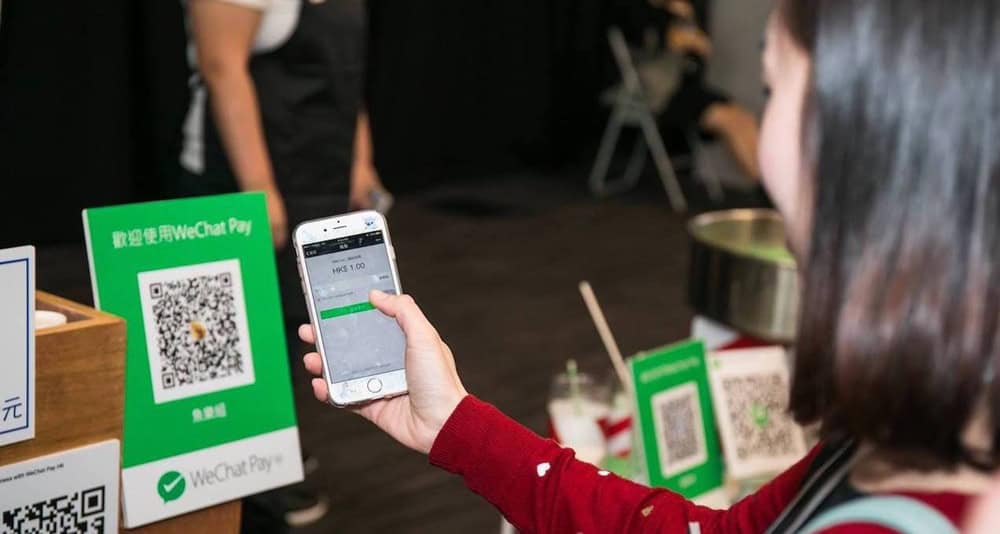
WeChat is arguably the most popular payment method in China
Russian bank cards don’t work in China — neither Visa, Mastercard, nor Mir. Cash yuan is accepted only at major hotels and airports. The entire country pays via QR codes through two systems: WeChat Pay and Alipay. Without one of them, you literally can’t buy water at a store.
WeChat Pay is a payment module within the WeChat messenger. Every resident of China has it. For a tourist, this means one thing: top up the wallet — and you can pay at any store, café, taxi, and even a street fruit vendor.
How to Transfer Money to WeChat Pay via MTS
MTS has launched transfers to WeChat Pay wallets with no commission. The service can be used by subscribers of any Russian carrier — you just need to log into the “My MTS” app with your phone number. Money can be debited from your MTS internal balance or from a linked bank card from any Russian bank.
Here’s how to do it:
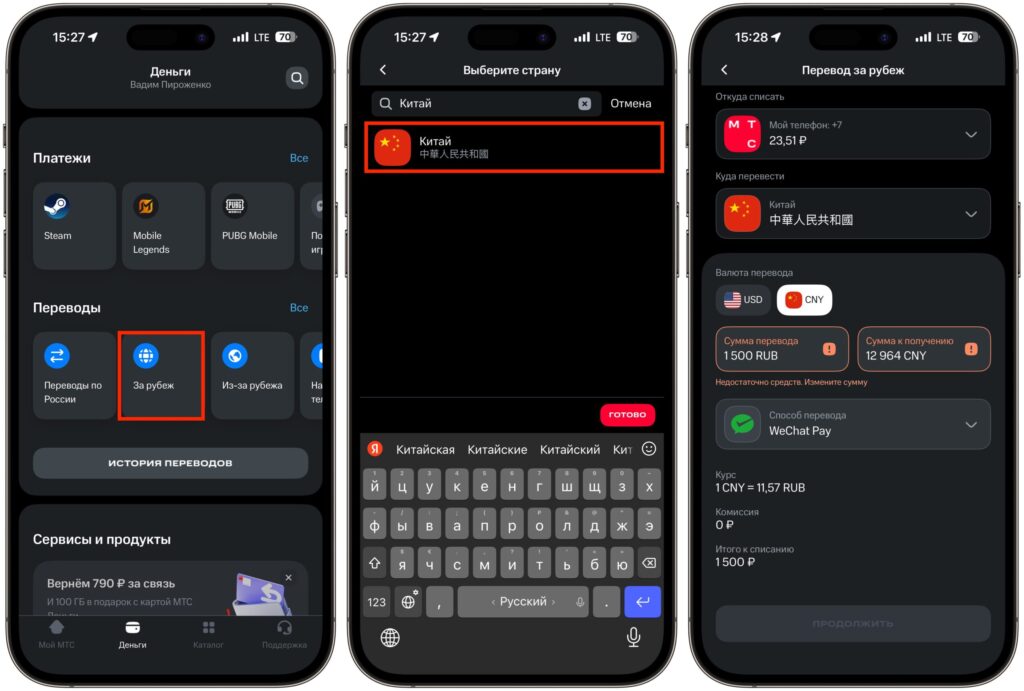
Money can be debited from either your MTS balance or a bank card
- Open the “My MTS” app and go to the “Money” tab.
- Select the “Transfers” section and tap “Abroad.”
- Choose the country — China.
- Enter the amount and transfer currency.
- Select WeChat Pay as the transfer method.
- Choose where to debit from: MTS balance or bank card.
- Confirm the transfer.
The minimum transfer amount is 1,100 rubles. The maximum is 400,000 rubles. The money is automatically converted to yuan. MTS doesn’t charge a commission, but there’s a catch — the conversion rate.
Commission for Topping Up WeChat Pay via MTS
There’s formally no commission, but MTS makes money on something else — the yuan exchange rate markup. At the time of writing, the rate in the “My MTS” app is 11.57 rubles per yuan. The market rate is around 11.0 rubles.
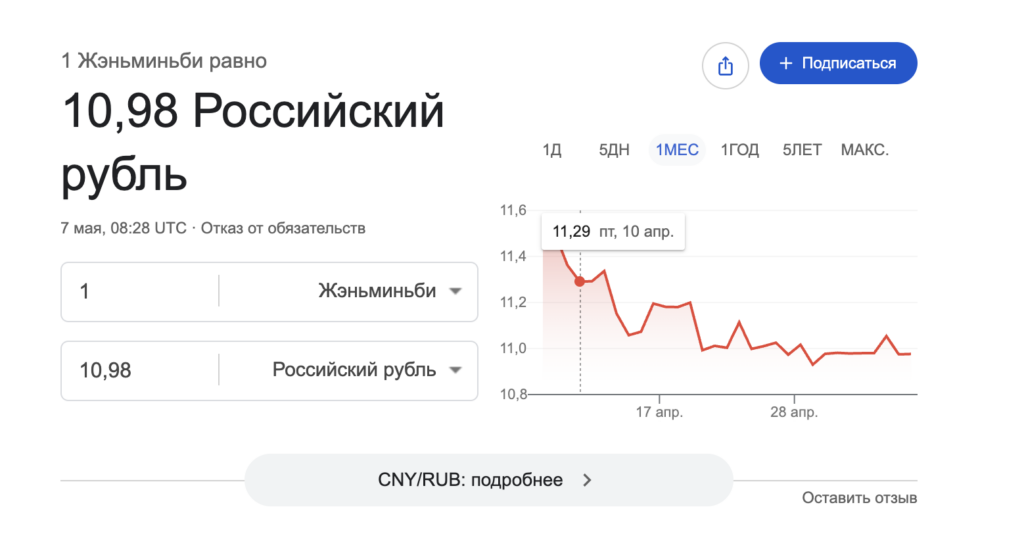
The market rate is somewhat lower than what’s shown in the app
The difference is approximately 5%. This means that for every 10,000 rubles, you “lose” about 500 rubles compared to the market rate. Whether that’s a lot or a little depends on the amount. For small transfers for a trip, the difference is tolerable, but when topping up 100,000 rubles, you’ll overpay about 5,000 rubles.
For comparison: T-Bank also offers transfers to WeChat Pay and Alipay. They launched this service back in November 2025, and since then the transfer volume has grown sevenfold. So before your trip, it’s worth comparing rates across different services.
Is It Safe to Transfer Money to WeChat Pay via MTS
MTS doesn’t disclose who exactly processes the transfers. And for good reason. Chinese banks and payment systems, including WeChat Pay, don’t work with Russia directly — they fear secondary sanctions from the US and EU.
According to Forbes, most likely MTS has partnered with one of WeChat’s partners in a third country — this could be a small financial company in Asia, Africa, or the CIS. Meanwhile, WeChat itself (or rather, parent company Tencent) may not even know about this partnership.
This creates certain risks for the user. If the intermediary stops operating, transfers could cease at any moment. On the other hand, while the service is functioning, it’s one of the simplest ways to top up WeChat Pay from Russia without leaving home.