Rare cosmic show: how the Moon will hide Venus in broad daylight this week
On June 17, the Moon will pass in front of Venus right in the daytime sky — a phenomenon astronomers call an occultation. The most interesting part is that the meeting of the two brightest objects in the sky after the Sun can be seen not in darkness, but in broad daylight — over the Caribbean, the USA, northern Mexico, and southern Canada. Such events don’t happen often, and this occultation is considered one of the best astronomical spectacles of 2026. Let’s break down what exactly will happen, why it’s rare, and how you can actually spot a planet in daylight.
What Is an Occultation of Venus by the Moon
An occultation is when the Moon, on its path across the sky, passes directly in front of another object and temporarily hides it from the observer. It’s not the same as a star dimming. Essentially, it’s the same mechanics as an eclipse, except instead of the Sun, the Moon blocks a planet or a star.
The Moon will cover Venus’s disk in just 29 seconds — the planet will appear to dive behind the dark edge of the lunar crescent and emerge on the other side half a minute later. During the event, Venus shines at roughly magnitude −4, making it the brightest object in the sky after the Sun and the Moon.
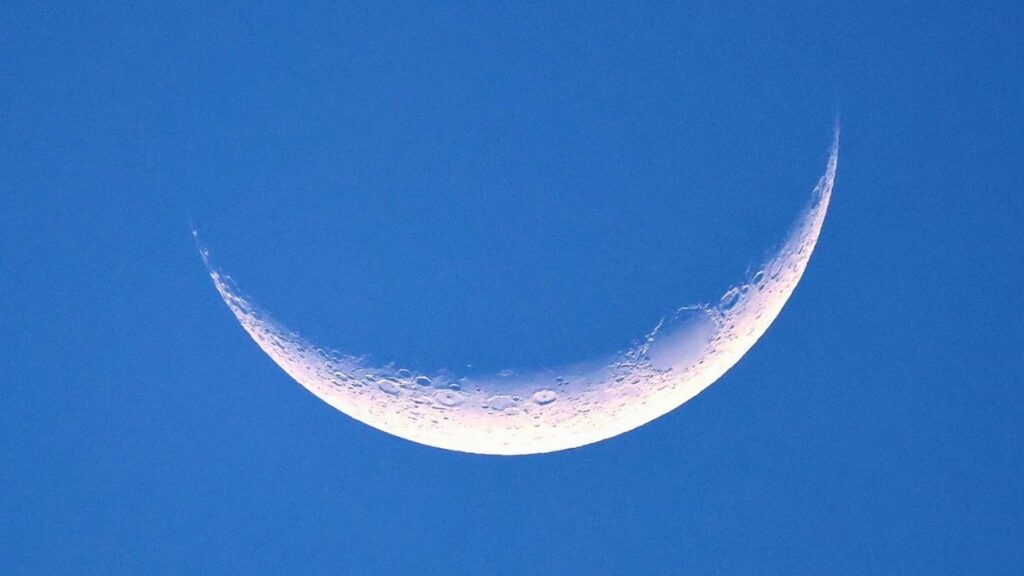
The Moon itself will be a very thin waxing crescent at that moment, only 11% illuminated. The New Moon occurred on June 15, so by the 17th, the Moon has moved only slightly away from the Sun — and met Venus along the way.
When and Where You Can See the Venus Occultation on June 17
The occultation will take place in the afternoon on Wednesday, June 17, with the central moment around 20:40 UTC. The exact time depends on your specific location.
The visibility zone is divided into two parts. Over the northeastern part of South America, Venus will be hidden against an already dark post-sunset sky, while over the Caribbean, the continental United States, northern Mexico, and southern Canada, the event will occur during the day, before sunset. If you want to find out the precise seconds of the beginning and end of the occultation for your location, it’s convenient to check the timing lists published by the International Occultation Timing Association (IOTA), or use the Stellarium planetarium software.
Why Venus Is Even Visible During the Day
Here’s where it gets really interesting. Venus is the only planet bright enough to be spotted during a daytime occultation. Its dense clouds reflect about 70% of incoming light, which is exactly why the planet shines so prominently.
And now for a strange fact: the Moon reflects light far worse than Venus — less than 14% compared to 70% for Venus’s clouds. Up close, the lunar surface resembles worn asphalt — gray and dull.
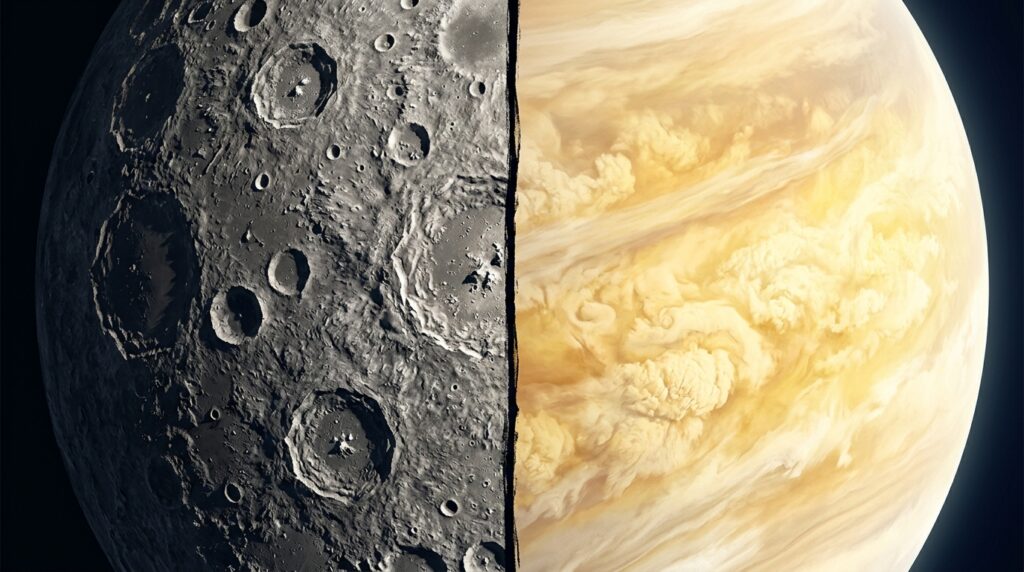
The gray surface of the Moon and the bright clouds of Venus reflect light in completely different ways
So why does the Moon appear pearly white to us? It’s a matter of concentration: the small amount of light the Moon does reflect is concentrated on a tiny patch of sky, and to the eye, that dull gray transforms into a bright glow.
Evening Bonus: Mercury and the Beehive Star Cluster
This week is generous with events beyond just Venus. Mercury reaches its greatest eastern elongation — that is, it moves 24.5 degrees away from the Sun, making it the best time to finally see the innermost planet with your own eyes. On the evening of June 16, the thin lunar crescent passed just 2.5 degrees to the north-northeast of Mercury.
And just hours after the Venus occultation, there will be a continuation. The same lunar crescent will occult the open star cluster Messier 44 (known as the Beehive Cluster, or Praesepe) in the constellation Cancer. This will be best seen in the southeastern United States during twilight. Then on June 19, Venus itself will pass just north of this cluster.
How to See the Venus Occultation: Practical Tips
Seeing Venus during the day is entirely possible, but it requires patience. A deep blue sky with high contrast works best — in haze, spotting the planet is much harder.
If you want to capture the event on video, keep a few things in mind:
- Turn off autofocus — it often stubbornly refuses to lock onto the daytime Moon
- Choose a wide-angle frame where the Moon and Venus are visible together
- Watch for the moment when the planet disappears behind the dark edge of the lunar crescent
- Check the exact start and end times for your location in advance
This is the first of three occultations of Venus by the Moon in 2026: the next ones will occur on September 14 in Southeast Asia and November 7 at the southern tip of South America. For residents of the continental United States, this event is one of the last favorable ones until 2029–2031.
Why You Should Watch the Occultation of Venus by the Moon
A daytime occultation of Venus is a rare case where astronomy becomes accessible to literally everyone: you don’t need to wait for deep night or drive out of the city away from streetlights. All you need is a clear blue sky, a bit of patience, and the exact time for your location.
If you can’t catch the moment, it’s worth noting the dates of the next occultations and observing Mercury — not everyone gets the chance to see the planet closest to the Sun. It’s also a great excuse to organize some daytime “sidewalk astronomy” with friends and show them that bright planets can be spotted even in broad daylight.