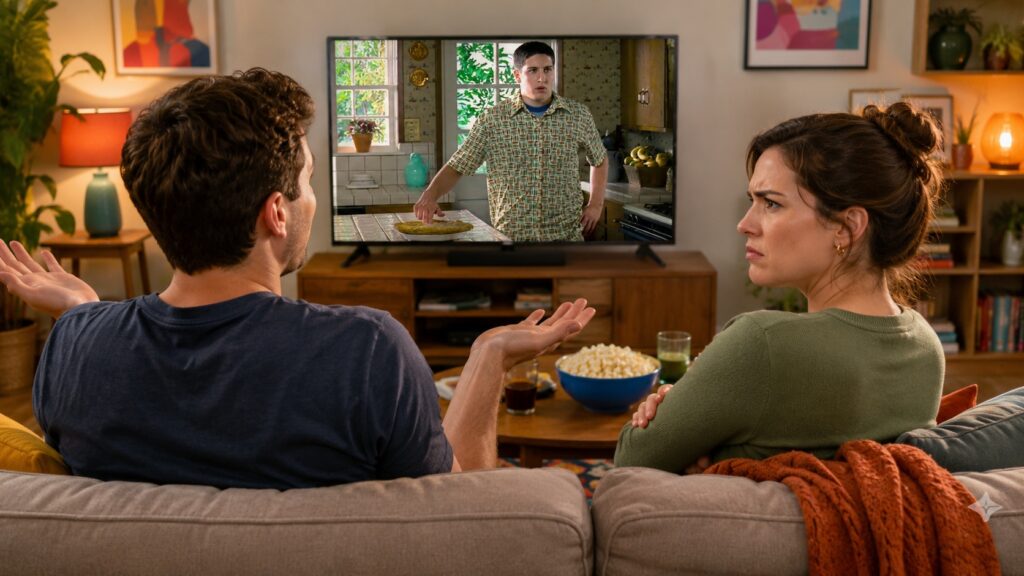
Sometimes choosing a movie for the evening leads to awkward situations
Finding a movie for the evening that everyone will enjoy is an almost impossible task. Streaming catalogs are overflowing, everyone’s tastes differ, so instead of watching, you spend half an hour arguing. And sometimes everyone agrees to just rewatch the same movie. But in reality, choosing a good film doesn’t depend on ratings or the director. There’s a simple rule that always works. And it’s not about cinema.
First, decide what kind of evening you want
According to survey results cited by Kommersant, searching for a movie takes about 25 minutes. And almost half of viewers sometimes get so exhausted from scrolling through options that they end up abandoning the idea of watching anything altogether. The problem is that people try to find a film that is guaranteed to please absolutely everyone, even though tastes differ even among the closest people.
Moreover, the perception of a film heavily depends on a person’s current state. After a hard workday, a complex three-hour drama can easily seem painfully boring, even though on a day off it could have made a huge impression.
Set strict limitations before you start searching
The most common mistake is immediately opening a streaming catalog and scrolling through new releases. Experts recommend starting the selection process by formulating the task in one sentence. For example, you want to laugh and unwind, or, on the contrary, you need an intense film that won’t let you get distracted. At this stage, the mood of the evening is much more important than the genre, so the request should be as precise as possible: not just “horror,” but “intense horror without gross scenes.”
Right after choosing the mood, each participant should set strict limitations. The question “What do you want to watch?” often stumps people, but almost anyone knows what they definitely don’t want.
Typically, restrictions concern the following aspects:
- exclusion of certain genres, such as musicals or horrors;
- runtime limitations;
- presence or absence of subtitles;
- exclusion of heavy themes, such as incurable diseases.
If each person names one such restriction, the huge list of options will instantly shrink, and making the final choice will be much easier.
Don’t choose from a hundred movies
The more similar covers you see, the harder it is to settle on something. It always seems like the next option will be even more interesting. To avoid falling into this trap, the choice needs to be artificially limited by handing the initiative to one person.
For groups or families, the following scheme works great. One person, taking all restrictions into account, finds exactly three candidates. The other participants have the right to eliminate one option they categorically dislike. The winner is chosen from what remains. Going back to the general catalog is strictly prohibited.
For couples, a similar method works: each person suggests two movies, then eliminates one of the partner’s suggestions. This removes the burden of responsibility from one person, so nobody complains about a bad decision later.

When choosing a movie, it’s important to identify unsuitable options from the very beginning
Quickly review movie reviews
Modern streaming platforms like Kinopoisk analyze viewing history and ratings to suggest films using the “similar to what you already liked” method. However, a high average score doesn’t guarantee success, as it only reflects the averaged opinion of the general audience.
A rating won’t show you how slowly the plot develops or how much dialogue there is on screen. That’s why you should pay attention not only to numbers but also to text reviews. If you skim through several short reviews, you can spot recurring words: “dragged out,” “predictable,” or “dynamic.” If five different people complain about a boring first half, that’s more useful than a single enthusiastic review spanning ten paragraphs.
Introduce the first 10–15 minutes rule
Even with perfect planning, misfires happen. The description sounds intriguing, the trailer looks lively, but the movie itself doesn’t hook you. Authors from specialized publications like Kino Mail advise agreeing in advance: if nobody is interested from the very beginning, the boring movie gets turned off without arguments or guilt.
How to find a good movie in 10 minutes:
- The first minute is spent determining the mood of the evening;
- The second minute is allocated for each person to name a strict restriction;
- The third minute is needed to set the maximum runtime;
- From the third to sixth minute, one person finds three candidates;
- Then ratings, reviews, and age restrictions are examined;
- Finally, viewers watch the beginning of trailers and make a decision.
You shouldn’t continue watching just because of the time spent searching. Fifteen lost minutes are always better than two ruined hours. The main goal of a good evening movie is not to turn out to be the greatest masterpiece in cinema history, but to start on time and bring viewers the emotions they gathered in front of the screen for.