Seedless table grapes do not reproduce on their own. Growers propagate them by rooting cuttings, which produce genetically identical copies of the parent vine, while breeders develop new seedless varieties by rescuing the undeveloped seeds in sterile laboratory conditions. The seeds themselves are not absent: in seedless varieties they begin to form but stop developing early, leaving soft traces inside the ripe berry.
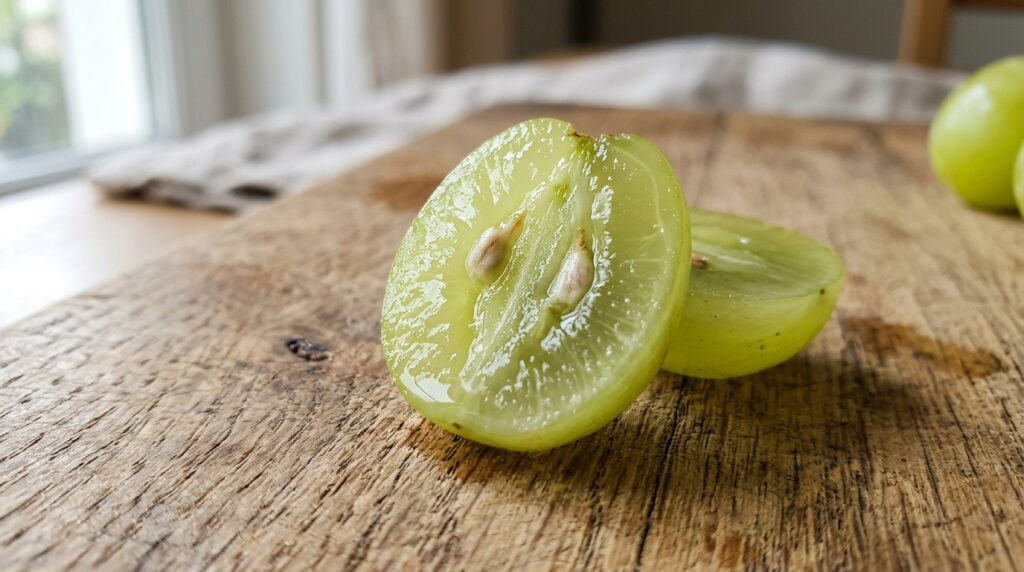
Halved grapes on a wooden board
What you need to know
- In seedless grapes, the flower is pollinated and fertilized normally, but the embryo becomes non-viable and the seed stops developing while the berry keeps ripening. This mechanism is called stenospermocarpy.
- Existing seedless varieties are multiplied by rooting cuttings, which yield exact genetic copies of the parent vine. This is why a vineyard can contain dozens of rows of one variety without a single seed being planted.
- To breed new varieties, scientists grow the immature seeds of seedless grapes in sterile conditions; success rates are not always high, but some become mature vines.
- Recent research suggests a gene in a relatively small region of chromosome 18 may be responsible for seedlessness, but this remains a working hypothesis, not a confirmed answer.
Seeds start to form but never harden
A fruit is a plant’s reproductive organ, so grapes are in principle supposed to contain seeds. In ordinary grapes, pollen lands on the flower, fertilization takes place, the berry sets, and a hard seed with a living embryo forms inside.
In seedless varieties the first steps are the same. The flower is pollinated and fertilized, the cluster sets, and the berries grow to roughly the size of a peppercorn. Then the paths diverge: the embryo inside the seed turns out to be non-viable, and the seed stops developing while the berry itself continues to swell and ripen. This mechanism is known as stenospermocarpy: the fruit grows, but the seed halts halfway.
As a result, the seeds in seedless grapes are underdeveloped rather than missing. Cut a berry open and you can make out soft traces of seeds that never hardened. It is like a construction site where the foundation was laid and then abandoned: the house around it is finished, but only an outline remains of what could have grown inside.
This should not be confused with seedless watermelons, where seeds fail to appear for a different reason. The explanation for grapes cannot be transferred to watermelons.
Cuttings produce an exact genetic copy of the vine
If there are no seeds, where do new vines come from? Plants do not have to reproduce by seed. Many of them, including wild grapes, can reproduce clonally: roots appear at certain growth points along a shoot, and once they touch soil they take hold, producing a daughter plant that is genetically identical to the parent.
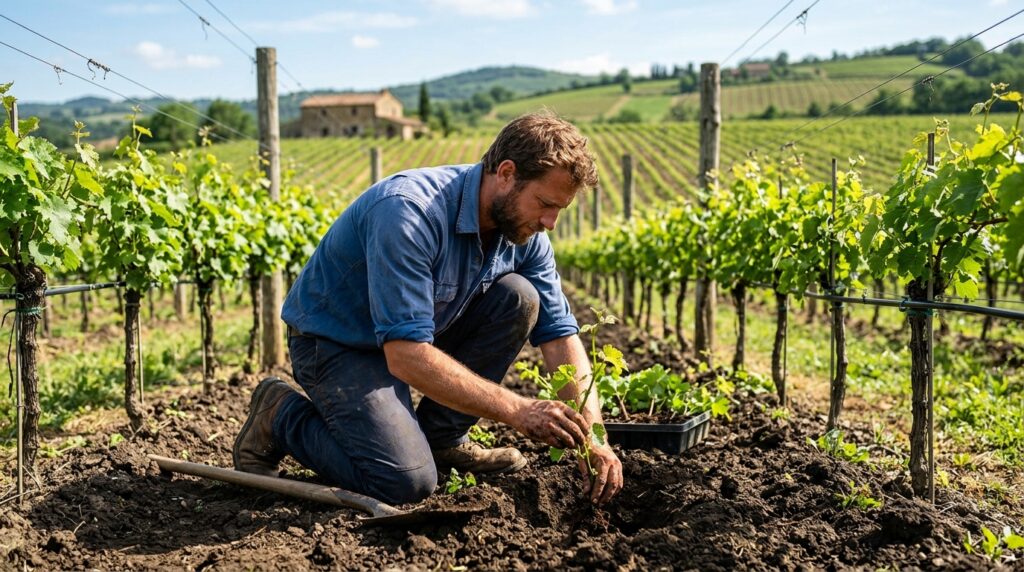
A grape grower planting a grapevine cutting in the soil
People have used this trait for thousands of years to multiply plants with desirable qualities. A cutting from a seedless vine is rooted and grows into an identical vine bearing the same seedless berries. That is how a vineyard can consist of dozens of rows of a single variety without a single seed ever being planted. The original seedless vine would struggle to reproduce on its own; humans have taken over that job.
Clonal propagation has a hard limit, however: it copies but does not create. A cutting reproduces its parent exactly, so it is impossible to obtain a new variety with different traits this way. That requires a different tool.
New varieties come from seeds that cannot be planted in soil
Breeding relies on crossing: pollen from one variety is transferred to the flowers of another, and the offspring are grown and screened for favorable combinations of traits. A seedless parent presents an obvious problem. Its seeds are underdeveloped and will not germinate in soil.
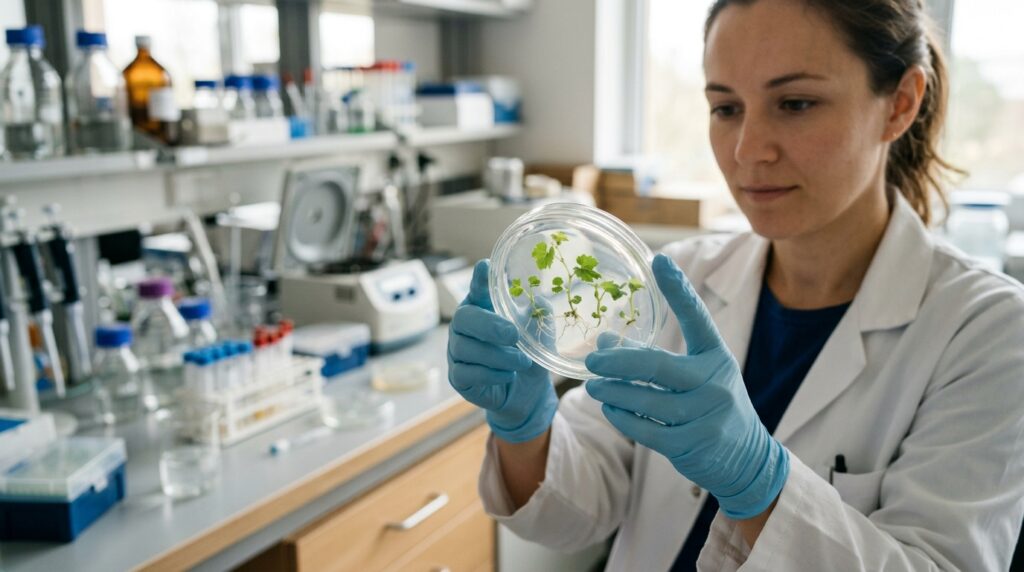
A scientist examining a Petri dish with plant seedlings in a laboratory
Scientists found a workaround: the immature seeds of seedless grapes can be grown in sterile conditions. The success rate is not always high, but some of these seeds do develop into mature vines. This lets breeders use seedless varieties as parents and obtain offspring with new combinations of traits.
From there the cycle closes. The best seedlings are selected, and only those few plants are then multiplied by cuttings. A new variety is born once in the laboratory and then copied many times over in the field. Multiplying an existing variety and creating a new one are two distinct tasks with different methods, and they should not be conflated.
The seedlessness gene is being sought on chromosome 18
The mechanism that halts seed development is understood, but its root cause is not fully known. Embryo development is blocked by what is called the Seed Development Inhibitor (SDI), and scientists are searching for the genes responsible for producing it. According to recent research, a gene in a relatively small region of chromosome 18 may be responsible for seedlessness. This is a working hypothesis rather than a final answer: the wording “may be responsible” is deliberate.
If the gene and its location are confirmed, it could become easier for breeders to transfer seedlessness into new table grape varieties that already have other desirable qualities.