
How old is your dog really?
A dog’s age isn’t just a number for the record. It determines what food to give, how often to visit the vet, how much longer your pup will live and keep delighting you with a wagging tail, and what to expect from them in general. But what if your dog came without papers? The good news is that a dog’s age can be determined by quite noticeable signs — teeth, coat, eyes, and behavior. Let’s explore how veterinarians do it, what you can notice yourself, and how to convert dog years into human years.
Why the “One Year Equals Seven” Rule No Longer Works
Many people still calculate a dog’s age using the old formula: multiply dog years by seven — and you get the “human” equivalent. It seems convenient, but in reality this is one of those persistent scientific myths: such oversimplification is almost always wrong.
The thing is, dogs mature unevenly:
- In the first year of life, a puppy goes through an entire childhood and adolescence at once — in terms of development, that’s roughly equivalent to a fifteen-year-old human;
- The second year adds about nine more “human” years;
- After that, the pace slows down, and each subsequent year counts for roughly four to five human years.
There’s also a second important factor: breed size. Small dogs live longer and age more slowly, while large ones do the opposite. A Great Dane at seven is already considered elderly, while a Chihuahua at that age is still in its prime. That’s why there’s no single chart “for all cases” — but the general principle is easy enough to understand.
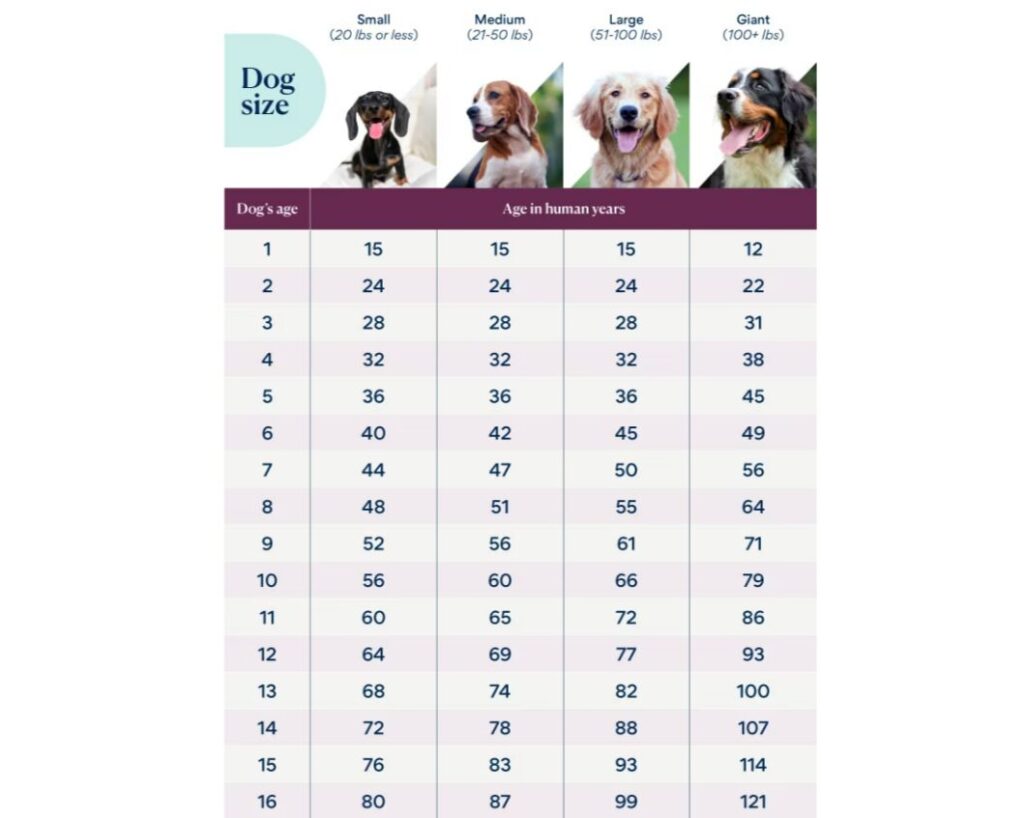
Dog-to-human age comparison chart
Teeth, Gray Hair, and Eyes: Key External Signs
If a dog is still young, teeth will tell you its age almost precisely. Veterinarians look in the mouth first.
Puppies have small, thin, and very sharp teeth. If there are fewer than 28 teeth and they look like tiny needles — you’re looking at a puppy eight weeks old or younger. Baby teeth begin to be replaced by permanent ones between 3 and 7 months of age. When the transition is complete, an adult dog has exactly 42 teeth — thicker, with more rounded, blunted edges.
After seven months, precision becomes more difficult. That’s when indirect signs come into play: darkening of enamel, tartar buildup, and gum inflammation. The more of these there are, the older the dog. However, there’s a nuance: in small breeds, gum problems can start as early as one year of age, so this sign only works in combination with others.
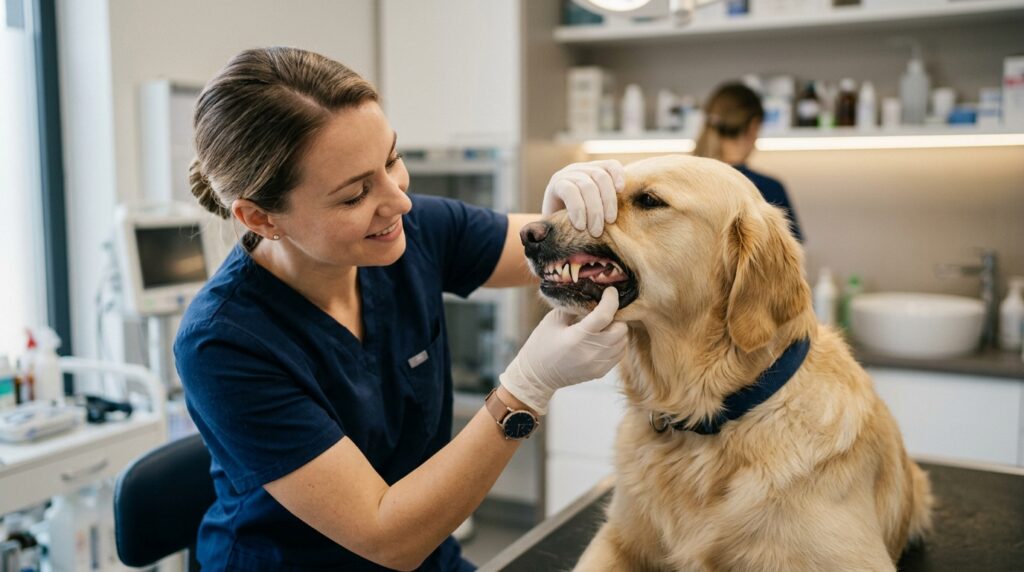
A veterinarian examines a dog’s teeth — the easiest way to determine age in the first year of life
When teeth are no longer helpful, a veterinarian and an attentive owner look at appearance. There are several reliable signs.
- Gray hair. A dog’s first gray hairs appear on the muzzle — around the eyes and on the nose, as well as on the paws. Young dogs rarely have any. It’s important not to confuse: gray hair can also appear at old scar sites from injuries or surgeries, and that’s not a sign of age.
- Eyes. In elderly dogs, the lens becomes cloudy and takes on a bluish tint. This is often called nuclear sclerosis — it doesn’t interfere with vision; it’s simply that the lens accumulates more fibers over the years and becomes denser. True cataracts, however — white and opaque — are a different matter and aren’t always age-related.
- Paws. The paw pads of old dogs are rougher and thicker than a puppy’s tender paws. Painless cracks or even tough horn-like “bristles” may appear on them.
Only a veterinarian with specialized instruments can distinguish harmless lens clouding from cataracts or glaucoma. So if your pet’s eyes have changed, it’s best to have them checked — you’ll find out whether it’s age-related or something else.
Muscles and Movement Give Away an Aging Dog
Age is also visible in the body. Older dogs noticeably lose muscle mass — especially in the thighs and shoulders. Most often the cause is arthritis: the joints in the elbows and knees hurt, but signs of pain in dogs aren’t always obvious. Because of this, the dog moves less, and muscles gradually shrink.
As a result, an elderly dog’s vertebrae may become more prominent along the spine — the muscles that covered them atrophy. A veterinarian palpates the back and legs: if bony protrusions that aren’t present in young dogs can be felt under the fingers, this indicates age. Regular moderate physical activity noticeably slows these changes.
Behavior: Hearing, Vision, and Sleep Change with Age
Age is revealed not only by the body but also by habits. Here’s what to pay attention to.
- Hearing. Over the years, the nerves in the ears conduct sound less effectively. If your dog has started flinching when you approach from behind or has stopped barking at the doorbell — it may simply be hearing less well.
- Vision. Age-related eye changes make it harder to see in twilight and darkness. The dog may be reluctant to go down stairs or not immediately find its bowl. Normal aging doesn’t usually cause complete blindness, but vision can noticeably decline.
- Mobility. Due to joint pain, older dogs “slow down”: they’re reluctant to jump onto the couch or into the car, and they walk slowly on stairs. Usually in the early stages of arthritis, dogs rarely limp, but reluctance to jump is precisely what gives away the uncomfortable problem.
- Sleep. Many elderly dogs have disrupted schedules: they sleep almost all day, then wander around the house at night, anxious and restless. Sometimes house-soiling accidents, anxiety, and confusion are added to this.
This last set of signs may point to age-related cognitive dysfunction — something like canine dementia. This can and should be managed, so it’s worth telling your veterinarian about such changes.
DNA Test for a Mixed Breed: Why It’s Useful
If your dog is a mixed breed of unknown origin, there’s one more tool: a DNA breed test. It won’t show the exact age directly, but it will indicate which breeds predominate in your pet. Sometimes such an analysis reveals even more unexpected details — for example, traces of wolf DNA in domestic dogs.
This matters because the breed and size determine how quickly a dog ages. Knowing the approximate “mix” of breeds, it’s easier for a veterinarian to estimate which category your dog falls into — small long-livers or large breeds that mature and age faster.
The most accurate age determination is still done by a veterinarian. They put everything together: the condition of the teeth, gray hair, eyes, muscles, behavior — and compare it with hundreds of dogs of the same breed they’ve seen before. Putting together such a puzzle on your own with year-by-year accuracy is unlikely, but now you at least know what to look for, how to calculate, and you’ll also be able to notice in time that your friend has quietly aged grown up.