
You don’t have to exhaust yourself with long workouts to live a long life
Strength training is usually associated with building muscle mass and achieving a great physique. However, a new study proves that regular exercises with dumbbells and other weights significantly reduce the risk of premature death, even if you don’t spend hours in the gym. It turns out that to protect the heart and brain, small but regular workouts are quite enough.
How muscle exercises affect health
The scientists relied on three large American projects in which they analyzed data from nearly 150,000 people, nurses and other healthcare workers. Participants were followed for up to 30 years.
Every couple of years, volunteers reported how much time they devoted to strength and aerobic training. Over three decades, about 36,000 participants passed away, which allowed researchers to trace a clear link between muscle strengthening and the risk of early death.
It turned out that the benefits of working with weights go far beyond aesthetics. People who regularly trained their muscles proved to be much more resilient against the most common age-related diseases.
How many hours a week do you need to train
Researchers discovered a clear sweet spot. Participants who devoted one and a half to two hours per week to strength exercises had a 13% lower risk of death from all causes compared to those who didn’t train at all.
The effect was especially pronounced for cardiovascular diseases: the risk of death from heart attacks and strokes among those who trained was 19% lower.
Interestingly, the “more is better” rule doesn’t apply here. If participants lifted weights for more than two hours per week, no additional risk reduction occurred. Moreover, for the prevention of cancer-related deaths, an even smaller load turned out to be optimal — up to one hour of weight training per week.
How muscles protect the body from disease
The secret to longevity lies in the metabolic function of our muscles. Skeletal muscles are one of the main energy consumers in the body. After a hearty meal, about 80% of blood glucose is directed to them. Insulin signals muscle cells to absorb sugar, which is then burned for energy or stored as glycogen, preventing the development of type 2 diabetes.
In addition, muscles function as an independent organ. During contraction, they release myokines — hormone-like substances — into the bloodstream. These molecules suppress chronic low-grade inflammation, which serves as the foundation for the development of heart disease and many types of cancer.
Myokines send chemical signals to the liver, adipose tissue, bones, and blood vessels. In fact, every muscular effort triggers a cascade of reactions that tune organs to proper metabolism and keep arteries elastic.
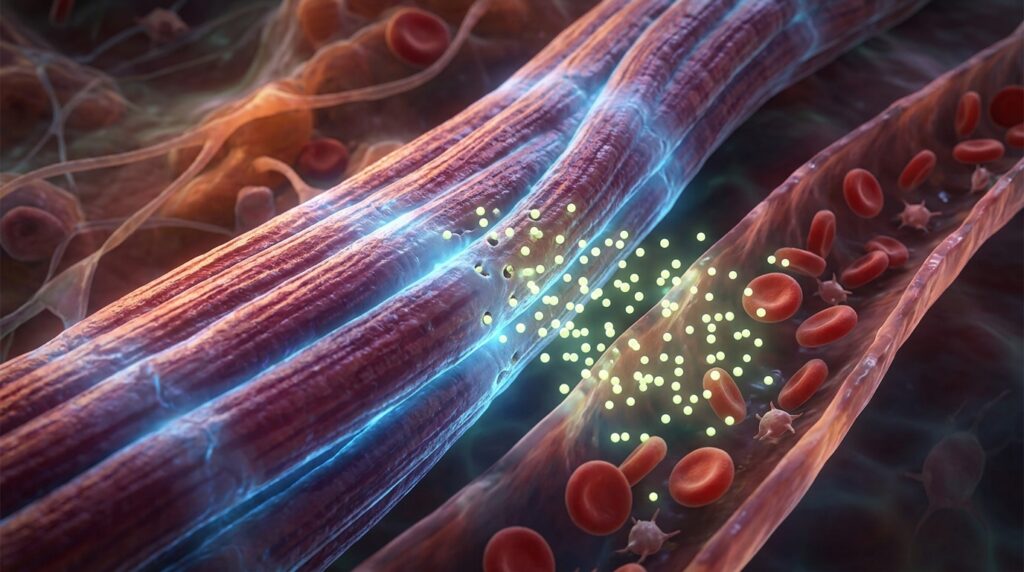
During exercise, muscles release myokines that protect internal organs
Why weight exercises are good for the brain
The link between physical strength and a sharp mind became one of the most intriguing findings of the study. Statistics showed that people with strong muscles have a 27% lower risk of death from neurological diseases. This primarily concerns protection against dementia.
This mechanism is explained by overall improved blood flow. The same processes that normalize sugar levels and protect the heart’s arteries also support the health of the tiniest blood vessels in the brain.
Grip strength has long been used by gerontologists as a reliable indicator of biological age. Strong muscles also mean better coordination, fewer dangerous falls, and the preservation of independence in old age.
How to reduce the risk of death from disease
Although strength exercises are effective on their own, the best results were seen when they were combined with aerobic activity. While regular walks, swimming, or cycling reduce the risk of premature death by 26–43%, adding weight training increases this figure to 45%.
To achieve this effect, you don’t necessarily need to buy a gym membership. For good health, it’s enough to follow a few basic principles:
- Do two short strength sessions per week, engaging all major muscle groups;
- Use your own body weight, resistance bands, or light dumbbells as resistance;
- Add moderate aerobic activity daily.
The study was observational and cannot conclusively prove a direct cause-and-effect relationship, because people who exercise often pay more attention to diet and health overall. However, the scientists’ conclusions sound extremely practical: you don’t need exhausting marathons to protect your body. Just a couple of hours of intentional muscle work per week can give your body years of active life.