There is a place in space that should smell like raspberries, but this scent is elusive
Astronomers have found erythrulose molecules in a dust cloud near the center of the Milky Way. It sounds complicated, but this is a sugar found in raspberries and used in cosmetics. This is the first real sugar discovered in interstellar space beyond the Solar System. Of course, space hasn’t become sweet in the usual sense, because substances there are far too dispersed to taste. The main value of the discovery is that it shows some building blocks of future life can arise long before planets form.
Sugar at the center of the Milky Way
The find was made in the molecular cloud G+0.693−0.027, located near the center of our galaxy. Molecular clouds are enormous cold accumulations of gas and dust, inside which new chemical compounds can form.
The substance discovered is called erythrulose. It is a simple sugar whose molecule consists of four carbon atoms, eight hydrogen atoms, and four oxygen atoms. In nature, erythrulose is produced, among other things, by raspberries, and humans use it in certain self-tanning products.
The connection to raspberries doesn’t end there. More than ten years ago, ethyl formate was discovered in the Sagittarius B2 cloud near the center of the galaxy. This is a compound involved in creating the aroma of raspberries and the smell of rum. Now sugar has been added to it, so the comparison of the center of the Milky Way to a raspberry cocktail doesn’t sound entirely coincidental.
But this is merely a beautiful chemical association. Cosmic erythrulose does not prove that the cloud actually smells like raspberries or has a sweet taste. Smell and taste require sufficiently dense matter, sensory organs, and a safe environment — none of which exist in open space.
How scientists found sugar in space
The researchers did not take a sample from the cloud or deliver cosmic dust to a laboratory. They aimed two radio telescopes at G+0.693−0.027 and searched for the characteristic set of radio signals left by rotating molecules.
Every substance has its own spectrum, a kind of molecular barcode. If the observed lines match laboratory data, scientists can determine the composition of a cloud even from an enormous distance.
About 340 molecules have already been detected in interstellar space. Among them are fairly complex organic compounds, yet a real sugar had not previously been found beyond the Solar System. Sugars have been found in meteorites, but meteorites belong to our planetary system.
Scientists expected that sugars with three carbon atoms would be the easiest to detect, since the smaller the molecule, the easier it should be, presumably, to form. However, their signals could not be found. Calculations show that such sugars in the cloud must be at least eight times less abundant than erythrulose.
Erythrulose itself contains 14 atoms. According to the authors of the study, it is the largest non-cyclic molecule found in the interstellar medium. A non-cyclic molecule is one whose atoms do not form a closed ring.
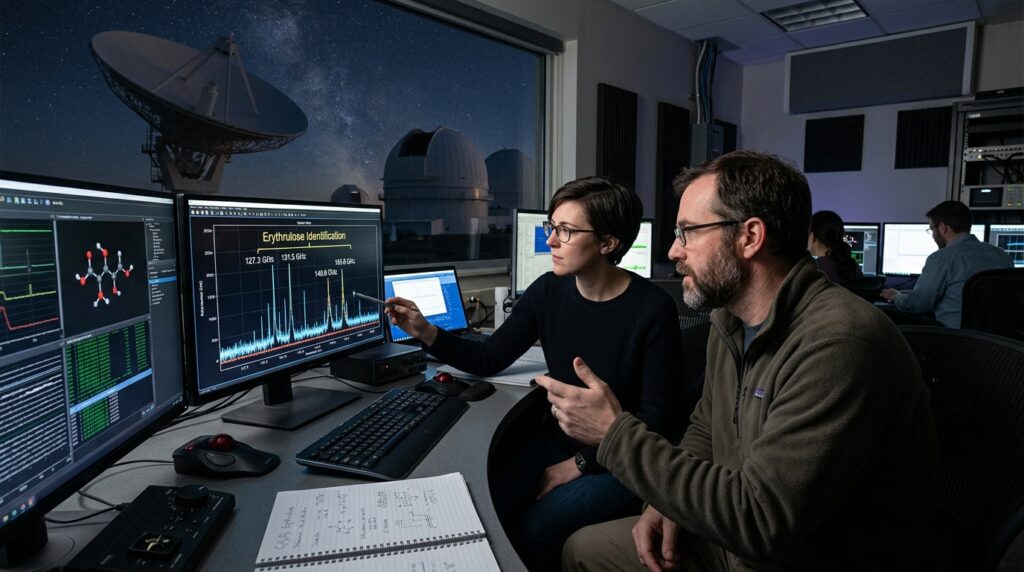
Spectral lines allow molecules to be identified at a distance
How did sugar form in space
How could such a complex substance appear in a cold cloud without cells, plants, or conventional chemical reactors? The researchers sought the answer using quantum-chemical calculations and models of cosmic chemistry.
According to these models, sugar forms on dust grains coated with ice. The surface of interstellar dust works like a tiny workbench. It holds simple molecules close together, giving them the opportunity to interact and assemble into more complex compounds.
Erythrulose could have arisen from simpler substances with two carbon atoms — aldehydes and alcohols. Individual parts of such molecules join on the icy surface of a dust grain and ultimately form a four-carbon sugar.
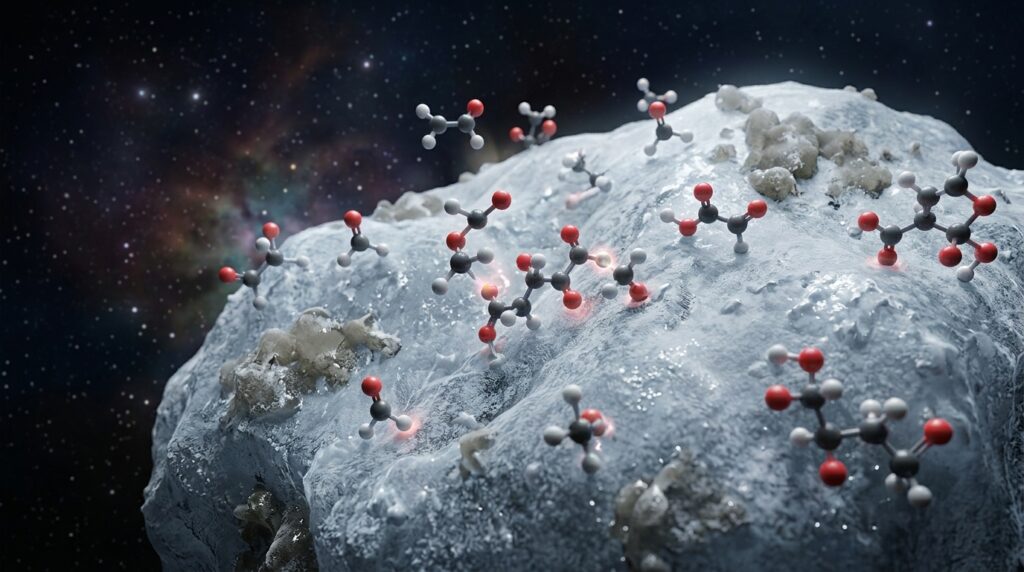
Molecules join on the icy surface of cosmic dust
Importantly, the researchers did not directly observe the entire process. They detected the spectral signature of the finished erythrulose, then verified a possible mechanism for its formation through calculations. Therefore, sugar formation on dust grains is a model that aligns well with the results, but not a video recording of an actual cosmic reaction.
Erythrulose also belongs to chiral molecules. This means it can exist in two mirror forms that resemble each other like the left and right hands but cannot be fully superimposed. This feature is commonly found in biological substances. Erythrulose became only the second chiral molecule found in the interstellar medium.
Cosmic sugar may have reached the young Earth
Sugars play a vital role in living organisms. They serve as energy sources, form parts of important biological structures, and participate in chemical processes without which life as we know it is impossible.
At the same time, early Earth faced a serious problem. The planet went through such a hot period that the original organic compounds should have been destroyed. Later, conditions did not necessarily allow sugars to form quickly in sufficient quantities either.
One possible explanation is that some sugars arrived from space. Such substances or their precursors could have existed in the protoplanetary disk — the cloud of gas and dust from which the Sun, planets, and asteroids formed. Some molecules could have been preserved inside asteroids and then delivered to Earth after it cooled.
In water, erythrulose and similar substances can transform into other varieties of sugars. This could have increased the chemical diversity of the environment in which the first self-replicating systems appeared.
However, the finding does not prove the origin of life from space and does not mean that erythrulose specifically triggered the first biological processes. The study, published in Nature Astronomy, demonstrates a more cautious but important point: interstellar clouds are capable of producing and preserving molecules linked to the chemistry of life.