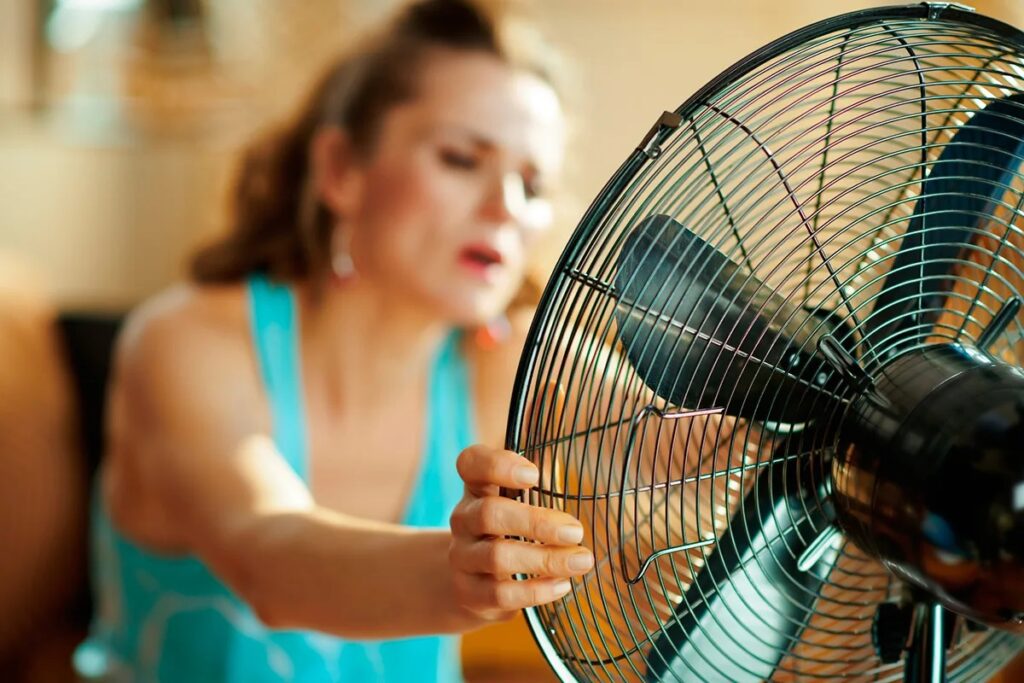
A fan in heat can be dangerous
In hot weather, you instinctively reach for the fan: a breeze blows, and it feels like relief. But this doesn’t always work. At very high temperatures, a fan can increase overheating rather than cool you down, essentially pushing heat toward the body. The issue has become especially pressing this summer. Western Europe is experiencing record heat, which is dangerous for health, and most people there are fighting it without air conditioning. Only about 20% of European homes have air conditioners — the rest have only fans. The situation with air conditioners in Russia is roughly similar. And even though extreme heat hasn’t hit us yet, it’s important to understand in advance: when does airflow actually cool you, and when does it start working against you.
Why a Fan Doesn’t Cool the Air — It Just Moves It
The key thing to understand: a fan is not cold. It doesn’t lower the room temperature like an air conditioner. It simply moves air along your skin. Whether that moving air saves you or harms you depends on the tug-of-war between two forces — the heat blowing toward the body and sweat evaporation from its surface.
Human skin in the shade is usually heated to about 35–37 °C. If the air is cooler than the skin, the moving airflow carries heat away. If the air is hotter than the skin, the airflow instead drives heat toward the body. This is why the 35 °C mark is often used as a warning line.
But a human is not an inanimate object. We sweat, and sweat changes the entire equation. Evaporation removes heat from the skin when liquid water turns into vapor. A fan helps by sweeping away the warm, moist layer of air clinging to the body, allowing sweat to evaporate more actively.
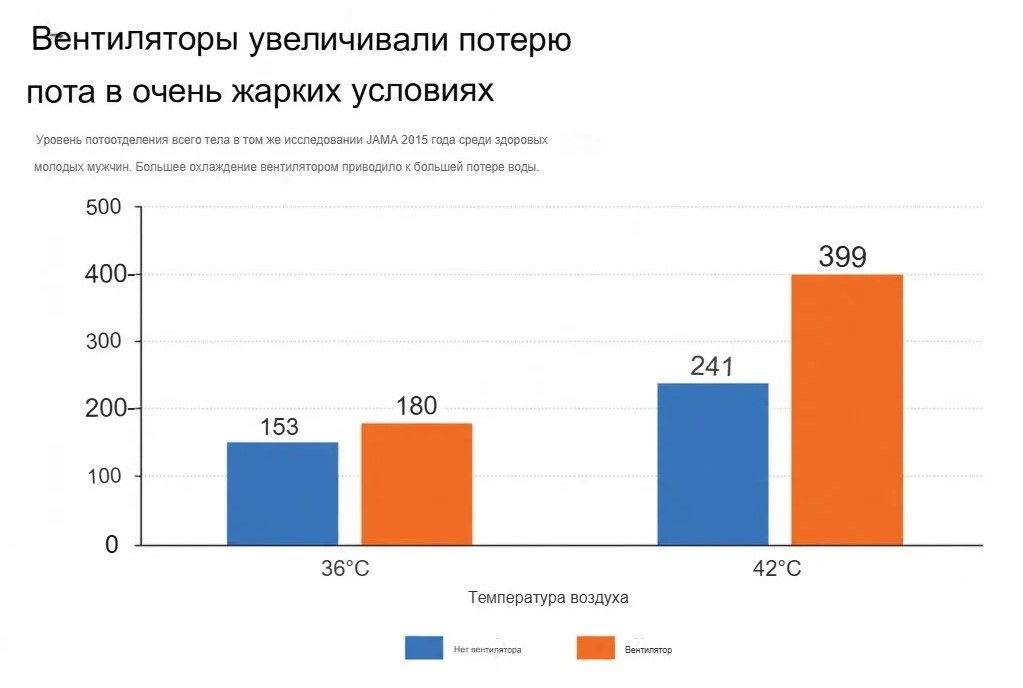
For young, healthy people who drink enough water and stay still, fans can sometimes help even when air temperature exceeds skin temperature.
In a small but influential 2015 study, eight healthy young men sat in heat chambers at 36 and 42 °C while scientists gradually increased humidity. With a fan, their heart rate and body temperature remained stable up to higher humidity levels than without one. So for young, healthy, and motionless people, a fan sometimes helps even when the air is hotter than the skin.
How Air Humidity Determines Whether a Fan Cools or Harms
Dry and humid heat torment the body differently: it all depends on how sweat evaporates. And that’s the key to the puzzle.
- In very dry heat, sweat can evaporate as fast as the body produces it. A fan barely increases evaporation — but the moving air simply delivers more heat to the skin. At this point, the fan starts working not as salvation, but more like a convection oven.
- In humid heat, everything is different: sweat accumulates and drips because the air is already saturated with moisture. Here, a fan helps more because it pushes moisture-laden air away from the skin and allows evaporation to resume.
This is confirmed by a recent study of elderly people, including those with ischemic heart disease:
- In hot and humid conditions — 38 °C and 60% humidity — a fan slightly lowered rectal temperature and improved well-being.
- But in very hot and dry conditions — 45 °C and 15% humidity — using a fan, on the contrary, worsened body temperature, sweating, and overall comfort.
The authors directly concluded that in a very hot and dry environment, a fan worsens all indicators, and it should be turned off.
Therefore, a day at 38 °C in humid Milan or Kaliningrad is physiologically not the same as a day at the same 38 °C in a dry room deep inland. The same fan produces a different effect. This explains why official recommendations from different countries diverge: Britain advises turning on the fan only below 35 °C, the American CDC is even more cautious — below 32.2 °C, while the WHO in one recommendation names a threshold of 40 °C.
Why Fans Are More Dangerous for Elderly People
With age, the body copes with heat less effectively. Elderly people start sweating later and less than younger people. Blood vessels are less efficient at carrying heat to the skin, and heart and kidney diseases that affect thermoregulation are more common. Some medications — for example, anticholinergics and certain cardiovascular drugs — also interfere with the body’s ability to regulate temperature.
With age, the body dissipates heat less effectively, and the familiar fan stops helping
This means that a temperature that a healthy 25-year-old can handle with a fan may be dangerous for a 75-year-old. In a 2016 study, elderly people sat in a chamber at 42 °C as humidity rose and, unlike the experiment with young men, the fan did not delay the dangerous rise in heart rate and body temperature. Moreover, both heart rate and body temperature were on average higher specifically with the fan.
In another 2024 trial, elderly people spent eight hours at 36 °C and 45% humidity — roughly what an overheated apartment looks like during a heatwave. Fans at normal and high speed failed to noticeably reduce peak body temperature. The authors concluded that the data does not support fans as a standalone cooling method for elderly people in hot rooms above approximately 33–35 °C.
Water Makes a Fan Safer and More Effective
There is one simple solution that makes a fan more useful and safer: add water. A fan helps the most when there is something for it to evaporate. If the body cannot produce enough sweat or if sweating would worsen dehydration, moistening the skin provides evaporation without losing precious fluid.
This can be spraying water on the skin, a damp T-shirt, a wet towel, a cool shower, or regularly wetting exposed arms and legs. The WHO also recommends moistening the skin with a damp cloth, spray, or wearing light wet clothing in heat. And this isn’t folk wisdom: in a study of elderly people at 38 °C and 60% humidity, moistening the skin made the heat more tolerable and reduced sweating, which, according to the authors, may decrease the risk of dehydration.
It’s also worth mentioning the importance of drinking water. In a 2025 study, young people were exposed to temperatures of about 39 °C and 49% humidity. With a fan, they lost roughly 125 grams more fluid per hour through sweat. And when participants were dehydrated, the fan raised heart rate and did not improve either body temperature or well-being.
A fan in heat can dangerously raise body temperature instead of cooling
When to Turn On a Fan in Heat and When to Turn It Off: Simple Guidelines
There is no universal threshold, but there is a working rule. Below 35 °C, a fan is usually beneficial. Above that, everything depends on the details: humidity, number of people in the room, age, and health condition. And above 40 °C, you definitely should not rely on a fan as your primary cooling method.