Returning to old environmental standards may solve the gasoline shortage problem
Russia may temporarily allow Euro-2 standard gasoline, the very same fuel that was banned back in 2013. The reason cited is a fuel crisis: production has been cut, so the government is looking for ways to saturate the market. But the main question that concerns drivers: won’t this fuel destroy a modern engine? The answer, as usual, is more complicated than it seems. Let’s figure out what this gasoline is, why it’s being discussed, and what it actually does to your car.
Why They Want to Allow Euro-2 Gasoline
It’s important to note that this doesn’t mean Euro-2 has already been poured into every fuel pump in the country. This is still a draft resolution and a possible temporary measure. According to Kommersant, the government may allow the production and distribution of Euro-2, Euro-3, and Euro-4 fuel classes until July 2027, as well as permit the import of gasoline with such characteristics.
The logic here is purely practical. If there isn’t enough fuel on the market or prices are rising, one way to quickly increase supply is to temporarily allow simpler gasoline. Not better, not more modern, but specifically simpler in terms of environmental and chemical requirements. Interestingly, something similar has happened before: previously, individual plants were allowed to produce fuel labeled as “Euro-5” but with actual parameters of “Euro-3” — for example, with sulfur up to 150 mg/kg instead of the required 10.
What Euro-2 Gasoline Is in Simple Terms
Euro-2 gasoline is not a separate grade like AI-92 or AI-95. It’s an environmental class of fuel. In other words, gasoline can be nominally AI-95 but class K2, or it can be AI-95-K5.
The difference is fundamental. The numbers 92, 95, 98 indicate the octane rating — that is, how the gasoline behaves in the engine. Meanwhile, the designations K2, K3, K4, K5 refer to something entirely different: how clean the fuel is in terms of sulfur, benzene, and other impurities. The technical regulation TR CU 013/2011 directly states that automobile gasoline labeling consists of “AI,” the octane number, and an environmental class from K2 to K5.
Octane number is about how gasoline performs in the engine. Euro-2, Euro-3, and so on indicate how much extra chemical contamination it contains. Therefore, the phrase “Euro-2 gasoline” doesn’t mean it’s weak in octane. It can be quite high-octane but still contain more sulfur and benzene, which damage the exhaust, the catalytic converter, and the surrounding air.
How Euro-2 Gasoline Differs from Regular Gasoline
By regular gasoline at modern Russian gas stations, people usually mean class K5 — the equivalent of “Euro-5”. Russia officially transitioned to fuel no lower than this class on July 1, 2016, gradually phasing out lower classes.
The main difference between “Euro-2” and “Euro-5” is sulfur. Here are the key figures:
- For class K5, no more than 10 mg of sulfur per 1 kg of fuel is allowed;
- For class K2 — up to 500 mg/kg;
- In terms of sulfur, “Euro-2” can be 50 times dirtier than “Euro-5”;
- Benzene in K2 is allowed up to 5%, while in K3–K5 — no more than 1%;
- K2 permits the octane-boosting additive monomethylaniline (up to 1.3%), which modern fuel standards try to exclude.
It turns out that outwardly, “Euro-2” can look like normal gasoline with the right octane number, but in composition, it is noticeably dirtier fuel. And it’s precisely this contamination that is the main source of debate.
Why Sulfur in Gasoline Is Dangerous for Your Car
Sulfur itself doesn’t kill an engine instantly. An engine will run just fine on high-sulfur fuel. The problem is what happens after combustion. Sulfur is naturally present in crude oil if it’s not specifically removed, and it makes emission control systems less effective, increasing air pollution.
To put it simply, the catalytic converter in a car is a filter that burns off and neutralizes some of the harmful substances in the exhaust. The more sulfur and impurities there are, the harder it has to work. In modern cars with precise electronics, oxygen sensors, and complex exhaust systems, low-class fuel contaminates and overloads these components faster. An older, simpler car will handle it more easily because there isn’t much to clean in the first place.
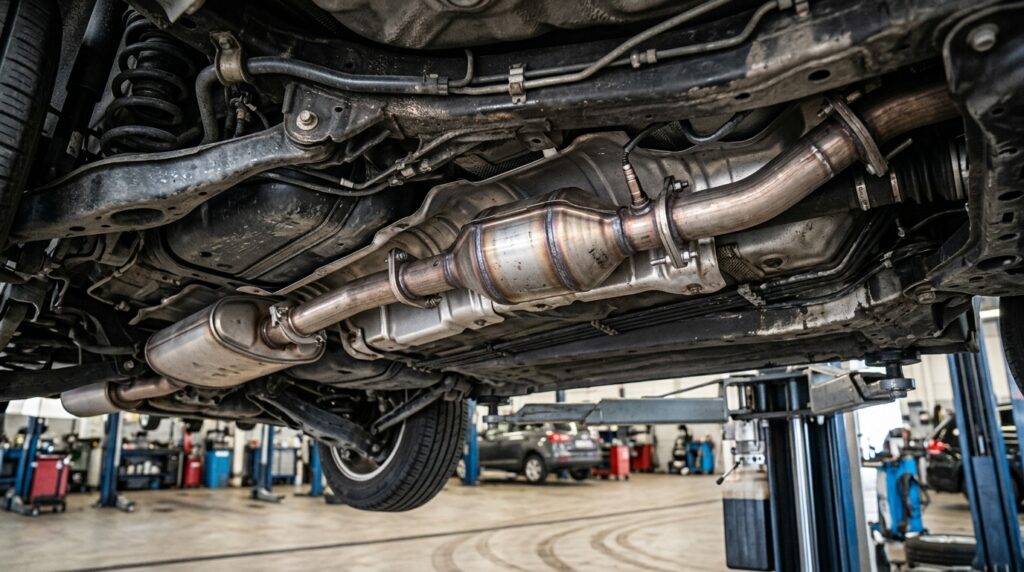
The catalytic converter cleans the exhaust — and sulfur in fuel hits it the hardest
Why Euro-2 Gasoline Is Easier to Produce
This is the main reason behind this rollback. Modern fuel production is not simply distilling crude oil and pouring it into a tank. At the refinery, various components are blended: naphtha, reformate, alkylate, isomerate, and other fractions. To obtain clean, high-octane fuel with low sulfur content, additional stages are required: sulfur removal, reforming, isomerization, and hydrotreating.
During reforming, low-octane naphtha is converted into high-octane components, and before that, the feedstock is purified of sulfur using hydrogen and a catalyst. All of these stages are expensive and require capacities that not every refinery possesses.
That’s why “Euro-2” is easier to produce. It is believed that lowering the standard will allow the use of naphtha as a base without deep processing and will enable refineries that cannot produce high-class fuel to participate.
A very simple analogy: Euro-5 is water that has passed through several filters, while Euro-2 is water that can also be used in a technical sense, but with less filtration. Tolerable for old equipment, but already a risk for modern machinery.
Can Euro-2 Gasoline Break an Engine
No, one tank of Euro-2 gasoline won’t kill an engine instantly. The car will run on it, and nothing will fall apart right away. But that doesn’t mean there’s nothing to worry about.
The main risk is not an immediate breakdown but increased stress on the catalytic converter, sensors, spark plugs, the fuel system, and the exhaust. And a lot depends on the car itself:
- An older, simpler car without complex electronics will digest such fuel more easily;
- A modern car with a turbocharged engine, direct injection, an expensive catalytic converter, and sensitive electronics is in a higher risk zone.
But for a large portion of modern vehicles, using Euro-2 may be unsafe. The problem isn’t that the engine will stall tomorrow, but that expensive components will wear out faster.
Why Benzene in Gasoline Is Dangerous
Benzene is another component that fuel standards try to strictly limit, and Euro-2 allows a higher percentage of it. Here the concern is not so much about the engine as about health. The WHO states that benzene exposure is linked to acute and long-term effects, including cancer and blood diseases, and motor fuel is one of the sources of such exposure.
For an individual driver, this doesn’t mean that something terrible will happen from one fill-up. But for a city as a whole, more benzene means noticeably worse air quality, especially near roads, traffic jams, gas stations, and courtyards where cars idle for long periods.
Why Gasoline May Contain Methanol
The draft includes another detail: methanol content in gasoline is proposed to be limited to 3%. Methanol can boost the octane number cheaply, which is why it’s sometimes added to blends.
But this additive has a dark side. Methanol is aggressive toward fuel system materials, so it can increase corrosion, affect rubber seals, plastics, and gaskets, and in the presence of water can cause fuel phase separation. Methanol can’t be handled carelessly, so if the tank, pump, and hoses aren’t designed for such blends, problems may arise.
Why Russia Previously Abandoned Euro-2
The old classes were phased out not because engines wouldn’t run on them. They were phased out because cars became more complex and air quality requirements became stricter. Since 2013, Russia banned gasoline and diesel fuel below “Euro-3,” then came the transition to “Euro-4,” and from 2016, the Customs Union enacted a ban on fuel below “Euro-5.”
In other words, “Euro-2” is not a new type of gasoline but a return to an older level of requirements. For its time, it was the norm, but it pairs poorly with modern cars and their exhaust purification systems.