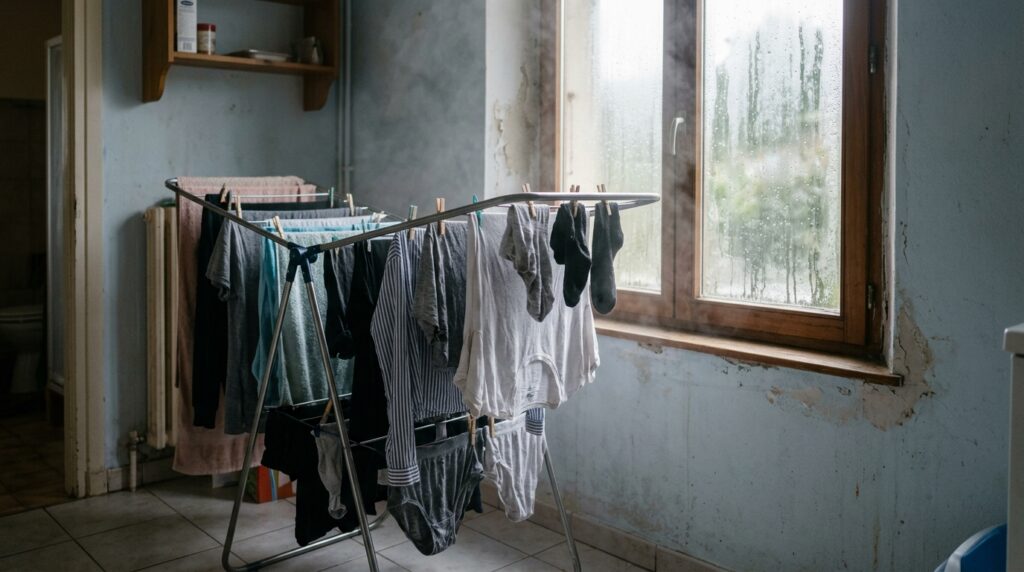
It’s better to open windows while drying laundry, because it can harm your health
Many people hang laundry to dry right in their room because the balcony is either occupied or simply doesn’t exist. However, this is not the best way to dry laundry, especially if the window is always closed. So what’s dangerous about drying laundry in a room, and how should you do it properly?
Why You Shouldn’t Dry Laundry in a Room
When clothes dry, the water from the fabric doesn’t dissolve into the air without a trace — it turns into vapor. According to a study published in the journal Indoor and Built Environment, a single load of 15 items can release about 2 liters of water into the air over 7 hours, with most of the moisture being released in the first hours of drying. The authors link passive indoor laundry drying to deteriorating air quality, rising humidity, and an increase in dust mites and mold spores.
If the windows are closed and there’s no exhaust fan or dehumidifier, those two liters of water remain in the room. The air becomes humid, and when it contacts cold surfaces like glass, exterior walls, or corners behind furniture, it cools down and releases water as droplets. Condensation appears wherever warm, humid air meets a colder surface, and over time this leads to dampness, mold, and damage to materials.
How Mold Appears in an Apartment
In winter, logic suggests closing windows tightly to keep the heat in. But it’s precisely in winter that the risk is highest, because exterior walls, glass, and window reveals become cold, and moisture settles on them faster. When warm, humid air cools near windows, mirrors, and cold corners, the relative humidity right at those surfaces spikes sharply.
And insidious mold doesn’t even need to wait for visible water droplets. Mold can start growing at 70–80% humidity near a wall surface, even if the wall looks dry. Visible condensation appears at 100%, but the problem starts much earlier.
Where Mold Most Often Forms in an Apartment
It’s important to note that humidity in the middle of a room and humidity near a wall are two different things. In the center, a hygrometer might show a calm 50%, but behind a wardrobe against a cold exterior wall, conditions will be much more humid. That’s why mold often appears not next to the drying rack, but in corners, behind furniture, on window reveals, and near poorly insulated sections of walls.
Normal humidity in the center of a room is no guarantee that everything is fine near cold surfaces. So you shouldn’t immediately trust a humidity sensor — its reading can be misleading.
Why Dampness and Mold Are Dangerous for Health
Persistent dampness creates ideal conditions for mold, and that’s already a health concern. The World Health Organization in its guidelines on indoor air quality states that dampness and microbial contamination are linked to the growth of fungi and bacteria. The main consequences are increased coughing, allergies, and asthma. The primary prevention measure is simply not allowing persistent dampness on walls and in building structures.
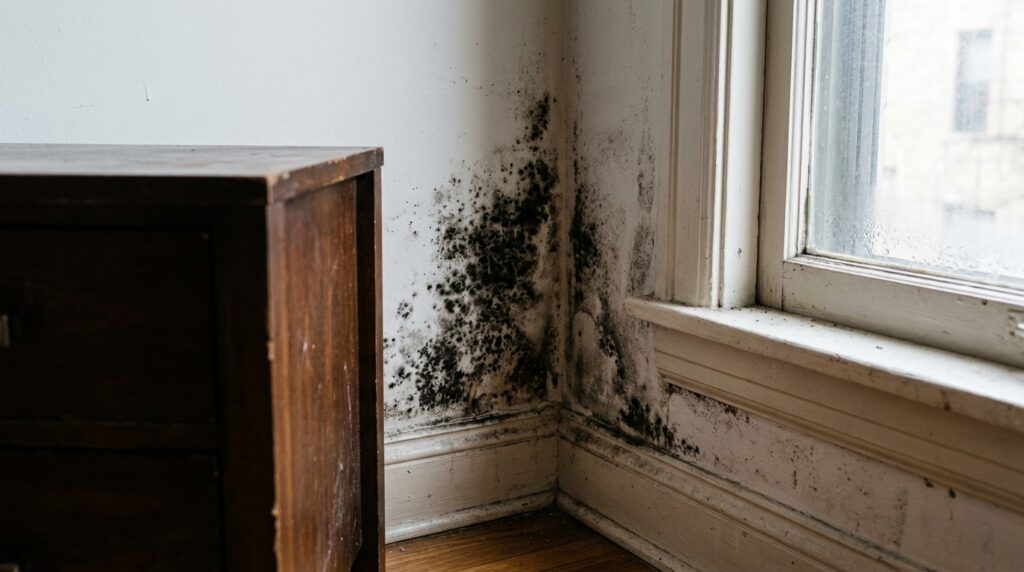
Mold most often appears in cold corners and behind furniture, not next to the drying rack
Why Dust Mites Thrive in a Damp Room
It’s not only mold that needs humidity. It also helps dust mites reproduce — microscopic creatures whose waste and particles cause runny nose, itching, coughing, and asthma attacks. It’s known that they need relative humidity above approximately 65%, and when it drops below 50%, their reproduction and survival rates decline.
It turns out that a closed room with wet laundry is almost an ideal breeding ground for mites.
Why Laundry Smells Musty
There’s also a purely practical side effect. When windows are closed, laundry dries more slowly, and the longer fabric stays damp, the higher the chance of a musty smell. Moisture lingers in the fibers, the air around the drying rack becomes saturated with water, and evaporation slows down. This doesn’t mean the clothes were poorly washed — they simply spent too long in dampness.
It’s also worth mentioning that moisture is absorbed by furniture, mattresses, carpets, curtains, books, and clothes in wardrobes. Eventually, dampness becomes a normal condition for the room. Experts recommend keeping air humidity in the 30–50% range and responding quickly to condensation on windows, walls, or pipes, as it’s the first sign of excess moisture.
What Happens If You Constantly Dry Laundry in a Room
Drying laundry once in a closed room isn’t a catastrophe. The danger lies specifically in the habit of drying without ventilation week after week in a bedroom or living room. Then humidity rises regularly, walls and corners don’t have time to dry out, and mold can appear even where you don’t initially notice it.
Ideally, laundry shouldn’t be dried inside the apartment at all — it’s better to use dedicated drying rooms or a balcony. If you have to dry indoors, you need to ventilate more often, and relative humidity should ideally be kept approximately in the 40–60% range.
How to Dry Laundry at Home More Safely
If you can’t avoid drying laundry at home, there are simple rules that significantly reduce the risk. The main thing is to give moisture a way out and not trap it in the room.
- The best option is a balcony, outdoors, a dedicated drying room, or a dryer that properly vents moisture;
- Don’t dry laundry in the bedroom and don’t place the drying rack where you spend a lot of time;
- Place the drying rack in a warm, well-ventilated spot, leaving a gap from walls and furniture;
- Don’t hang items right up against each other, because the worse the air circulates between fabrics, the longer they take to dry;
- Don’t constantly dry laundry on a radiator, because moisture is rapidly released into the air, and the room becomes warm but damp.
A separate note on ventilation. While drying, windows should be opened briefly and wide, rather than on micro-ventilation. In winter, a few minutes is usually enough, especially if you can create a cross-draft.

Short, intense ventilation removes excess moisture faster than a slightly open window left all day
It’s useful to buy an inexpensive hygrometer. If humidity rises above 60% during drying, it’s a signal to ventilate, turn on the exhaust fan, or use a dehumidifier. If your apartment is on a corner, the walls are cold, the windows are old, or mold has already appeared, stay closer to 40–50%, because humidity near cold surfaces is higher than what the device shows in the center of the room.
You shouldn’t dry laundry in a room with closed windows not because the air gets poisoned by chemicals. The reason is simpler and more honest: you’re adding liters of water to the room and not letting them escape. This moisture settles on cold surfaces, feeds mold and dust mites, damages walls, furniture, and air quality, and for people with asthma and allergies, it can noticeably worsen how they feel. Going forward, pay attention to simple signs: fogged-up windows, dampness in corners, musty smells — and react to them before a black spot appears on the wall.