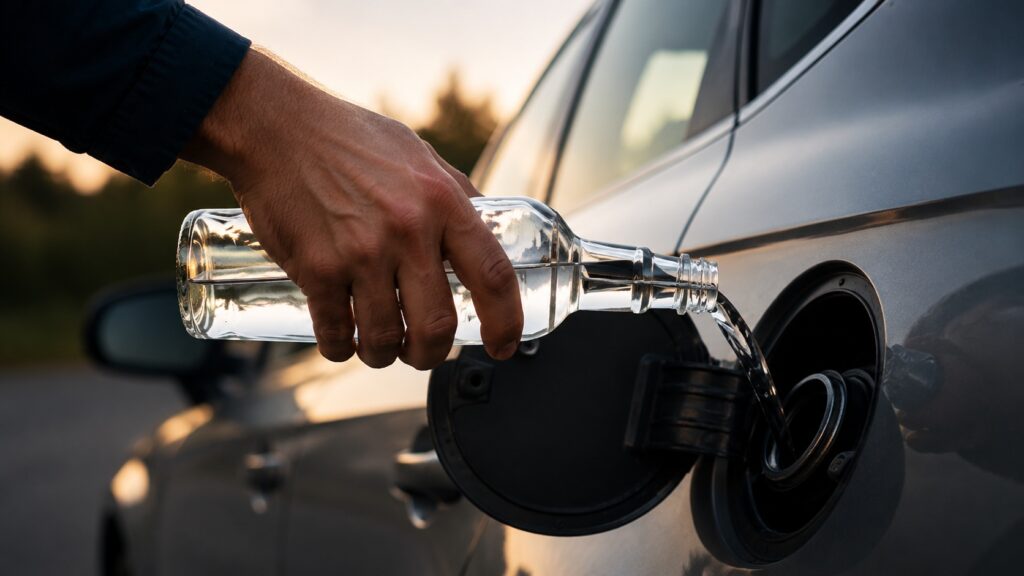
Alcohol is added to gasoline only at refineries, and DIY experiments can cause problems
The desire to save on fuel or squeeze more power from every liter pushes many drivers to experiment. One of the most popular ideas is to add alcohol to gasoline, since gas stations in some countries have long been selling ethanol-blended fuel and even praising it. But there’s a huge difference between what’s done at a factory and what you can replicate in your garage. And if you think a glass of alcohol will turn your AI-80 into AI-95, we have bad news for you.
Why Is Alcohol Added to Gasoline
The main reason for creating alcohol-blended fuel is that ethanol raises the octane number. Simply put, fuel with this additive is less prone to detonation — the incorrect, explosive combustion in the cylinders. At modern refineries, ethanol is used as a legal and effective octane-boosting additive, with every stage of blending carefully controlled.
The second reason is environmental. The alcohol molecule inherently contains oxygen, which allows the fuel mixture to burn much cleaner. The exhaust contains fewer unburned hydrocarbons and carbon monoxide. In Russia, under current standards, ethanol content in gasoline is limited to five percent, although technologically, refineries are capable of producing more concentrated blends.
What Happens If You Add Alcohol to Gasoline Yourself
Many drivers look for workarounds and consider mixing cheap components on their own. But in practice, such garage experiments only bring losses. Alcohol has one significant disadvantage compared to pure petroleum products: it contains significantly less energy. The specific heat of combustion of gasoline is about 44 MJ/kg, while for ethanol this figure barely reaches 30 MJ/kg.
If you overdo the proportions during manual mixing, fuel consumption will inevitably increase. The engine will have to burn more liquid to deliver the same power. A modern car with smart electronic fuel injection will try to adjust the process, but in cold weather the car will start jerking, have trouble starting, and throw error codes on the dashboard.
The attempt to turn AI-92 into AI-95 using a canister of ethanol is doomed to fail for several reasons:
- Factory gasoline is a complex mixture with a balanced fractional composition, not just a liquid for dilution;
- DIY mixing doesn’t account for saturated vapor pressure, which is critical for stable engine starting;
- Homemade proportions are always approximate, so the engine’s fuel map won’t be able to adapt in time to octane number fluctuations.
Can You Add Vodka to Gasoline
The most destructive idea is to add vodka to gasoline. This drink is only 40% alcohol, while the remaining 60% is water. Water doesn’t burn, causes instant corrosion of metal parts, and in winter simply freezes in the fuel lines. By pouring liquor from the supermarket, you’re deliberately adding water to your fuel, which is guaranteed to result in calling a tow truck.
Medical alcohol at 95% concentration is also unsuitable for a car. To create alcohol-blended gasoline, factories use nearly anhydrous ethanol with a concentration of no less than 99.3%. Any excess moisture causes the liquid in the tank to separate: the lighter gasoline floats to the top, while a water-alcohol puddle settles at the bottom — right at the fuel pump pickup.
Methanol deserves a separate mention. This toxic substance is cheaper than ethanol, but it absolutely must not be poured into a regular engine. Manufacturers like Kia explicitly prohibit using mixtures with any proportion of methanol, as it is incredibly aggressive toward plastic and rubber seals.
Can Isopropyl Alcohol Be Added to Gasoline
There’s a popular trick among drivers: pour a little alcohol before winter to remove condensation from the tank. Indeed, isopropanol mixes excellently with moisture and helps bind a small amount of water, preventing it from turning into ice. Most factory fuel driers are based on this substance.
However, the difference between specialized automotive chemicals and a bottle from a hardware store is enormous. A dedicated drier has a precisely calibrated dosage and contains protective additives. If a lot of moisture has accumulated, garage-bought isopropanol won’t solve the problem — it will only spread the dirt throughout the entire fuel system, completely clogging the injectors.
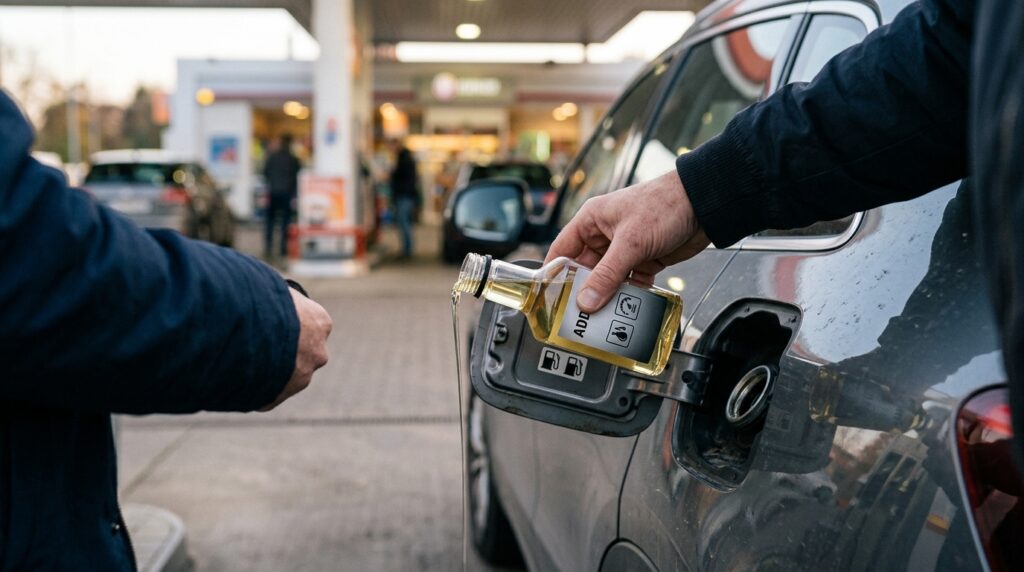
Only pour chemicals into the tank from certified bottles with precise dosage
How Alcohol-Blended Gasoline Affects Your Car
New cars handle factory ethanol-blended fuel without issues, as confirmed by AvtoVAZ tests and instructions from foreign brands.
But for older vehicles, alcohol in gasoline is deadly dangerous for several physical reasons:
- It acts as a powerful solvent, washing years of deposits off the tank walls straight into the fuel filter;
- Old rubber hoses and gaskets not designed for contact with aggressive substances quickly swell and crack;
- Carbureted engines start running on a critically lean mixture due to an uncontrolled excess of oxygen.
Furthermore, ethanol works like a chemical sponge, constantly drawing moisture from the surrounding air. Because of this, the shelf life of gasoline with an alcohol additive is significantly reduced. If a car, lawn mower, or boat engine sits with such fuel for many months, rust will inevitably form inside.