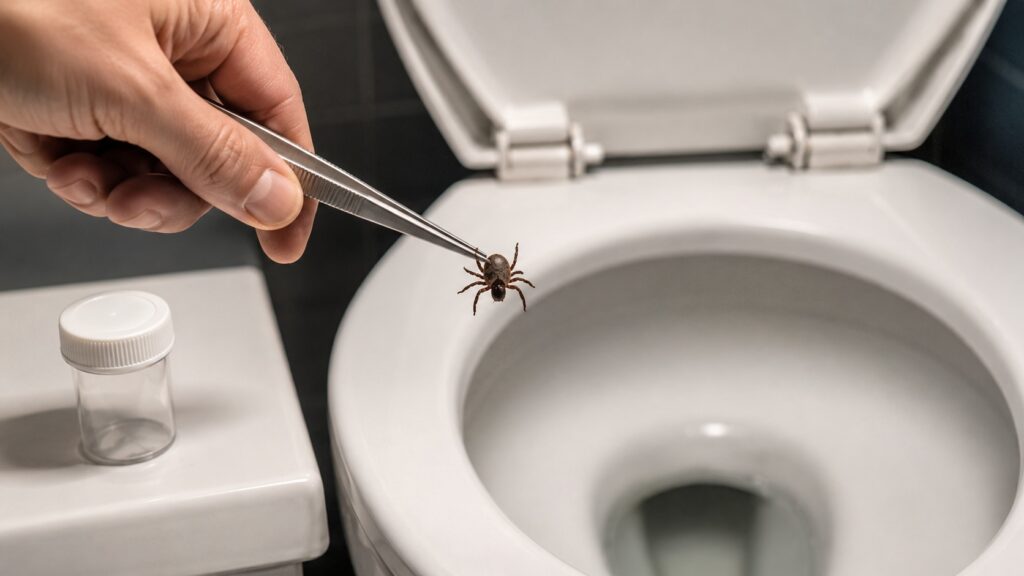
You shouldn’t flush ticks down the toilet, and not just because they can survive there
Many people think that ticks hunt humans only in spring. But they actually pose a danger to us at any time of year except winter. Some people remove ticks from their bodies themselves and then flush them down the toilet. Undeniably, it looks very badass. But you should never do this, because the consequences can be far-reaching.
Why Water Doesn’t Kill Ticks
Many arthropods possess remarkable resilience, and ticks are no exception. Due to the peculiarities of their respiratory system and slowed metabolism, they tolerate submersion in water for quite a long time.
If you simply toss a parasite into the toilet, it won’t drown. The flow of water will merely move it into the sewer system, where it can quite easily survive. Air pockets in the pipes allow them to remain unharmed, and in some cases they are even capable of crawling back out. Therefore, relying on a simple flush is pointless.
Interesting fact: In Russia, there are ticks that have mutated to the point where they are resistant to poisons and can run fast. So water definitely won't destroy them.
Why You Should Take Ticks to a Hospital
Beyond the physical resilience of the insect, there is another important reason to avoid using the toilet. By sending a tick into the sewer, you are literally destroying important epidemiological data that is critically needed by science. It’s worth remembering that they carry tick-borne encephalitis, and in some cases can even cause a meat allergy.
Entomologists and laboratories constantly collect information about where new populations are appearing and which specific pathogens they carry in a given season. Every specimen submitted for laboratory analysis helps scientists update risk maps and warn local hospitals about disease outbreaks. Experts emphasize that to effectively combat the spread of diseases, researchers need to receive real samples taken from people and pets.
What to Do with a Tick Removed from the Body
If you’ve removed a parasite from yourself or your pet, experts recommend handling it as little as possible. It’s best to place the tick in a sealed plastic bag or a pill bottle so you can then take it to a laboratory or your local health department. This was reported by authors at Popular Science.

For laboratory analysis, the tick must be preserved in the most undamaged condition possible
If submitting the sample for analysis is not possible and you simply want to safely dispose of it without resorting to the sewer, there are several reliable methods:
- Submerge the parasite in a small container of rubbing alcohol — this will guaranteed kill it and preserve the body;
- Tightly seal the tick between two pieces of clear tape, depriving it of the ability to escape and breathe;
- Crush it with a hard object, having first wrapped it in a thick paper napkin to avoid contact with fluids;
- Carefully pierce the insect with a medical needle if other methods are unavailable.
In the end, properly disposing of ticks is your personal contribution to public safety. By preserving the parasite for testing or competently destroying it, you protect your health and help medicine more accurately forecast the epidemiological situation.