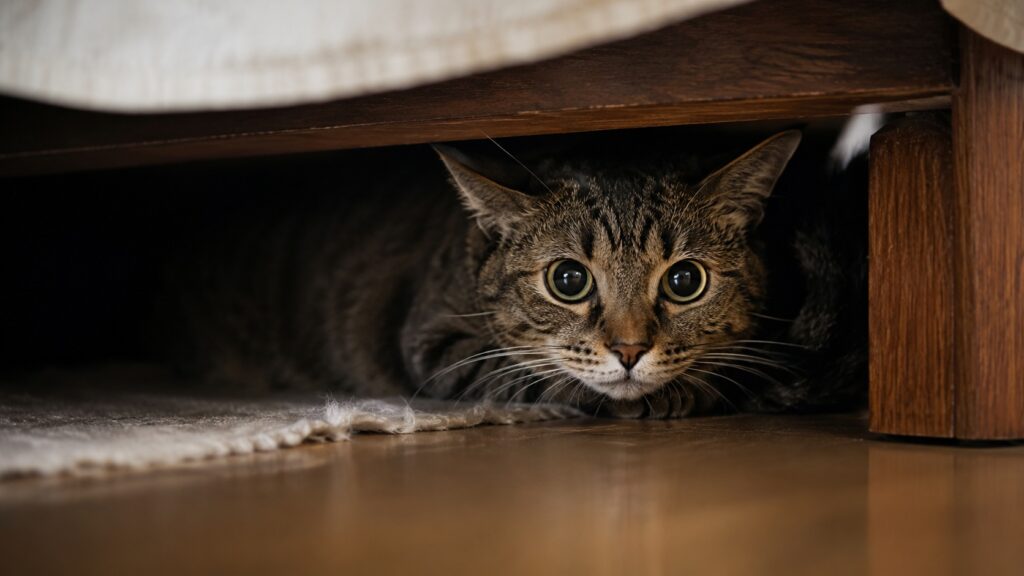
Cats don’t leave to die beautifully — the reason is much simpler
Many cat owners believe that their pets sense the approach of death. They supposedly feel the approach of not only others’ death but also their own, and deliberately leave home to die alone. This beautiful legend is passed down from generation to generation and sounds almost human. But biologists and veterinarians see it differently, and their explanation is far less romantic. It turns out that cats’ behavior before death follows entirely different rules, and if you know them, you can understand what is actually happening with your beloved pet.
Why a Cat Hides When It Feels Unwell
The main reason a sick cat hides is an ancient self-preservation instinct. Although a cat is a predator, in nature it is far from the top of the food chain, so a weakened animal is easily attacked by larger predators or competitors. That’s why a sick cat tries to become invisible — it moves less, makes fewer sounds, and tucks itself into a quiet corner.
There’s also a second aspect: cats generally solve problems through distance. Domestic cats have a flexible social structure — they can interact with humans and other cats, but they spend most of their time on their own and hunt alone. For them, hiding and waiting it out is a far more natural strategy than seeking help, as dogs or humans do.
Does a Cat Understand That It Is Dying
The beautiful notion that a cat knows death is approaching and leaves has no scientific confirmation. There is no evidence that a cat comprehends death as an abstraction — that is, it doesn’t think “I’m going to die soon, so I’ll leave.” However, it perfectly senses physical changes: pain, weakness, nausea, fear, loss of energy, confusion. That is precisely why behavior changes — the cat hides, becomes lethargic, loses appetite, or, on the contrary, unexpectedly becomes more affectionate.
So the phrase “the cat went away to die” is beautiful but inaccurate. It’s more correct to say that the cat felt vulnerable and found a place where no one would bother it. If the illness is severe, it may die there — but not because it decided to say goodbye, rather because its body could no longer cope.
Why Cats Go Away to Die Alone
When a cat feels unwell, it usually needs not cuddles but quiet, control, and safety. A sick animal has a harder time tolerating light, noise, touch, children, other pets, carriers, and attempts to pick it up. Even a beloved owner at that moment may be perceived not as a savior but as a source of extra stress: their hands move the cat, touch the sore spot, try to give medicine, or put it in a carrier.
Signs of pain in cats are barely noticeable: the animal sleeps more, hides under the bed or in the closet, moves less, eats less, stops grooming properly, sits hunched over, and avoids being petted. So solitude here is not proof of love for the owner. It’s the feline way of reducing threat, following the principle: I’m weak, I shouldn’t be seen, I shouldn’t be touched.
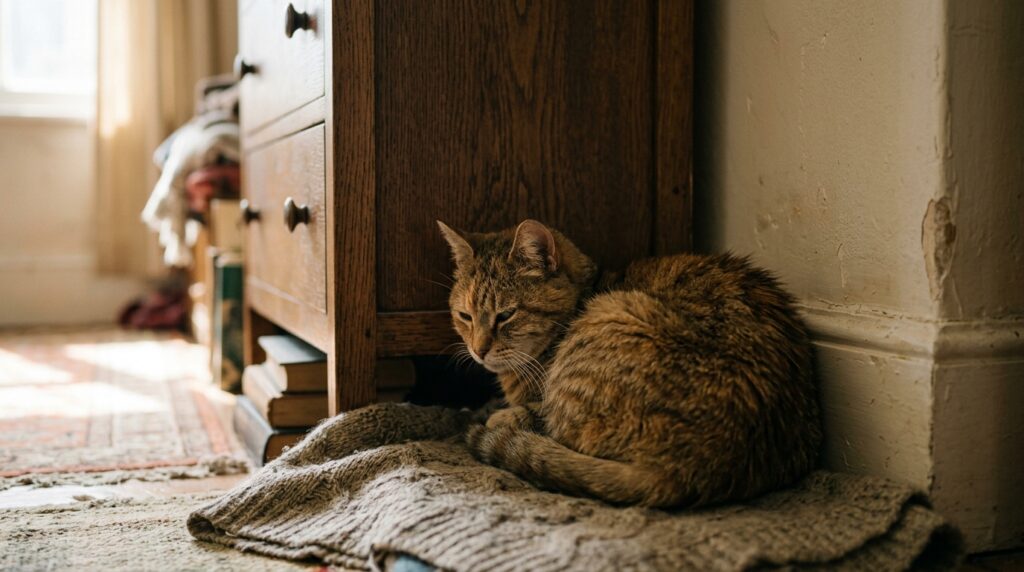
For a cat in poor condition, peace matters more than the owner’s attention
Why Domestic Cats Hide Before Death
You might think a house cat that has spent its entire life in an apartment and never seen a predator would behave differently. But the ancient programming never disappears. When such a cat gets sick, it hides in all sorts of places:
- under the bed, behind the sofa, or in the closet;
- in a box, in the bathroom, behind the washing machine;
- on the balcony or in a dark corner;
- under a car in the yard, in the basement, shed, or stairwell.
The myth that cats run away to die is addressed separately by specialists, who emphasize that sick cats usually don’t go far — they look for the nearest quiet and safe spot. If the cat is too weak to eat, drink, or return home, it may die right there.
This is especially noticeable with outdoor cats: the animal went out as usual, started feeling worse, hid, and couldn’t get out or return. To the owner, it seems like the cat deliberately left, but in reality it could have been very close: under the porch, in the basement, under the garage, at the neighbors’, or in the bushes.
What Illnesses Cause a Cat to Hide
Hiding in itself is not a diagnosis. It can be a manifestation of almost any condition in which the cat is in pain, scared, or feeling unwell. The list includes injuries, poisoning, infections, kidney problems, urolithiasis, tumors, dental pain, arthritis, heart failure, severe weakness, dehydration, nausea, and high fever.
This is especially relevant for elderly cats. Older cats are skilled at hiding illnesses, and a serious problem may go undetected for a long time until the condition becomes advanced. So if your cat suddenly starts hiding, it’s not a matter of a bad temperament — it could be the first noticeable sign that something is wrong.
How to Tell Normal Hiding from a Warning Sign
It’s normal if a cat sleeps in a secluded spot, especially after guests, noise, renovations, a move, or the arrival of a new animal. It’s concerning if the cat suddenly starts hiding more than usual and other changes appear at the same time.
The following signs are especially alarming:
- not eating, not drinking, sudden weight loss;
- becoming lethargic, breathing heavily, sitting hunched over;
- hiding all day, stopped grooming;
- not using the litter box or frequently going to the litter box without result;
- crying during urination, reacting aggressively to touch.
Signs of pain in animals include decreased appetite, a desire to remain motionless, restlessness, hiding, withdrawal, and personality changes. And if a cat hasn’t eaten for more than a day, is breathing heavily, cannot urinate, lies motionless, doesn’t react as usual, has seizures, severe vomiting, bleeding, an injury, or signs of poisoning — a veterinarian is urgently needed.
What to Do If Your Cat Starts Hiding
The best thing you can do is not forcibly pull the cat out without necessity, but carefully assess its condition.
Act calmly and step by step:
- Place water, food, and a litter box nearby;
- Ensure quiet — remove children and other animals;
- Observe its breathing, gait, appetite, and urination;
- Check its response to your voice and overall behavior;
- If unusual hiding lasts longer than a few hours along with lethargy or refusal to eat, contact your veterinarian.
In the end, it turns out that cats leave or hide before death not because they want to die beautifully, avoid upsetting their owner, or say goodbye in their own way. The most likely explanation is simpler and more honest: the cat feels weakness, pain, or fear and activates an ancient safety mode. Sometimes this saves its life. And sometimes, if the illness is already too severe, the owner only sees the final stage and remembers it as “she went away to die alone.”
The key practical takeaway here is that sudden hiding by a cat is not a whim but a possible sign of illness. The sooner you notice that something is wrong with your cat, the higher the chance of helping it in time.