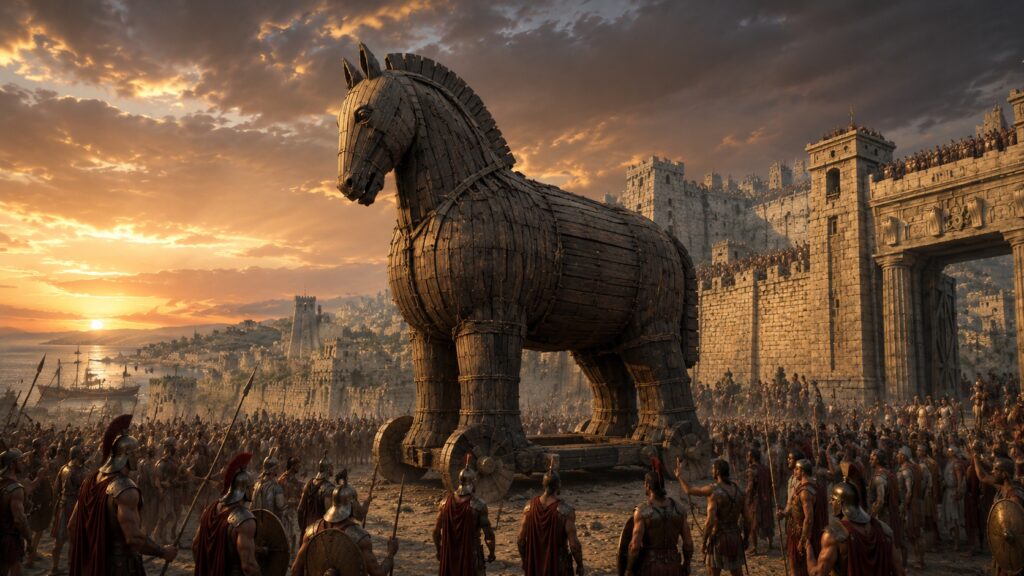
According to ancient Greek mythology, the Trojan Horse episode occurred around 1200 BC during the Trojan War
The story of the wooden horse that the Greeks used to trick the Trojans and infiltrate the city is known to everyone from school. But archaeologists and historians still debate whether the Trojan Horse really existed or if it was just a beautiful fiction. Troy itself existed, and this has been proven by excavations. But when it comes to the famous Trojan Horse, opinions diverge.
How the Trojan War Began
According to ancient Greek mythology, the Trojan War began because Prince Paris abducted Helen, the wife of the Spartan king. The siege of the city lasted many years until the cunning Odysseus devised a plan. The Greeks built a massive wooden horse, hid warriors inside, and left it at the gates of Troy as a peace offering.
Many still believe that the Trojan War is purely a beautiful fairy tale, and that the city itself belongs alongside the mythical Atlantis. Ancient sources, including Homer’s poems, describe the horse as a unique wheeled mechanism created by the craftsman Epeius. Various texts claim that between 30 and 100 warriors hid inside, while one legend even speaks of 3,000 soldiers.
Believing in the existence of a wooden statue that could hold an entire army is quite difficult. But if we set aside poetic exaggerations, it turns out that this story has a very real historical basis, confirmed by excavations.
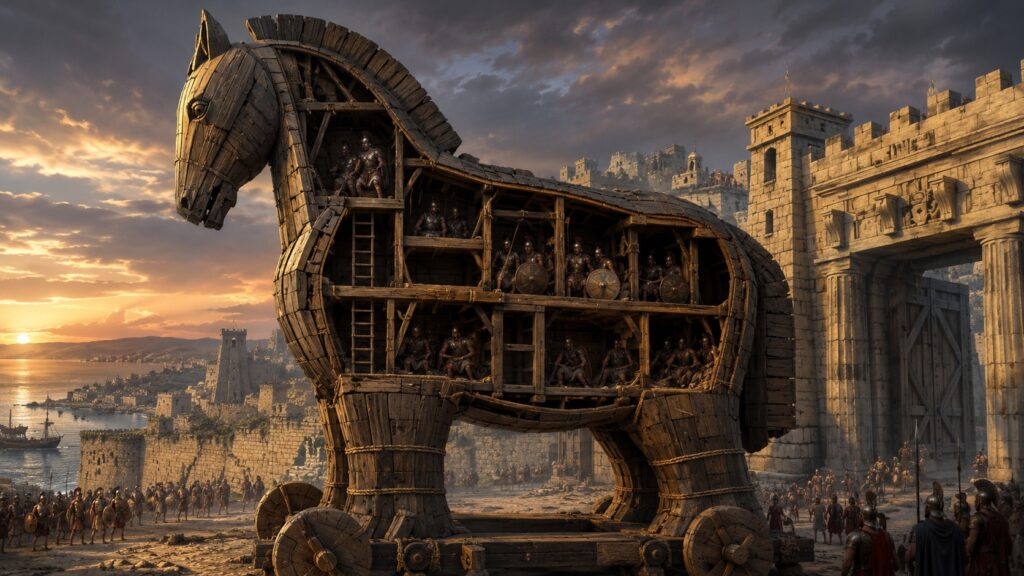
Trojan Horse cross-section
Where the Real Troy Was Located
For a long time, the city was considered fictional until German archaeologist Heinrich Schliemann began excavations in 1873. It turned out that the ruins of the real Troy are located in modern-day Turkey.
Although direct evidence of a decade-long siege involving gods and heroes is impossible to find, the city’s ruins bear many scars from real battles. Archaeologists have repeatedly found at the excavation site:
- remains of destroyed and hastily rebuilt fortress walls;
- stockpiles of projectiles prepared for defense;
- human skeletons bearing evidence of fierce battles.
Around 1180 BC, the settlement was permanently abandoned. This date coincides with the time of the Trojan War described by Homer in the “Iliad.” However, it remains unclear whether Troy was destroyed by an enemy army or suffered from a powerful natural disaster.
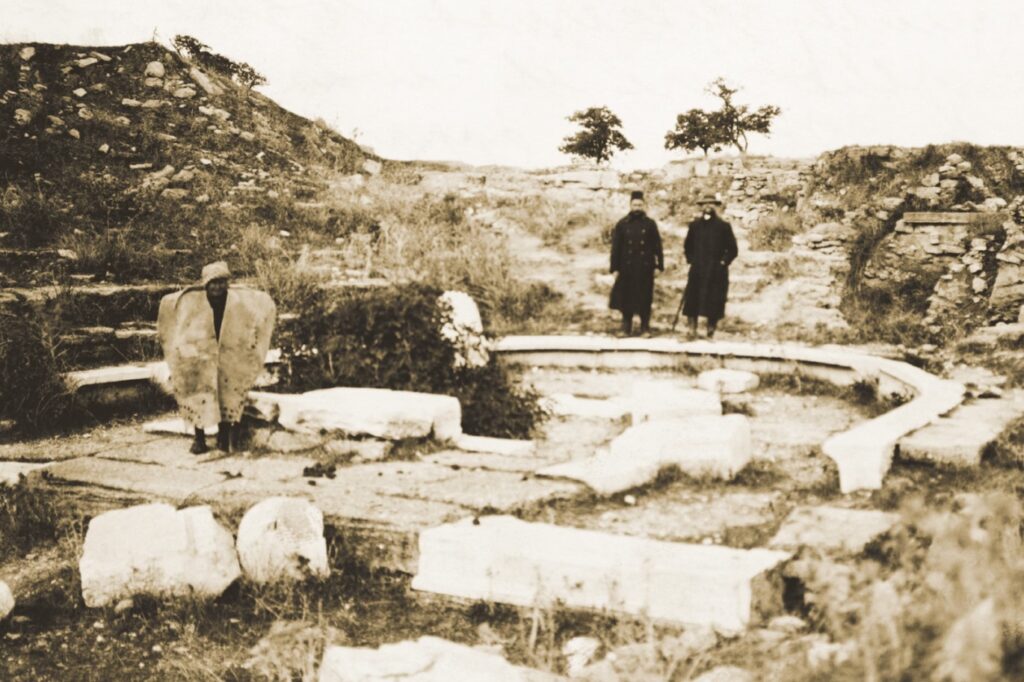
Photograph from the Troy excavations. Image source:
What Could Have Been Instead of the Trojan Horse
If the city and the siege were real, then how can the appearance of a huge wooden animal be explained? Scientists suggest that the image from the poems is a metaphor concealing quite ordinary ancient siege technologies.
Historian and author Julia Kindt believes that the Trojan Horse may have been a metaphor for a ship. In ancient times, Homer often called ships “horses of the deep,” and the ancient Greek playwright Euripides directly compared the horse to the dark hull of a vessel on which the invaders arrived.
Another popular theory states that the animal concealed a battering ram. A classic battering ram was often covered with wet hides for fire protection, and such a structure could have vaguely resembled a horse in appearance.
Finally, the choice of this particular animal for the myth was not accidental. In Bronze Age society, horses played a crucial role. Moreover, in Ancient Greece, the horse was a symbol of Athena, the goddess of war and wisdom, who, according to myths, was the patron of the Greeks.
Regardless of whether the Trojan Horse was a cunning trap, an ordinary battering ram, or simply a poetic allegory, this image has forever become part of world culture. And real archaeological findings prove that behind beautiful ancient legends, genuine historical conflicts are often hidden.